
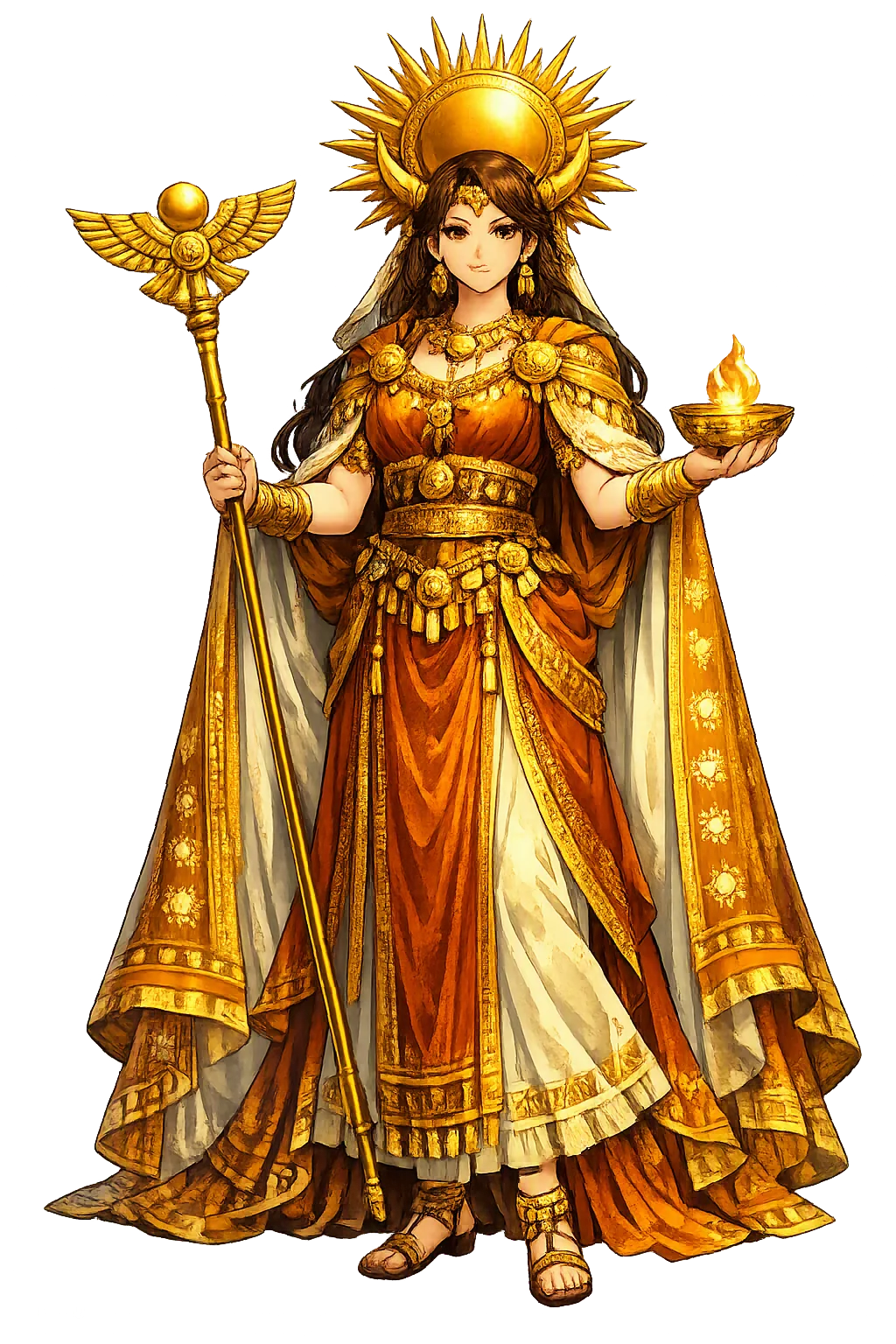
The many faces of Arinna
No important name has only one face. Arinna appears as a figure of myth, a scholarly reconstruction, a piece of material culture, a memory carried across languages, and — most recently — a Unicode domain. This post looks at each face in turn: the name and its roots, the Cuneiform (Hittite, mixed logographic-syllabic) original, the reconstructed pronunciation, the mythological record, the symbols and sanctuaries, the cross-cultural afterlife, and the engineering that lets the restored spelling resolve in a browser. Taken together, those faces explain why arinniti was never going to be enough — and why the restored form is worth a domain of its own.
At a Glance
- Restored name: Arinna
- ASCII form: arinniti
- Meaning: "Of Arinna"
- Domain of influence: Sun Goddess, Supreme
- Pantheon: Hittite
- Classification: Tier 2
- Original script: 𒀭𒌓 𒌷𒀀𒊑𒅔𒈾 (Cuneiform (Hittite, mixed logographic-syllabic))
Overview
Arinna (arinniti) — Sun Goddess, Supreme · Of Arinna — belongs to the Hittite tradition, where it is catalogued under the domain "Sun Goddess, Supreme". The name means "Of Arinna".
Arinna is the Sun Goddess of Arinna, the supreme deity of the Hittite state pantheon. Her cult center at the city of Arinna made her the divine patron of Hittite kingship, and Hittite monarchs styled themselves her beloved son. Unlike the Hattian sun-god, she is a goddess of the sun disk whose warmth and radiance guarantee fertility, justice, and cosmic order. Prayers to her are among the most elaborate compositions in the Hittite language, showing a theology in which the king, the land, and the cosmos are bound together under one solar sovereign.
PuniCodex restores the name as Arinna and serves its temple at its temple. The restoration needs no distinctive letters or diacritics its ASCII form would lose, which places the name in Tier 2. The plain ASCII form arinniti survives as a modern convenience imposed by the early domain-name system; the restoration, not the fallback, is the form the project defends as philologically complete.
The Name
The name is attested in Cuneiform (Hittite, mixed logographic-syllabic) as 𒀭𒌓 𒌷𒀀𒊑𒅔𒈾. Etymologically it means "Of Arinna".
The ASCII form arinniti survives only because the early domain-name system could not carry diacritics; it is a technological compromise, not an ancient spelling. The Unicode restoration Arinna recovers the full diacritic detail of the scholarly transliteration directly in the address bar. The restoration needs no distinctive letters or diacritics its ASCII form would lose, which places the name in Tier 2.
The letter-by-letter transformation runs:
- a → A — Same, capitalized
- r → r — Same
- i → i — Same
- n → n — Same
- n → n — Same
- i → a — Special character
- t → — — Dropped
- i → — — Dropped
The Original Script
The name is preserved in Cuneiform (Hittite, mixed logographic-syllabic) as 𒀭𒌓 𒌷𒀀𒊑𒅔𒈾 — Sumero-Akkadian cuneiform (Hittite scribal tradition), attested Hittite Empire, c. 1400–1180 BCE, in Anatolia (Ḫattuša, Arinna). The script is written left-to-right.
The scholarly transliteration is ᵈUTU ᵁᴿᵁa-ri-in-na (Hittitological), giving the normalized reading /ˈarinniti/.
The rendering proceeds step by step:
- The Sun goddess of Arinna is written ᵈUTU ᵁᴿᵁa-ri-in-na — the Sumerian sun logogram plus the syllabic town name
- 'Arinniti' ('the Arinnian') is an attested epithet; her phonetic Hittite name is unknown (Hattian Eštan, Hittite transcription Ištanu)
The name is attested in Hittite cuneiform as 𒀭𒌓 𒌷𒀀𒊑𒅖𒈾 — the divine sun-god logogram combined with the city name Arinna. The scholarly transliteration is dUTU URUArinna. The Unicode restoration Arinna reproduces the capitalized citation form used in modern Hittitology; the ASCII form arinniti is a DNS compromise that does not correspond to the ancient spelling.
Pronunciation
The reconstructed pronunciation of the name is /aˈrin.na/ — Hittite Reconstruction.
Phoneme by phoneme:
- A- — Open vowel [a], the light initial syllable of the solar name.
- -rin- — Tapped or trilled [r] with close front vowel [i] and nasal [n].
- -na — Final syllable with nasal [n] and open vowel [a].
For the modern speaker, the closest approximation is: Scholarly reconstruction /aˈrin.na/; the exact ancient pronunciation is debated.
Kindred and historical forms of the name:
- Hittite — dUTU URUA-ri-in-na / Arinna, Sun Goddess of Arinna, queen of heaven
- Cuneiform — 𒀭𒌓 𒌷𒀀𒊑𒅖𒈾 (divine sun + city Arinna)
- Akkadian/Hurrian contact — The Hittite state pantheon assimilated solar and cosmic sovereignty under the Arinna cult
Arinna is Tier 2: the restored form preserves the scholarly citation shape but adds no distinctive diacritic; the ASCII form is a domain-name convenience; the cuneiform original is written in the Sumero-Akkadian syllabary.
Mythology
The mythology of Arinna is not a cycle of adventures but a theology of sovereignty. Her prayers present her as the all-seeing, all-ruling sun who knows the hearts of gods and mortals and who holds the king accountable for justice.
The Queen of Heaven (State theology)
In the great prayer CTH 376 the Sun Goddess of Arinna is invoked as the supreme power who sees and hears everything on earth. She is the mother of the king, the mistress of the land of Hatti, and the one before whom both gods and humans appear. The text makes clear that Hittite kingship is not absolute: it is a delegated responsibility held under her gaze.
The Sun Who Crosses the Sky (Solar journey)
Each day the Sun Goddess rises in the east and travels across the heavens in a chariot. At night she passes through the underworld or returns to her house, so that her absence is never total. Her journey is the cosmic clock by which festivals, oaths, and royal decrees are timed.
Mother of the King (Divine legitimation)
Hittite kings regularly call themselves the 'beloved son' of the Sun Goddess of Arinna. This is more than flattery: it is a theological claim that royal authority flows from her and that the welfare of the king, the queen, and the land depends on her continued favor.
The All-Seeing Judge (Cosmic order)
Because the sun sees everything, the goddess is a natural guarantor of oaths and treaties. Deities are called to witness treaties as the sun rises, and perjury before the sun is a cosmic crime that invites famine, plague, and defeat.
Symbols & Iconography
The iconography associated with Arinna concentrates in a small set of recurring attributes, each a compressed statement about the name:
- Sun disk — The radiant wheel of the sun, source of life and royal authority.
- Lion — Her animal companion and symbol of sovereign power.
- Throne — The seat of supreme kingship in heaven and on earth.
- Golden crown — The solar diadem that marks her as queen of the gods.
- Winged sun — The sun in motion across the sky, seeing all that happens below.
Archaeology & Evidence
The texts that name Arinna were excavated from the Hittite royal archives at Boğazköy-Hattusa and related sites in central Anatolia, including temple storerooms and administrative buildings within the citadel. The tablets belong to the corpus of Hittite cuneiform literature preserved in the imperial chancery, with duplicates and parallels in Hurrian, Hattic, Luwian, and other Anatolian traditions. Many were written or copied during the Empire period (c. 1400–1180 BCE), though some compositions may descend from older oral or written sources. The clay tablets were baked, either deliberately or by the fire that destroyed the city, which helped preserve them for modern excavation and study.
Realm & Domain
Arinna is the Sun Goddess of Arinna, the supreme deity of the Hittite state pantheon. Her cult center at the city of Arinna made her the divine patron of Hittite kingship, and Hittite monarchs styled themselves her beloved son. Unlike the Hattian sun-god, she is a goddess of the sun disk whose warmth and radiance guarantee fertility, justice, and cosmic order. Prayers to her are among the most elaborate compositions in the Hittite language, showing a theology in which the king, the land, and the cosmos are bound together under one solar sovereign.
Queen of Heaven
Supreme deity of the Hittite state pantheon, enthroned above gods and kings.
Sun Disk
The radiant sun wheel whose light sustains grain, law, and life across Hatti.
Divine Mother of Kings
Hittite kings are her beloved children; her blessing legitimates royal rule.
Cult Center at Arinna
The city of Arinna housed her chief temple and seasonal state festivals.
Across Cultures
Arinna absorbed and transformed older Hattic and Mesopotamian solar traditions.
The Hattian sun-god Estan was originally male; in the Hittite state pantheon the solar deity of Arinna became female and supreme, probably under Hurrian and Syrian influence. She has been compared to the Mesopotamian sun-god Shamash, who also oversees justice, and to the Egyptian sun-god Re as a royal patron. Yet her theology is distinct: she is not primarily a warrior but a mother-queen whose radiance is the condition for ordered life. The shift from a male to a female supreme solar deity is one of the most striking features of Hittite religious history.
Kindred figures in the PuniCodex cross-tradition index include Amaterasu, Apóllōn, Beli, Dažbog, Gnowee, and Hēlios, each linked through sun / light.
Cultural Legacy
Arinna survives as a paradigm of sacred kingship and solar queenship.
Scholars of ancient Near Eastern religion study her cult to understand how a state creates a national deity, and feminist historians of religion note the unusual prominence of a supreme goddess in a major Bronze Age empire. Her name appears in studies of Hittite prayer, royal ideology, and comparative solar mythology. For PuniCodex, Arinna represents the restoration of a name that once stood at the center of an imperial state: the queen of heaven whose light was synonymous with legitimate rule.
The Scholarly Record
The account of Arinna given in this edition rests on the witnesses and reference works listed below. Lexica and etymological dictionaries secure the form and meaning of the name; the literary and religious texts supply the narrative evidence.
- CTH 376 — Prayer to the Sun Goddess of Arinna.
- Singer, I., Hittite Prayers (2002).
- Gurney, O. R., Some Aspects of Hittite Religion (1977).
- Hoffner, H. A., Hittite Myths, 2nd ed. (1998).
- Haas, V., Geschichte der hethitischen Religion (1994).
- CHD (Chicago Hittite Dictionary), ed. Güterbock, Hoffner, and van den Hout.
- van den Hout, T. P. J., The Elements of Hittite (2011).
- Kloekhorst, A., Etymological Dictionary of the Hittite Inherited Lexicon (2008).
A Meditation
To contemplate Arinna is to contemplate the sun as sovereign. Her light does not merely illuminate; it legitimates. Every field that ripens, every oath that is sworn, every king who rules does so under her gaze. In an age of digital networks, the restoration of her name reminds us that sovereignty was once imagined not as domination but as radiant care: the queen of heaven who sees all and provides for all.
The Unicode Restoration
Arinna is classified as Tier 2: the restoration needs no distinctive letters or diacritics its ASCII form would lose. The ASCII fallback arinniti still resolves everywhere, but it is the restored form that carries the name's full information. Across the 8 characters of the name, the restoration adjusts 3: 3 further adjustments (a, t, i). That is the whole thesis of this temple: the marks are the message.
Character by Character
The journey from arinniti to Arinna, one character at a time:
- a → A — Same, capitalized
- r → r — Same
- i → i — Same
- n → n — Same
- n → n — Same
- i → a — Special character
- t → t — Dropped
- i → i — Dropped
The Hittite Pantheon
Arinna is one of 8 entries the PuniCodex lexicon catalogues under the Hittite pantheon. The Pantheon page gathers the tradition's major figures in one place, and the Lexicon lets you filter all 980 restorations by tradition, tier, or script — the fastest way to see where this name sits among its kin.
Frequently Asked Questions
What does Arinna mean? The traditional gloss is "Of Arinna."
Which tradition does Arinna belong to? Arinna is catalogued in the Hittite pantheon of the PuniCodex lexicon.
Why is Arinna classified as Tier 2? Because the restoration needs no distinctive letters or diacritics its ASCII form would lose — and the marks in the restored spelling preserve exactly that evidence.
Can I use Arinna in a normal browser? Yes. The DNS resolves the punycode form automatically, and the type tool on this site converts arinniti to Arinna for copying and pasting.
Where does the scholarly information come from? The entry is built from lexica, inscriptional evidence, and reviewed scholarly sources listed in the Scholarly Edition. Every claim is traceable to a canonical source.
Typing Arinna
You do not need a special keyboard to use this restoration. The PuniCodex Type Tool converts the ASCII form arinniti into Arinna as you type, and the browser extension offers the same conversion inside any text field. Copy the restored form, paste it into the address bar, and the DNS does the rest.
Sister Temples
Other temples in the Hittite pantheon include Inaras, and Wurušemu — each with its own restoration story, its own scholarly record, and its own place in the lexicon.
Why This Restoration Matters
Myth, script, sound, cult, legacy, domain: the faces of Arinna add up to a single argument — that a name is a record, and records deserve fidelity. The PuniCodex restoration keeps that record in working order: the temple presents it, the Scholarly Edition footnotes it, the lexicon catalogs it, and the domain makes it addressable. arinniti will always exist as a fallback. But fallback is not identity. Arinna is the name; everything else is a convenience.
Explore Further
This post is one doorway into the temple. The home page carries the full character breakdown and the ambient canvas; the lore page tells the myths in long form; the Scholarly Edition preserves the sources, pronunciation data, and revision history; and the patron wall supports the restoration directly. For the wider map, browse the Lexicon, explore the Pantheon, or return to the PuniCodex blog.
A Closer Look at the Marks
A restored name is a small map. In Arinna, the journey from the ASCII fallback arinniti to the Unicode form can be read letter by letter, and each letter tells a story. Of the 8 characters, 5 remain unchanged; they anchor the name to its modern shape. The remaining adjustments recover marks the source tradition used to distinguish this name from every other word built from the same letters.
The a stays as it is — Same, capitalized.
The r stays as it is — Same.
The i stays as it is — Same.
The n stays as it is — Same.
The n stays as it is — Same.
The i becomes a — Special character.
The t becomes t — Dropped.
The i becomes i — Dropped.
Together these changes are not decoration. They are the minimum set of marks needed to keep the name legible in its own tradition. Remove them and you still have a string of letters; you no longer have the name as it was written.
Arinna in Its Tradition
Arinna does not stand alone. It belongs to the Hittite tradition, where it is counted among 8 names in the PuniCodex lexicon. Its sphere — Sun Goddess, Supreme — places it beside other figures who govern similar aspects of experience. The restored spelling is therefore not only a philological decision; it is a way of keeping the name in the company of its kin. When the address bar shows Arinna, it marks the boundary between a generic search term and a named entry in a living catalog of myth. That catalog is the point of the project. Every restored name is a vote for specificity: the web should know the difference between a figure and a keyword, between a tradition and a trend. Arinna is one such vote.
What You Will Find in the Temple
The temple page for Arinna is more than a landing page. The home tab presents the character breakdown, the pronunciation guide, and the live domain status in a single view. The lore tab gathers the myths and narratives that give the name its depth. The Scholarly Edition tab publishes the sources, variant forms, and review history that justify the restoration. Industry patterns show where the name appears in modern commerce and culture, while the gallery and creatives tabs collect visual and sponsor material. The patron wall lets visitors support the restoration directly. Each tab is generated from the same canonical sources, so the domain, the blog, the scholars page, and the search index all agree. The result is a single source of truth about a name, delivered through several doors.
Related Names
Sources
The full scholarly apparatus — every citation, revision, and review — lives in the Scholarly Edition. Key references for this post:
- CTH 376 — Prayer to the Sun Goddess of Arinna.
- Singer, I., Hittite Prayers (2002).
- Gurney, O. R., Some Aspects of Hittite Religion (1977).
- Popko / Taracha via Sun goddess of Arinna scholarship.
- Lexicon authorities for this entry: Hittite texts, CHD.