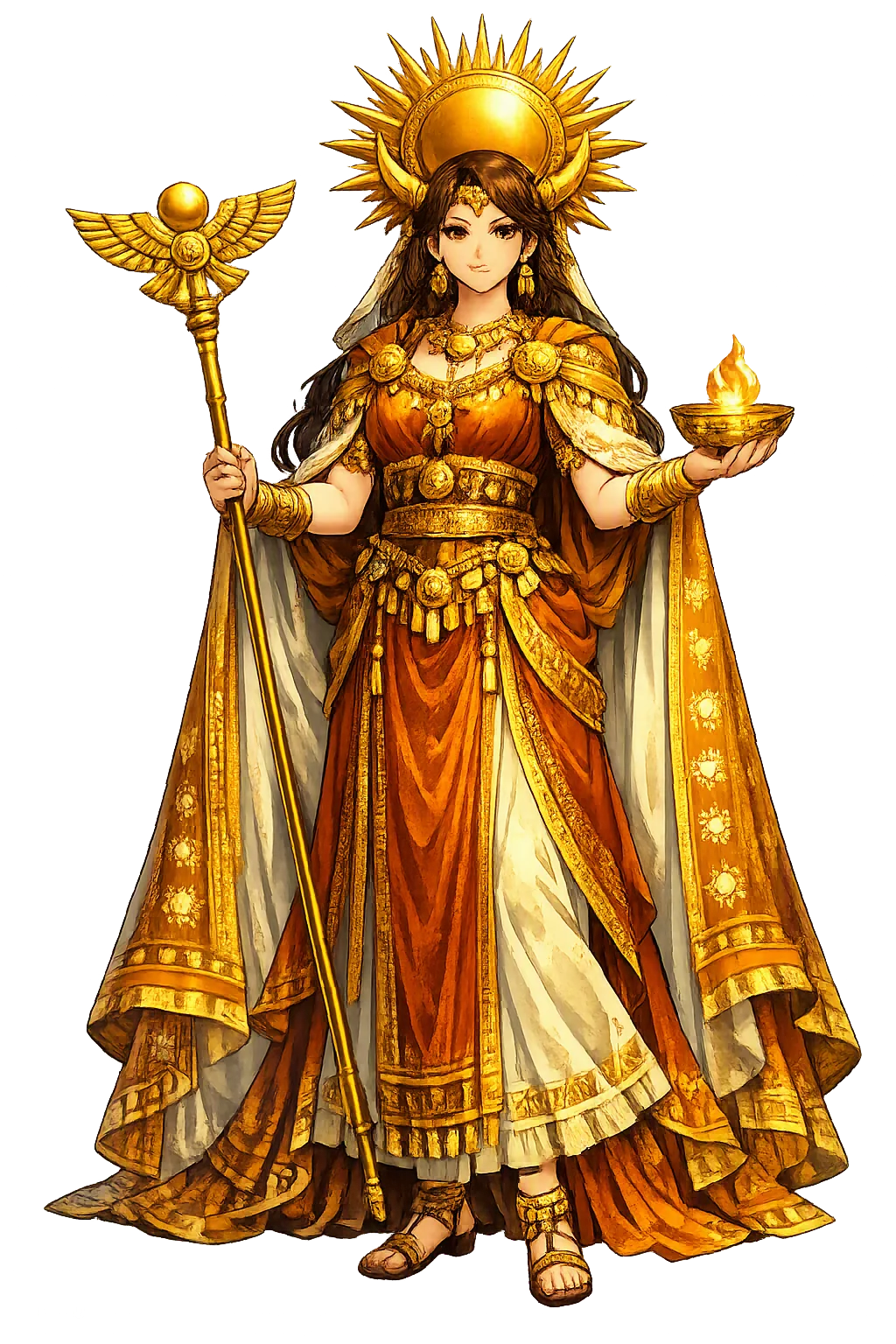
Stories of Arinna
The mythology of Arinna is not a cycle of adventures but a theology of sovereignty. Her prayers present her as the all-seeing, all-ruling sun who knows the hearts of gods and mortals and who holds the king accountable for justice.
The great prayer of King Muwatalli (CTH 376) opens by walking the goddess's names across the empire: my lady, queen of all the lands — in Hatti she is the Sun-goddess of Arinna; in Arzawa, the Sun-goddess of Arzawa; in the land of Lycia they call her Mother; and so on through the subject kingdoms, name after name, land after land, down toward the Syrian coast. The passage is the earliest surviving theology of a multi-ethnic state: one sovereign radiance, known in every subject people's tongue. Arinna is her headquarters — the city whose temple housed the state cult — but the prayer insists she is no local deity. What the Hittite empire held together by treaty and dynastic marriage, it worshipped as a single sun with many local spellings; and the king who prays does so as her servant, asking the queen of all lands to remember her servant in Hatti. The theology is deliberately imperial: as the sun sees every land, so the goddess rules them all, and so, by her delegation, does her beloved son.
Each dawn the Sun-goddess rises in the east and rides her chariot across the heavens, and her light is the empire's clock: oaths were sworn to her as she cleared the horizon, festivals opened at her rising, and treaties took force under her witnessing disk. Sun-disc emblems cap Hittite stelae and gate monuments at Boğazköy, and winged suns fly over the empire's seals. At night she does not simply vanish: Hittite ritual knows a chthonic counterpart, the Sun-goddess of the Earth, who receives the dead and the setting light, so that solar sovereignty continues beneath the ground — a nocturnal voyage scholars have long compared, cautiously, to the Mesopotamian sun's nightly passage. Her heat is not the devouring fire of the desert but the ordered warmth that ripens the grain of Hatti; her regularity, not her brilliance, is her divinity. A goddess who never surprises her worshippers was the perfect patron of a bureaucratic state: in her courses, as in its archives, everything came round on time.
Hittite kingship was sonship. From the Old Kingdom onward the monarch styled himself the beloved son of the Sun-goddess of Arinna, and the titulary ran through the empire's three centuries like a signature: the king rules not by conquest alone but by adoption into the supreme family. Hattusili I's Testament (CTH 6) already instructs his heir to honor her among the chief gods of the state; centuries later Mursili II still prays as your servant, the son of your servant, the grandson of your servant. The goddess is the dynasty's mother, and the theology carries a sharp edge of accountability: an adopted son who misrules can be disowned, and the plague prayers of Mursili II read exactly like a family's reckoning — the gods have withdrawn their care because the house has broken its word. Royal piety was therefore not decoration but constitutional theory in ritual dress. The king was the goddess's son on loan, and the loan could be called in.
Because the sun sees everything, the Sun-goddess of Arinna heads the thousand gods who witness Hittite treaties; her name comes early in the oath lists, near the great Storm-god. Perjury before her was a cosmic crime, and the empire's gravest texts are confessions of it. Mursili II's plague prayers (CTH 378) ask why the land has bled with pestilence for twenty years, and find the answer in broken oaths sworn before precisely these witnesses — above all in the death of Prince Tudhaliya, done only for the word of evildoers, and never set right. The confession is remarkable theology: the king himself, the goddess's son, stands in the dock of the sky. Justice in Hatti was not blind — it was all-seeing, and it was administered not by a court but by the sun, whose archive nothing escapes. When the empire finally burned and its clay tablets were baked hard in the fire, even its catastrophes, duly recorded in the chancery hand, became her testimony.
Solar Sovereignty · State Cult · Divine Kingship
Arinna is the Sun Goddess of Arinna, supreme deity of the Hittite state pantheon. Her cult city made her the divine patron of Hittite kingship, and every monarch styled himself her beloved son. Her radiance guarantees fertility, justice, and cosmic order; prayers to her are among the most elaborate compositions in the Hittite language.
Supreme deity of the Hittite state pantheon, enthroned above gods and kings.
The radiant sun wheel whose light sustains grain, law, and life across Hatti.
Hittite kings are her beloved children; her blessing legitimates royal rule.
The city of Arinna housed her chief temple and seasonal state festivals.
From the original script to the living URL
𒀭𒌓 𒌷𒀀𒊑𒅔𒈾
The name in its original Hittite form. Arinna (𒀭𒌓 𒌷𒀀𒊑𒅔𒈾) is attested in the source tradition — “Of Arinna”. Its original diacritics and script distinctions carry the full phonetic and orthographic weight of the source tradition.
arinniti
The plain arinniti form is identical to the Unicode restoration. Because this name is already written in Latin letters, no diacritics, stress, or script information were lost — only capitalization differs.
Arinna
The Unicode restoration does not need to recover lost marks for Arinna. Its value is canonical spelling and consistent cataloguing, not the reconstruction of erased orthography. The domain is readable as-is to both DNS and humanity.
Arinna.com
This restoration is written entirely in ASCII letters — no Punycode encoding stands between Arinna and the DNS. The domain reads identically to machines and to human eyes.
Owned, ideal, and ASCII forms of Arinna
Arinna
Restores 𒀭𒌓 𒌷𒀀𒊑𒅔𒈾. The full Unicode restoration. arinna.com is not in the PuniCodex collection — it is watched for release; if it drops, this temple upgrades to an owned flagship.
arinniti
Flattens 𒀭𒌓 𒌷𒀀𒊑𒅔𒈾. The plain ASCII fallback — what DNS and legacy systems see.
How Arinna was spoken
How Arinna travels from ancient script to the modern URL
The lore you have read is the living myth. Extended Lore opens the scholarly vault beneath it: the cult and its material remains, a history of the image, the name after antiquity, a meditation on what the name still means, and the full scholarly apparatus — etymology, orthography, sources.
Enter Extended Lore