The Living Myth
Immovable, East · The Unshakable · Mirror-Like Wisdom
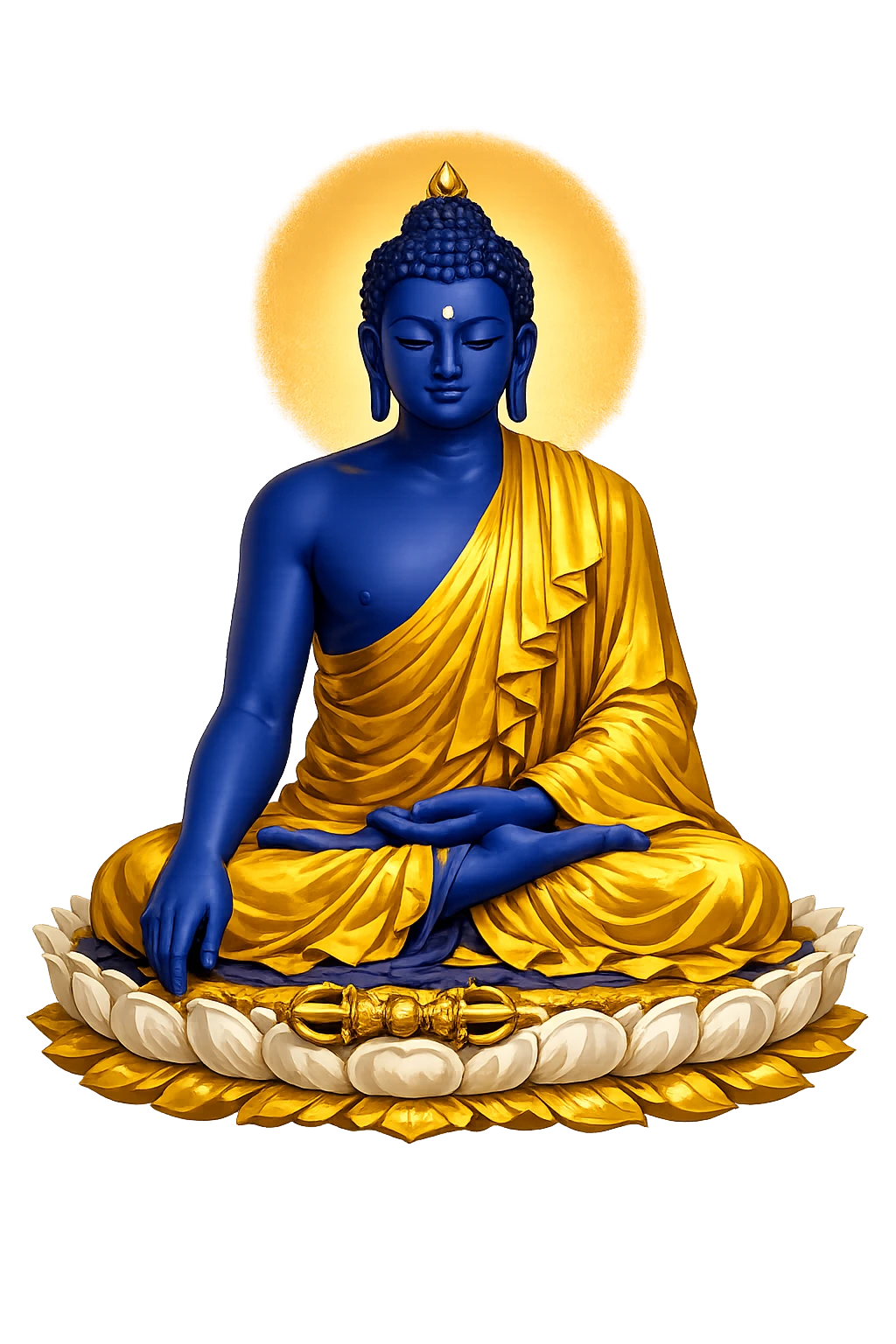
Stories of Akṣobhya
Akṣobhya's mythology is the story of a single vow kept without a crack: the monk who resolved never to be angry, and became the Buddha of the unshakable land. He is the least sung of the five great tathāgatas — and, liturgically, one of the most invoked.
His sūtra — the Akṣobhya-tathāgatasya-vyūha, carried into Chinese by the Central Asian translator Lokakṣema around 186 CE and surviving as the Āchù-fó guó jīng (Taishō 313) — is among the earliest pure-land scriptures translated into any language. It tells how a monk of a past age stood before a Buddha and made a vow without ornament: until his own awakening he would never give rise to anger or malice toward any being, however provoked. From that vow came his name — Akṣobhya, the Unshakable — and his Buddha-field: Abhirati, the Land of Delight, which he adorned through ages of practice until it surpassed every world men know. The sūtra then turns outward: beings who aspire to Abhirati, even laypeople, even those afraid of death, are promised rebirth there if they keep the vow's spirit. The myth's economy is the point: of all the great vows, his is the shortest to state and the hardest to keep — no anger, ever — and he kept it to Buddhahood.
Abhirati, 'the Delightful,' is the east's answer to Sukhāvatī, and the sūtra lavishes on it the loving detail of a travelogue: a land level and fragrant, beautiful beyond the worlds men know, where jewels and flowers pave the paths and the rivers run with scents. There are no lower destinies in Abhirati — no hells, no hungry ghosts, no animals; sickness is unknown; and beings are born from lotuses or from apparition, as they choose. The text even takes up the question of women, insisting that in Abhirati there is no servitude of one being to another, and no birth-pain. Its most quietly radical note is its gate: the land is open not to monks alone but to anyone — laymen and laywomen alike — who aspires to be born there. It is the pure land of moral steadiness: not an escape from the world, but a world where steadiness is finally possible, built by the one quality its lord refused to abandon.
In the mandala of the five tathāgatas — the system that crystallized in the Indian esoteric tantras and spread across the whole Buddhist world — Vairocana sits at the center, Akṣobhya in the east, Ratnasambhava in the south, Amitābha in the west, Amoghasiddhi in the north; each governs a poison and transmutes it into a wisdom. Akṣobhya's poison is hatred (dveṣa), and his transmutation is the ādarśa-jñāna, the mirror-like wisdom: the mind that reflects anger, insult, and loss exactly as they are, as a mirror shows a storm, and is not stormed. His whole iconography speaks one word — unmoved: the blue body of deep water, the vajra of the family he heads, the elephant that cannot be stampeded, and the earth-touching hand, the very gesture of Śākyamuni's awakening, reassigned to the Buddha whose vow was steadiness. To place the awakening gesture in the east is to say where awakening begins: not in ecstasy, but in not being moved.
In the Highest Yoga Tantras his rank rises further. The Guhyasamāja system — the first and greatest of the father tantras, expounded in India by the lineage of Nāgārjuna as Tibetan exegetes received it — places Akṣobhya at the mandala's very center, above even Vairocana, and the Nyingma tradition identifies the primordial Buddha Vajrasattva with him: the still point around which the whole esoteric cosmos is arranged. His bodhisattva is Vajrapāṇi, the thunderbolt-bearer, and his wrathful emanations — the blue, frowning guardians — stand at the gates of every tantric mandala in Tibet, Japan, and Java. The gentle vow of an early sūtra thus became the axis of the most technically elaborate Buddhism ever built. The irony is the tradition's own: the least-known of the five in the modern West is, liturgically, among the most invoked — every vajra-family rite, every HŪṀ at the heart of a mantra, is his household.
The Eastern Pure Land, the Mirror-Like Wisdom, and the Vow Against Anger
Akṣobhya is the Buddha who cannot be shaken: lord of Abhirati, the eastern Land of Delight, blue as the vajra family he heads, seated in the earth-touching gesture — the one of the five tathāgatas who turns the poison of hatred into the mirror-like wisdom that reflects everything and is disturbed by nothing.
The Land of Delight in the east — his Buddha-field, open to all who aspire to be reborn there, without the evil destinies.
Ādarśa-jñāna: awareness that shows all things exactly as they are — and holds none of them.
The earth-touching mudrā — the awakening gesture itself, assigned to him among the five tathāgatas.
Head of the vajra clan of the five tathāgatas: blue, eastern, indestructible as the thunderbolt.
From the original script to the living URL
अक्षोभ्य
The name in its original Buddhist form. Akṣobhya (अक्षोभ्य) is attested in the source tradition — “The Unshakable — the immovable Buddha of the eastern pure land Abhirati (from a-√kṣubh)”. Its emphatic consonants and palatal/retroflex sibilants carry the full phonetic and orthographic weight of the source tradition.
akshobhya
Reduced to plain akshobhya, the name loses everything that made it specific: emphatic consonants and palatal/retroflex sibilants. What remains is an ASCII string that machines can parse but that no longer speaks with its original voice.
Akṣobhya
The Unicode restoration recovers what ASCII flattened. Akṣobhya restores emphatic consonants and palatal/retroflex sibilants, returning the name to its original written dignity. The domain encodes to Punycode, but the browser displays the truth.
Akṣobhya.com → xn--akobhya-473c.com
The non-ASCII characters in Akṣobhya are encoded while the ASCII remains visible. To the DNS, it is Punycode. To humanity, it is Akṣobhya.
Owned, ideal, and ASCII forms of Akṣobhya
Akṣobhya
Restores अक्षोभ्य. The live temple domain — akṣobhya.com.
akshobhya
Flattens अक्षोभ्य. The plain ASCII fallback — what DNS and legacy systems see.
How Akṣobhya was spoken
How Akṣobhya travels from ancient script to the modern URL
The lore you have read is the living myth. Extended Lore opens the scholarly vault beneath it: the cult and its material remains, a history of the image, the name after antiquity, a meditation on what the name still means, and the full scholarly apparatus — etymology, orthography, sources.
Enter Extended Lore