PuniCodex

Extended Lore

अक्षोभ्य Akṣobhya

Etymology · Orthography · Cult · Iconography · Reception · Sources

Tier 1 Akṣobhya.com
Akṣobhya — Immovable, East
01

Quick Facts

Essential information about Akṣobhya, Immovable, East

Original Scriptअक्षोभ्य
Unicode RestorationAkṣobhya
Reconstructed Pronunciation/ɐk.ˈʂoː.bʱjɐ/
PantheonBuddhist
DomainImmovable, East
MeaningThe Unshakable — the immovable Buddha of the eastern pure land Abhirati (from a-√kṣubh)
ClassificationTier 1
Primary DomainAkṣobhya.com
Sacred SymbolsThe blue vajra, The elephant mount, The seed syllable HŪṀ, The earth-touching hand, The blue body
02

Etymology & Word Family

From original script to Unicode restoration

Original Script अक्षोभ्य Akṣobhya — "The Unshakable — the immovable Buddha of the eastern pure land Abhirati (from a-√kṣubh)"
Unicode Restoration Akṣobhya Restored stress, length, and script
Modern ASCII akshobhya Plain-ASCII fallback

The name Akṣobhya carries the orthographic signature of the buddhist tradition: अक्षोभ्य. Unicode restoration recovers what ASCII flattens.

03

Unicode Character Breakdown

Character-by-character philological analysis

CharacterUnicodeNameBlockPhonetic Role
AU+0041Latin Capital Letter ABasic LatinSame, capitalized
kU+006BLatin Small Letter KBasic LatinSame
ṣU+1E63Latin Small Letter S with Dot BelowUnknownSpecial character
—N/ADropped characterBuddhist orthographyDropped
oU+006FLatin Small Letter OBasic LatinSame
bU+0062Latin Small Letter BBasic LatinSame
hU+0068Latin Small Letter HBasic LatinSame
yU+0079Latin Small Letter YBasic LatinSame
aU+0061Latin Small Letter ABasic LatinSame

The Tier 1 classification reflects how much of the original phonology this restoration preserves — stress and vowel length for Greek names, distinctive letters and diacritics for every other tradition.

04

Cult & Worship

How the sacred was kept — rites, sanctuaries, remains

The Cult

Akṣobhya's worship has always run through text and mandala rather than a temple cult dedicated to him alone. His sūtra, the Akṣobhya-vyūha, is among the very first Buddhist scriptures translated into Chinese — Lokakṣema's version of about 186 CE — evidence that devotion to the Buddha of Abhirati reached Central Asia and China within three centuries of the Buddha's death. Practice centers on his vow and his land: rebirth in Abhirati is sought through merit and recollection of Akṣobhya, and in the esoteric traditions he is invoked by his seed-syllable HŪṀ, heart of the vajra family. Tibetan ritual manuals prescribe Mi bskyod pa's rites at deaths and dedications of merit; in Japan the Shingon and Tendai schools enshrine Ashuku in the eastern quarter of the Taizōkai and Kongōkai mandalas, invoked at fire-offerings. No separate priesthood serves him — he is worshipped through the living liturgies of Mahāyāna and Vajrayāna.

In the Earth

His oldest document is textual: Lokakṣema's second-century Chinese translation of his sūtra, among the first pure-land scriptures rendered into any language. In stone he belongs to the five-jina program that matured in the eighth and ninth centuries: the eastern niches of Borobudur carry his series in the earth-touching gesture, and the crowns of Nepalese paubhā and Tibetan sculpture place him on the east petal of the jina-mandala. East Javanese bronzes and stone Akṣobhyas — dark, right hand to the earth — are among the finest small Buddhist images in the world. In Japan, the great Tō-ji mandalas brought by Kūkai in 806 fixed his iconography at the capital's heart, where it has remained ever since.

05

Iconography

How Akṣobhya was imaged across the ages

The Image

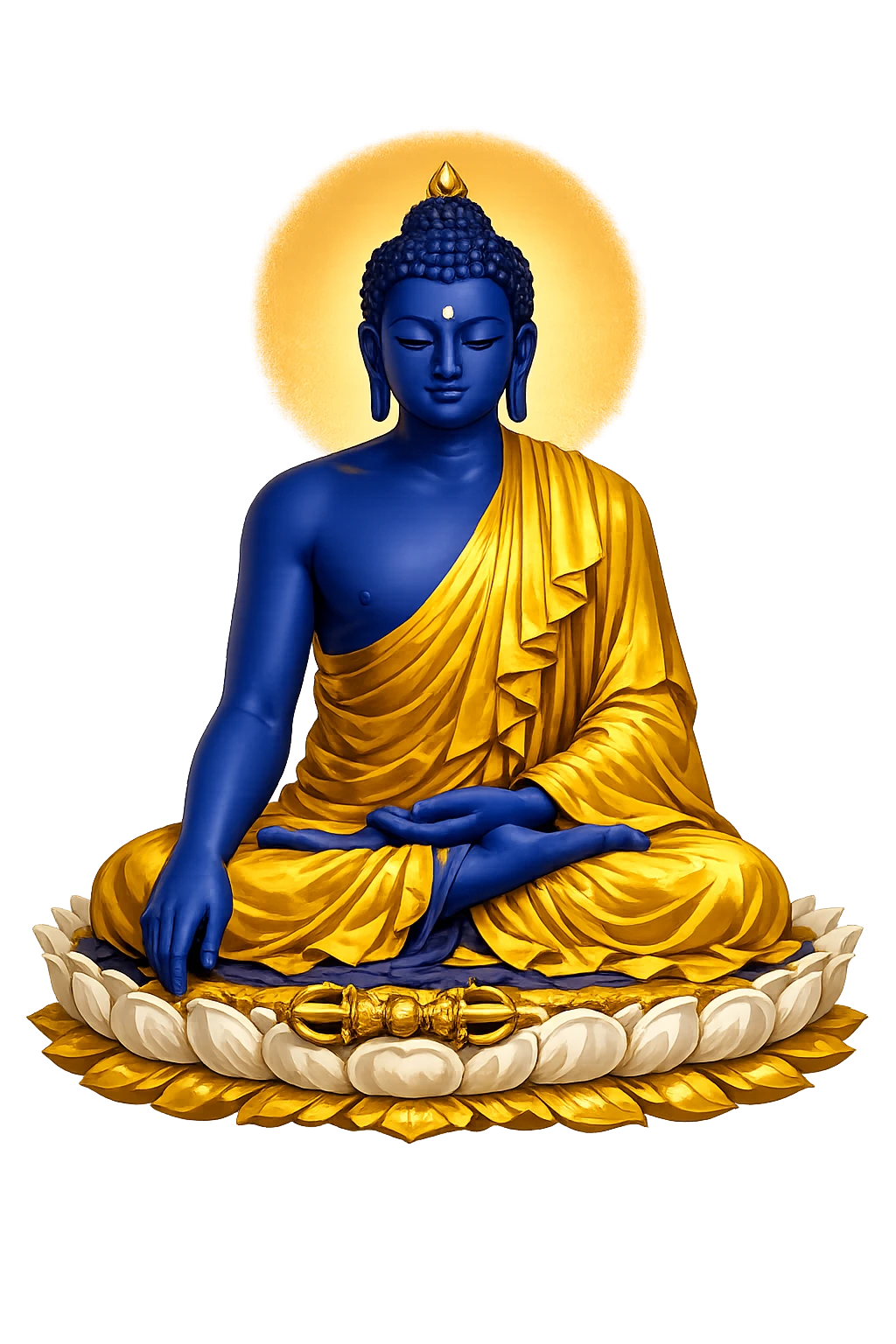
Recognize Akṣobhya by the hand that touches the earth. In the five-Buddha system he is blue — the color of the vajra family — seated in the eastern quarter, right hand lowered in the earth-touching gesture (bhūmisparśa-mudrā) that proclaims unshakability, the vajra in his left, his throne supported by elephants in the tantric systems. The gesture is older than the name: it marks the historical Buddha's defeat of Māra at Bodhgayā and appears already in Gandhāran reliefs. But from the eighth and ninth centuries, as the five-tathāgata maṇḍala matured, the pose was reassigned to the eastern jina — Śākyamuni's awakening re-read as Akṣobhya's seal. Key witnesses: the eastern niches of Borobudur (ninth century), the dark blue Javanese and Nepalese bronzes, and Kūkai's Tō-ji mandalas, brought from Tang Chang'an in 806, which fixed the canonical image for Japanese esoteric art from that day to this.

06

Reception & Transformation

The name after its own age — transmission, translation, survival

Afterlives

Akṣobhya's journey is the journey of the pure-land idea itself. His sūtra reached Luoyang by 186 CE, making Abhirati the first Buddhist pure land known to Chinese readers; the Chinese canon (Taishō 313) kept the Āchù-fó guó jīng circulating for centuries, though Amitābha's more spacious Sukhāvatī eventually eclipsed it in East Asian devotion. The Tibetan translation movement of the eighth and ninth centuries carried the Guhyasamāja tantras — where Akṣobhya is lord of the vajra clan — into the new canon, and he became central to Tibet's highest initiations. In Japan, Kūkai's two-mandala transmission from Chang'an (806) enthroned Ashuku in the east of every esoteric maṇḍala from Tō-ji onward. European Buddhology met him last: nineteenth-century Sanskritists and the Central Asian manuscript finds recovered the vyūha literature, and twentieth-century scholarship placed him at the root of pure-land doctrine and of tantric five-Buddha iconography — the quiet patriarch of one of Buddhism's most far-reaching visions.

Identifications Across Traditions

China received him early as Āchù and later rendered him semantically as 'the Immovable' — a name he shares as a near-doublet with Acala, the blazing, sword-wielding Fudō Myōō of Japan, whose wrathful immovability is the mirror image of Akṣobhya's serene one; the two were never quite merged, but they rhyme across the esoteric schools of both countries. Tibet made Mi bskyod pa central to the highest tantras and to rites of purification and of the dead, and the five-Buddha system that enthrones him traveled from the Indian universities to every Himalayan valley and onward to Japan's Shingon mandalas and Java's ninth-century jina programs. His earth-touching gesture — assigned to him among the five — is the most reproduced Buddha pose on earth, the seal of the historical awakening reassigned to the unshakable one, so that every image of Śākyamuni touching the earth quietly conjugates Akṣobhya's name.

Modern Legacy

Akṣobhya's legacy is the mirror itself: the image of mind as a reflecting surface that needs only to stay still became one of the deep metaphors of East Asian Buddhism, from Huayan's calm interpenetration to Zen's immovable sitting. His vow remains the tradition's standing definition of patience — not slowness, but a stillness no insult can reach. In Japan, Ashuku holds the east of every esoteric mandala at Tō-ji and the great temple halls; in Tibet, Mi bskyod pa presides over vajra-family rites recited at deaths and dedications daily. Scholars have noted the quiet irony that the least-known of the five tathāgatas in the West is among the most invoked — his syllable HŪṀ is the heart-sound of countless mantras. The restoration Akṣobhya keeps the retroflex ṣ, the one letter that distinguishes the Unshakable from every merely calm ideal.

07

The Meditation

What Akṣobhya means — beyond the dictionary

Akṣobhya is the patron of unhurried strength: the hand that does not strike back, the mind that registers the insult and lets it pass through like weather through a window frame. He does not ask for indifference — a mirror is not indifferent; it shows everything, storm included. He asks for the one thing harder than anger: to see clearly and remain unmoved, and to let clarity, not reaction, do the answering.

His vow sounds small beside the cosmic promises of Vairocana or Amitābha — no jeweled lands, no measureless light, only 'I will not be angry' — yet the mandala places him at its heart, and the highest tantras at its very center. The tradition seems to know something psychology now confirms: the person who cannot be provoked is not passive but sovereign, and the rage of others spends itself like waves on a stone. Akṣobhya's stillness is not the absence of force; it is force that has stopped needing to move.

08

Frequently Asked Questions

Common questions about Akṣobhya, Immovable, East, and Unicode restoration

01How do you pronounce Akṣobhya?

In reconstructed pronunciation, Akṣobhya is /ɐk.ˈʂoː.bʱjɐ/ — approximately uk-SHOH-bhyuh — the kṣ is a single conjunct sound (k + retroflex ṣ); the bh is aspirated.

02What does Akṣobhya mean?

Akṣobhya means The Unshakable — the immovable Buddha of the eastern pure land Abhirati (from a-√kṣubh) in the buddhist tradition.

03What are the symbols of Akṣobhya?

Akṣobhya is associated with The blue vajra (Indestructibility: the thunderbolt that is also the diamond, his family and his nature), The elephant mount (The unshakable animal — the stillness that cannot be stampeded), The seed syllable HŪṀ (The sound of the unstruck stillness at the heart of the mandala), The earth-touching hand (The right hand calling the earth to witness: the gesture in which no argument, however fierce, can move him), The blue body (The color of deep water and deep space — hatred's antidote, a calm that has no surface to strike).

04Why restore Akṣobhya in Unicode?

Plain ASCII akshobhya strips the stress, length, and script that make the name specific. Unicode restoration returns the name to its original written dignity.

05What is the most important myth about Akṣobhya?

“The Vow Against Anger” — the Akṣobhya-vyūha Sūtra story that anchors the mythology of Akṣobhya, told in full on the lore page.

09

Scholarly Sources

The philological foundations of this restoration

Every claim on this page is grounded in established scholarship. The orthographic restorations follow disciplinary convention. The etymological chain follows the best available reference works. This is not invention — it is resurrection through scholarship.

◈

Lexicography & Philology

  • Vajrayana texts
  • Buddhist texts
◎

Primary Texts

  • The Larger Sukhāvatī-vyūha Sūtra; the Smaller Sukhāvatī-vyūha Sūtra; the Amitāyurdhyāna Sūtra; the Lotus Sūtra.
◉

Archaeology & Art History

  • Material evidence — iconography, inscriptions, and temple archaeology — for Akṣobhya and related cults.
✦

Religious Studies

  • Akṣobhya-tathāgatasya-vyūha Sūtra (Lokakṣema's Chinese translation, c. 186 CE, Taishō 313)
  • Guhyasamāja Tantra
  • Conze, Buddhist Texts Through the Ages
  • Edgerton, Buddhist Hybrid Sanskrit Dictionary
  • Monier-Williams
Return

The Surface Awaits

You have traced the name from its earliest attestation to its Unicode restoration. Now return to the myth. The story is where the name lives.

Back to Lore
Akṣobhya mascot