The Living Myth
Supreme Creator, Wisdom, Light · The Wise Lord of Light
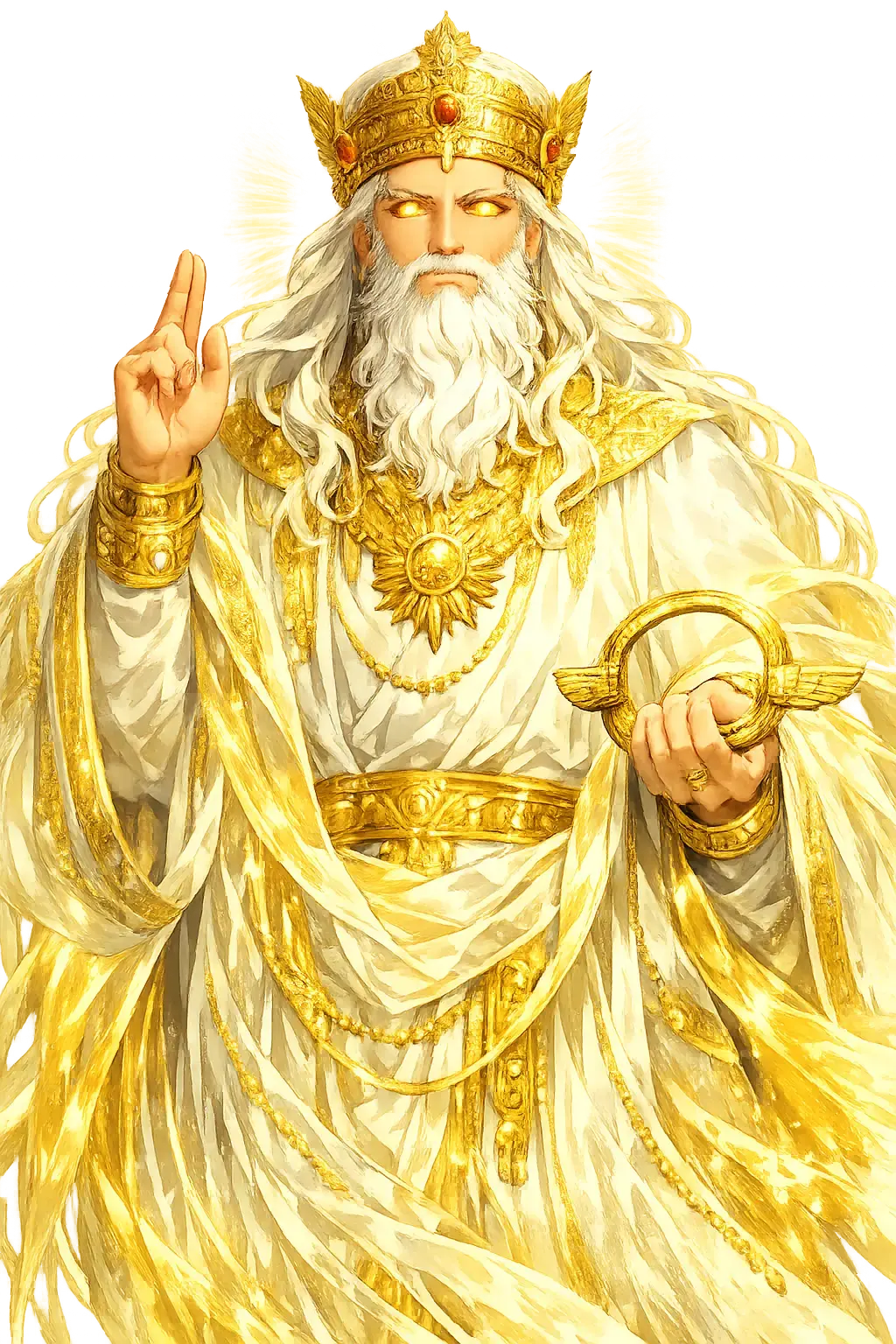
Stories of AhuraMazdā
The mythology of AhuraMazdā is not a cycle of adventures but a grand cosmology: the twin spirits at the world's dawn, the creation in seven acts, the golden age of Yima, the first man Gayōmart, and the final renovation (Frashokereti) when evil will be destroyed and the world made perfect. Every human moral choice participates in this cosmic drama.
In the Gāthās, the oldest stratum of Zoroastrian scripture, AhuraMazdā is not alone at the beginning. Two spirits stood forth there, twins — Spenta Mainyu, the Holy Creative Spirit, and Angra Mainyu, the Destructive — 'the better and the bad in thought, word, and deed' (Yasna 30.3–5). The two chose differently at the first dawn: one embraced truth (aša), the other the lie (druj), and through that choice the world became an arena where every human being must choose again. AhuraMazdā is lord of the good choice, not its manufacturer — the Gāthās call him 'the father of Good Purpose' (Yasna 45) while the evil spirit acts 'knowing no lord.' Scholars still debate whether this is metaphysical dualism or a dramatized moral one; either way, the myth insists that evil is a real counter-force that goodness must outlast, not an illusion to be explained away.
In the Pahlavi Bundahišn, AhuraMazdā creates the world in seven successive acts: first the sky as a round shell, then water, then earth, then plants, then the sole primordial bull, then Gayōmart the first man, and finally fire — 'the life of all creation' (Bundahišn 1–3). Knowing Angra Mainyu would attack, the Wise Lord fixed time at nine thousand years and offered the destroyer a covenant: darkness would be his for half of it. Ahriman's counter-creations answer each good with its poison — drought against water, the wolf against the dog, winter against summer, death against life — and the cosmos becomes a mixed substance from the start: good in essence, wounded in fact. Human labor, tending fire, cattle, fields, and truth, is thus the active repair of creation. The myth means that the world is not a masterpiece to be admired but a workshop to be defended.
Before Zarathustra, the first king was Yima (Jamšīd), whom AhuraMazdā commissioned to enlarge and perfect the world (Vendidad 2). Under Yima's rule there was neither cold nor heat, neither old age nor death; herds multiplied until the very earth swelled. Then AhuraMazdā warned of a killing winter and bade him build a var, an underground enclosure, and shelter within it for six hundred years the best of every kind — the seeds of every plant, pairs of every animal, the finest men and women. Yet Yima's own end was a fall: the lie entered him, he claimed divinity, and the royal glory (xᵛarənah) fled from his body like a bird; he was sawn in half and the world declined toward the harsher age of the prophet (Vendidad 2; Yašt 19). The myth means that even a paradise ruled by a perfect king perishes when the king forgets he is not a god — prosperity is borrowed time, not a throne.
When Ahriman breached the sky and set death loose, the first man Gayōmart — bright, golden, dwelling by the river Dāityā — was struck by the destroyer, yet for thirty years he did not die (Bundahišn 3, 6–14). From his seed, gathered from the earth through the thirty years, grew the rhubarb-like stem from which the first human couple, Mašyā and Mašyōy, were born; and from the seed of the slain primordial bull arose the beneficial species of cattle and plants. AhuraMazdā revealed to the couple their twin duties of agriculture and procreation, but they were tempted by the lie, offered a counterfeit sacrifice, and mortality entered human flesh: bodies made for immortality began to age. The myth reads almost as a diagnosis of the human condition — death came not from our making but from our greed, and the labor of the farmer is an atonement offered in advance for the first theft.
Zoroastrian hope culminates in Frashokereti, the 'making wonderful' of the world (Bundahišn 34; Dēnkard 7). A final savior, the Saoshyant, will be born of the seed of Zarathustra preserved in a mountain lake; he will raise the dead, and all humanity — the righteous and the wicked alike — will pass through a river of molten metal, which will feel like warm milk to the truthful and like fire to the liars (Dēnkard 7; Pahlavi Rivāyat). The last adversary will be annihilated, and the world remade incorruptible: no old age, no decay, the resurrected bodies clothed in light. It is one of the ancient world's most radical doctrines: history has a direction, death is temporary, and the end is not an escape from the world but its repair. The myth means that goodness wins not by force but by finishing — creation completed at last.
Supreme Creator, Wisdom, Light, and Order
AhuraMazdā is the highest god of Zoroastrianism, the uncreated creator who thinks the cosmos into being and sustains it through truth (aša), good thought, and the Holy Immortals. He is not a storm warrior or a tribal patron but a cosmic architect whose enemy is the lie (druj). In the Gāthās, the oldest Zoroastrian hymns, he speaks directly to the prophet Zarathustra, asking humanity to choose between good purpose and evil.
The cosmos existed first as his plan: he shaped it in thought (mainyu), then clothed it in matter — creation as a design executed, not an accident.
Aša — truth, right order, the fitness of things — is his first emanation; fire itself is aša embodied, which is why temples tend it as his visible self.
Vohu Manah (Good Mind), Aša, Khshathra (Sovereignty), Spenta Ārmaiti (Holy Devotion), Haurvatāt (Wholeness), Ameretāt (Immortality) — his attributes become beings.
The atar, sacred fire, is honored as his purest visible sign — purity, energy, and vigilance in one flame, tended five times a day.
From the original script to the living URL
𐬀𐬵𐬎𐬭𐬀 𐬨𐬀𐬰𐬛𐬁
The name in its original Zoroastrian form. AhuraMazdā (𐬀𐬵𐬎𐬭𐬀 𐬨𐬀𐬰𐬛𐬁) is attested in the source tradition — “Wise lord”. Its macron-length vowels carry the full phonetic and orthographic weight of the source tradition.
ahuramazda
Reduced to plain ahuramazda, the name loses everything that made it specific: macron-length vowels. What remains is an ASCII string that machines can parse but that no longer speaks with its original voice.
AhuraMazdā
The Unicode restoration recovers what ASCII flattened. AhuraMazdā restores macron-length vowels, returning the name to its original written dignity. The domain encodes to Punycode, but the browser displays the truth.
AhuraMazdā.com → xn--ahuramazd-ecb.com
The non-ASCII characters in AhuraMazdā are encoded while the ASCII remains visible. To the DNS, it is Punycode. To humanity, it is AhuraMazdā.
Owned, ideal, and ASCII forms of AhuraMazdā
AhuraMazdā
Restores 𐬀𐬵𐬎𐬭𐬀 𐬨𐬀𐬰𐬛𐬁. The live temple domain — ahuramazdā.com.
ahuramazda
Flattens 𐬀𐬵𐬎𐬭𐬀 𐬨𐬀𐬰𐬛𐬁. The plain ASCII fallback — what DNS and legacy systems see.
How AhuraMazdā was spoken
How AhuraMazdā travels from ancient script to the modern URL
Avestan Ahura Mazdā; ahura “lord" is related to Sanskrit asura, and mazdā “wise" to Sanskrit medhā; the supreme creator and wise lord of Zoroastrianism.
Supreme Creator, Wisdom, Light
The Unicode restoration AhuraMazdā uses registrable Latin diacritics; the Avestan script form is not registrable in .com.
The lore you have read is the living myth. Extended Lore opens the scholarly vault beneath it: the cult and its material remains, a history of the image, the name after antiquity, a meditation on what the name still means, and the full scholarly apparatus — etymology, orthography, sources.
Enter Extended Lore