
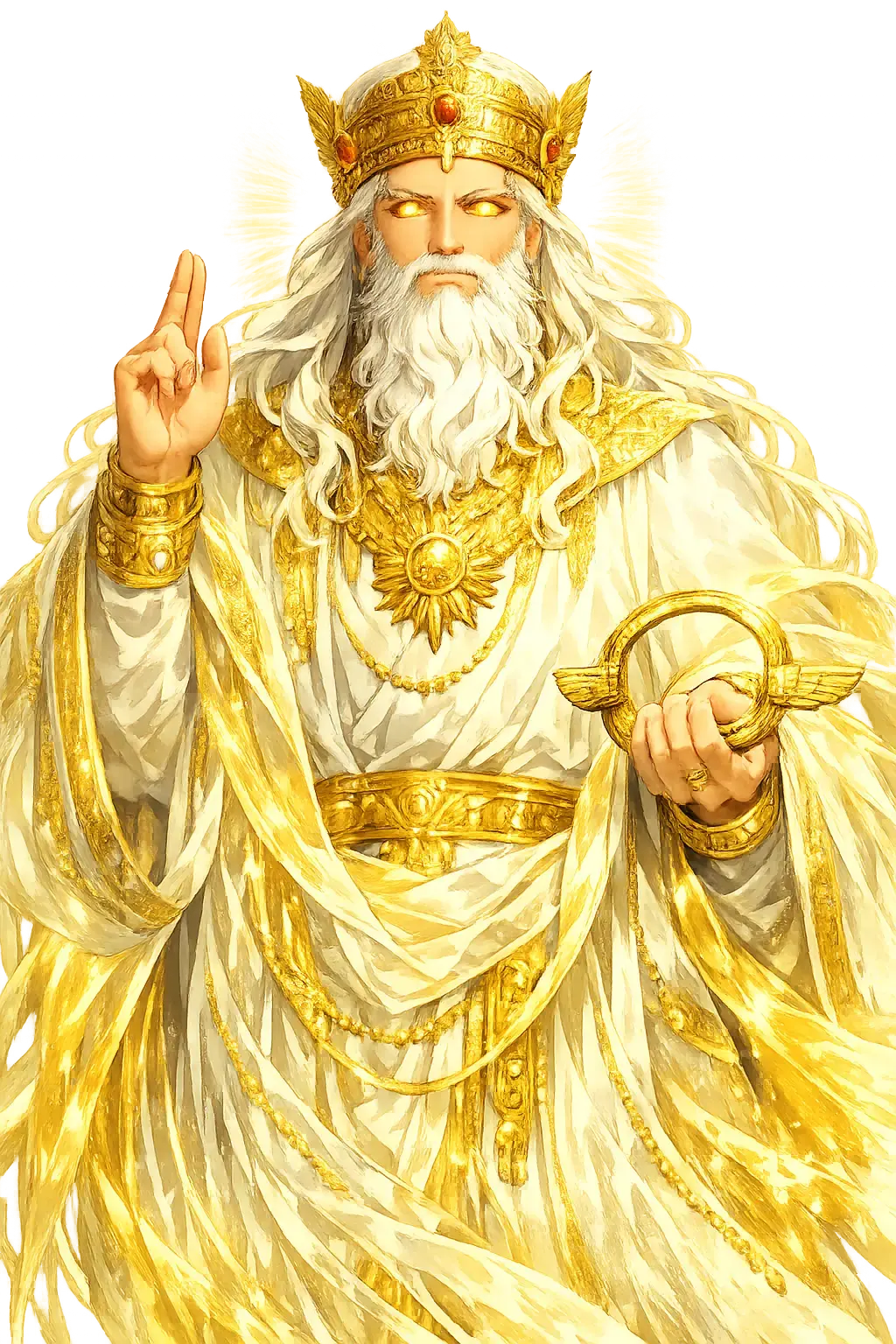
AhuraMazdā: the stories first, then the spelling
The marks in AhuraMazdā make the most sense standing next to the myths they have to carry. So the myths come first.
The Stories That Carry the Name
The Choice at the World's Dawn. In the Gāthās, the oldest stratum of Zoroastrian scripture, AhuraMazdā is not alone at the beginning. Two spirits stood forth there, twins — Spenta Mainyu, the Holy Creative Spirit, and Angra Mainyu, the Destructive — 'the better and the bad in thought, word, and deed' (Yasna 30. 3–5).
The Seven Creations and the Assault of Ahriman. In the Pahlavi Bundahišn, AhuraMazdā creates the world in seven successive acts: first the sky as a round shell, then water, then earth, then plants, then the sole primordial bull, then Gayōmart the first man, and finally fire — 'the life of all creation' (Bundahišn 1–3). Knowing Angra Mainyu would attack, the Wise Lord fixed time at nine thousand years and offered the destroyer a covenant: darkness would be his for half of it. Ahriman's counter-creations answer each good with its poison — drought against water, the wolf against the dog, winter against summer, death against life — and the cosmos becomes a mixed substance from the start: good in essence, wounded in fact.
Yima and the Perishable Paradise. Before Zarathustra, the first king was Yima (Jamšīd), whom AhuraMazdā commissioned to enlarge and perfect the world (Vendidad 2). Under Yima's rule there was neither cold nor heat, neither old age nor death; herds multiplied until the very earth swelled. Then AhuraMazdā warned of a killing winter and bade him build a var, an underground enclosure, and shelter within it for six hundred years the best of every kind — the seeds of every plant, pairs of every animal, the finest men and women.
And Here Is What the Spelling Preserves
The restoration keeps one feature the ASCII form ahuramazda cannot show:
- a → ā — Macron: long a: how long the vowel is held.
A storyteller pronouncing the name would restore every one of them by instinct. The file only writes down what the voice already knows.
At a Glance
- Restored name: AhuraMazdā
- ASCII form: ahuramazda
- Meaning: "Wise lord"
- Domain of influence: Supreme Creator, Wisdom, Light
- Pantheon: Zoroastrian
- Classification: Tier 1
- Original script: 𐬀𐬵𐬎𐬭𐬀 𐬨𐬀𐬰𐬛𐬁
- Series: The Restoration Files, No. 12 of 546
The Name Travels
Under the Achaemenids, AhuraMazdā (Auramazdā) stood behind nearly every royal inscription, and Greek observers equated him with Zeus — Herodotus speaks of Persian Zeus-worship, and Greco-Bactrian coins naming Zeus-Oromasdes show the identification made visual. Plutarch (De Iside 46–47) preserves the late-antique pairing of Oromazes with Arimanius, light against darkness.
The Address It Earned
The temple of AhuraMazdā stands at /ahuramazda/ — lore, scholars, patterns — because a name carrying this much story deserves more than a parking page. The restoration preserves more than the ASCII form can express — stress, length, or a letter the Latin keyboard lost — which places it, mechanically, in Tier-1.
The Sources Are Open
The myths above are retold from the temple's record; the primary voices are in the Sacred Texts: Avesta — Yasna & Yashts. Nothing in this file outranks them.
The File Continues
Read the founding dispatch for the name's full story, the Resonance File for the archetype at work — or the whole archive in one sitting.
Continue the series — previous file: Ahriman (read it here) · next file: Aígyptos (read it here).
The Restoration Files are written from the same canonical record as the temples themselves: the lexicon, the lore catalog, the pattern atlas, and the cited scholarly sources. If a file ever disagrees with its temple, the temple is right — tell us, and the file will be corrected.