
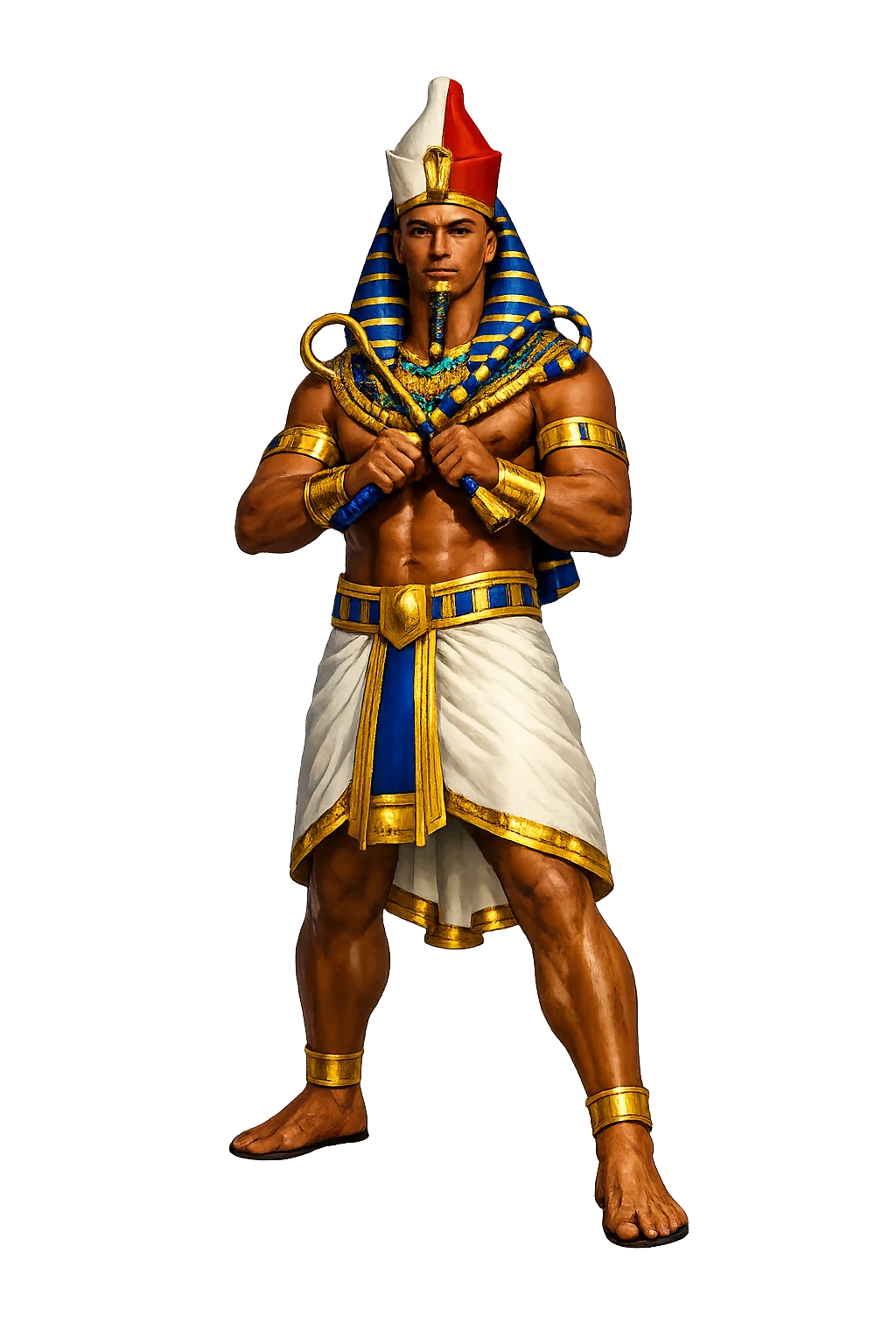
Aígyptos: the stories first, then the spelling
The marks in Aígyptos make the most sense standing next to the myths they have to carry. So the myths come first.
The Stories That Carry the Name
A Land Born from Io. Greek myth made Egypt a branch of the heroic family rather than a foreign land. Io, the Argive princess loved by Zeús, was transformed into a cow and driven across the world by Hēra’s jealousy until she reached the Nile delta. There, Aeschylus’ Prometheus Bound (824–852) has her finally touched by Zeús’s hand: she recovers her form and bears a son, Epaphos — ‘he of the touch’.
The Fifty Brides and the Bloody Night. The Danaid myth turns Aígyptos from a place into a tragedy. Aígyptos the king, son of Belos and the Nile-nymph Achiroē, fathered fifty sons; his brother Danaos fathered fifty daughters. The sons pursued the daughters to force a mass marriage — the catastrophe dramatized in Aeschylus’ Suppliants, where the Danaïdes beg Argos for asylum while the Aigyptioi land with threats.
Three Hundred and Forty-One Generations. Herodotus opens Book 2 of his Histories in a different key from every other book: Egypt, he insists, is where Greek assumptions go to be tested. The priests at Thebes, he reports (2. 142), recited three hundred forty-one generations of high priests in an unbroken line — a past eleven thousand years deep, against which Greece was an infant.
And Here Is What the Spelling Preserves
Against those stories, the attestation: Αἴγυπτος, in the attestation Herodotus, Histories Book 2 and Aeschylus, Suppliants give us. The name means "From Egyptian Ḥwt-kꜣ-ptḥ ("House of the Ka of Ptah")".
The restoration keeps one feature the ASCII form aigyptos cannot show:
- i → í — Acute on iota (diphthong ai): where the voice peaks.
A storyteller pronouncing the name would restore every one of them by instinct. The file only writes down what the voice already knows.
At a Glance
- Restored name: Aígyptos
- ASCII form: aigyptos
- Meaning: "From Egyptian Ḥwt-kꜣ-ptḥ ("House of the Ka of Ptah")"
- Domain of influence: Personified Egypt, the Black Land
- Pantheon: Greek
- Classification: Tier 1
- Original script: Αἴγυπτος
- Series: The Restoration Files, No. 13 of 546
The Name Travels
Greek religion met Egypt not by replacing its gods but by translating them. Herodotus already reads the Nile’s theology through Greek names — Amun as Zeus, Isis as Demeter, Ptah as Hephaestus — the interpretatio graeca that made Egypt legible to outsiders.
The Address It Earned
The temple of Aígyptos stands at /aigyptos/ — lore, scholars, patterns — because a name carrying this much story deserves more than a parking page. The restoration preserves more than the ASCII form can express — stress, length, or a letter the Latin keyboard lost — which places it, mechanically, in Tier-1.
The Sources Are Open
The myths above are retold from the temple's record; the primary voices are in the Sacred Texts: Theogony, Homeric Hymns, and Works and Days. Nothing in this file outranks them.
The File Continues
Read the founding dispatch for the name's full story, the Resonance File for the archetype at work — or the whole archive in one sitting.
Continue the series — previous file: AhuraMazdā (read it here) · next file: Aithḗr (read it here).
The Restoration Files are written from the same canonical record as the temples themselves: the lexicon, the lore catalog, the pattern atlas, and the cited scholarly sources. If a file ever disagrees with its temple, the temple is right — tell us, and the file will be corrected.