Stories of Zmey Gorynych
The crown of the Dobrynya cycle: how a hero's mercy gave the dragon a second life, and how the second battle was won by a wet hat, not a sword. The byliny are oral epic, recorded from living singers in the eighteenth and nineteenth centuries.
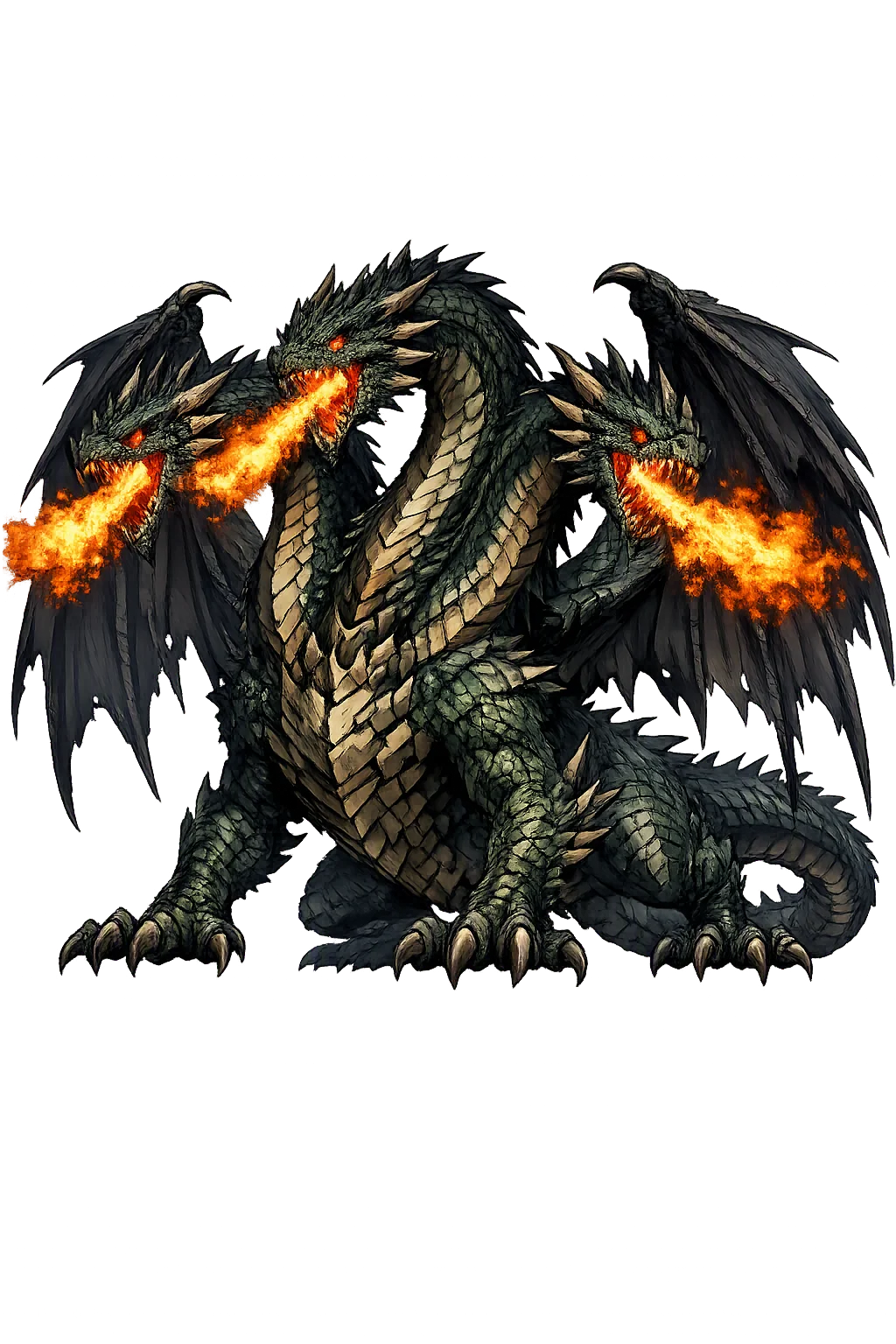
In the bylina of Dobrynya Nikitich and Zmey Gorynych, recorded by the nineteenth-century collectors of the Kireevsky circle, the hero's mother warns him never to ride to the Sorochinsky mountains, for the fire-breathing serpent holds them. The young hero rides anyway. From a dark cloud the dragon descends with three heads, and fire pours from each mouth. They fight for three days — Dobrynya's arrows spent, his clothing burnt, the earth scorched black around them. At last the dragon begs for mercy: let me go, brave Dobrynya, and I will never again carry off Christian people. The hero remembers his mother's teaching — she who spared the serpent brought grief upon herself — but he sheathes his sword and lets the dragon go. The bylina's first lesson is mercy; its second, still to come, is what mercy costs when it is spent on a dragon.
The dragon keeps neither his word nor his fear. He seizes Zabava, niece of Prince Vladimir, and carries her to his mountain. Dobrynya rides after him, but at the serpent's river his horse stumbles and refuses the water — an omen he cannot ignore. The second battle is worse than the first: flame no shield can face. Dobrynya survives by his mother's counsel — he soaks his women's hat in the river and fights beneath the dripping hood, the wet wool hissing where the fire strikes it. When the dragon weakens, Dobrynya cuts off all three heads, then gathers the severed stumps and burns them, for a zmei's heads grow back if they are allowed to rejoin; finally he bathes in the dragon's blood and returns Zabava to her uncle's hall. The detail every singer kept is the wet hat: the weapon that wins the second battle is not steel but preparation — soaked wool against dragonfire, and the patience to finish what mercy left unfinished.
Outside the bylina, in the fairy-tale corpus gathered by Afanas'ev in the nineteenth century, the three-headed zmei belongs to a darker economy. He descends on a town and names his price: maidens, nine at a time, year after year, and the townsfolk pay, because the alternative is fire. These are anonymous tales of the ATU 300 dragon-slayer type, and the dragon's hunger here is less personal than the bylina's — he is not anyone's nemesis, he is the thing the community feeds. A peasant's third son, the fool of the family, marks his arrows and climbs to the lair. In these tales the dragon-slayer is almost never the expected one: not the king's champion but the youngest brother, the one nobody fed to the serpent. The tribute myth turns the whole village into an accomplice, and the slayer into the one who finally refused to pay — the point being that dragons are affordable only until someone counts the cost.
The bylina itself had to be saved as often as the princess. It survived in the mouths of peasant singers in the Russian north until the mid-eighteenth century, when the compiler Kirsha Danilov set down the earliest known collection of byliny, and again in the 1860s when P. V. Kireevsky's expeditions took the songs from living performers whose grandmothers had sung them. Folklorists from Veselovsky to Propp argued over the dragon's ancestry: a pagan storm-serpent, they proposed, overlaid with the Christian St George — the folk hero Dobrynya standing in for the saint, the dragon for the devil of the iconostasis. Propp, in his Russian Epic Studies, read the dragon fight as a seasonal spring rite pressed into epic form. Whatever the origin, the song outlived every theory about it. The epic is the only weapon in the cycle that never had to be reforged: as long as someone sings it, the dragon stays slain and alive at once.
Three-Headed Dragon
Zmey Gorynych is the fire-breathing, three-headed dragon of the Russian byliny — terror of the Sorochinsky mountains, abductor of princesses, and the nemesis of the hero Dobrynya Nikitich. His name joins zmei, the Slavic dragon, with Gorynych, 'of the mountain': the serpent made into geography.
Each head spits flame; the bylina says his breath scorched the mountains black and burnt the hero's clothing to ash.
His lair beyond the serpent's river — the ridge Dobrynya's mother forbade her son ever to ride toward.
Prince Vladimir's niece, carried off twice — the abduction that forced the hero to break his oath and finish the fight.
Dobrynya swore on his sword to let the beaten dragon live; mercy once given became the dragon's second chance — and the hero's second battle.
From the original script to the living URL
Zmey Gorynych
The name survives in scholarly transliteration. Zmey Gorynych is the standard Slavic romanisation, documented in academic sources — “Mountain dragon”. Because the spelling uses only Latin letters, the form is the same in both ASCII and Unicode.
No indigenous writing system is securely attested for individual slavic names. The form shown is a modern scholarly transliteration.
zmeygorynych
The plain zmeygorynych form is identical to the Unicode restoration. Because this name is already written in Latin letters, no diacritics, stress, or script information were lost — only capitalization differs.
Zmey Gorynych
The Unicode restoration does not need to recover lost marks for Zmey Gorynych. Its value is canonical spelling and consistent cataloguing, not the reconstruction of erased orthography. The domain is readable as-is to both DNS and humanity.
Zmey Gorynych.com
This restoration is written entirely in ASCII letters — no Punycode encoding stands between Zmey Gorynych and the DNS. The domain reads identically to machines and to human eyes.
Owned, ideal, and ASCII forms of Zmey Gorynych
Zmey Gorynych
The full Unicode restoration. zmey gorynych.com is not in the PuniCodex collection — it is watched for release; if it drops, this temple upgrades to an owned flagship.
zmeygorynych
The plain ASCII fallback — what DNS and legacy systems see.
How Zmey Gorynych was spoken
How Zmey Gorynych is preserved in writing
No indigenous writing system is securely attested for individual slavic names. The form shown is a modern scholarly transliteration.
Contribute scholarly provenance →The lore you have read is the living myth. Extended Lore opens the scholarly vault beneath it: the cult and its material remains, a history of the image, the name after antiquity, a meditation on what the name still means, and the full scholarly apparatus — etymology, orthography, sources.
Enter Extended Lore