
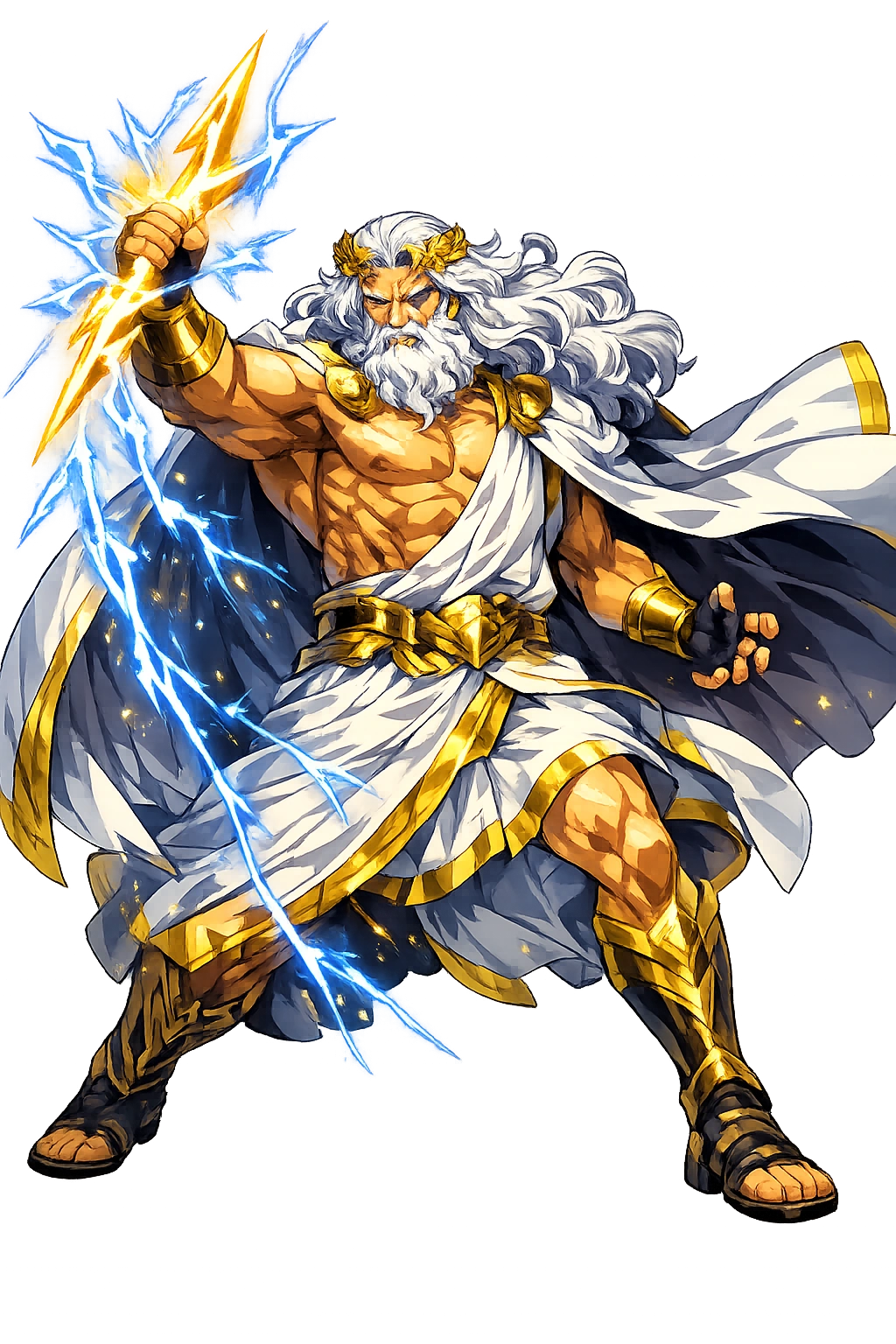
Zeús and the industries that were always telling its story
The myths did not retire. They moved offices. This is the file on where Zeús works now.
The mythology of Zeús is dominated by two great struggles: his overthrow of the Titans and his defense of cosmic order against every subsequent threat. He is the last son of Kronos, the only one not swallowed at birth, and nearly every Greek cosmogony moves toward his throne.
The pattern atlas — which maps every flagship temple to the industries its archetype demonstrably resonates with, each match argued and open to challenge — seats this temple in 4 industries. This file reads those seats the way they were earned: through the myths.
At a Glance
- Temple: Zeús
- Pantheon: Greek
- Domain of influence: Sky, Thunder, King of Gods
- Pattern seats: 4
- Sectors touched: Commerce & Governance · Energy & Natural World · Technology & Innovation · Culture & Entertainment
- Strongest seat: Leadership, Governance & Public Administration
- Series: The Resonance Files, No. 545 of 546
The Myth at Work
Hidden in a Cretan Cave. Kronos swallowed each of his children at birth, convinced by a prophecy that a son would dethrone him. Rhea, pregnant with her youngest, appealed to her parents Gaia and starry Ouranos, who hid the infant Zeus in a cave 'in the rich land of Crete' (Hesiod, Theogony 453–491). — hold that image; the industries below are where it goes to work.
The Ten Years' War for the Cosmos. Grown to strength, Zeus forced Kronos to disgorge his siblings — Hestia, Demeter, Hera, Hades, and Poseidon, with the stone disgorged last — and led the younger gods in a war against the Titans that raged for ten full years, 'a terrible battle' in which neither side could prevail (Hesiod, Theogony 617–735). The Cyclopes armed Zeus with thunder and lightning, Poseidon with the trident, Hades with the cap of invisibility, and the three hundred-handed Hekatonkheires pelted the Titans with mountains. — that is not just a story. It is a business model, four thousand years early.
The Seats
Each of these is argued in the atlas with a weight and a why-line. What the atlas cannot fit in one line is the whole myth — so here is each seat with its story restored.
Leadership, Governance & Public Administration
Government, executive leadership, and statecraft. (Sector: Commerce & Governance)
King of gods; sovereignty with thunder behind it. — the atlas stops there, out of discipline. The myth keeps going: the function Zeús performs in the stories is precisely the function this industry sells.
Meteorology & Weather Intelligence
Forecasting, storm tracking, and climate analytics. (Sector: Energy & Natural World)
The why-line says it in one breath: The thunderbolt is his weapon and the sky his domain; every storm warning still reads his signature. That is not a resemblance; it is the same act, performed in a newer building.
Aviation & Aerospace
Flight, aerospace engineering, and the sky economy. (Sector: Technology & Innovation)
The why-line says it in one breath: The sky father whose domain every flight crosses. That is not a resemblance; it is the same act, performed in a newer building.
Wine, Brewing & Hospitality
Vineyards, craft beverage, and hospitality venues. (Sector: Culture & Entertainment)
Zeus Xenios, protector of guest-friendship; hospitality to strangers is his sacred law. Swap the costume and the sentence is indistinguishable from the myth. That is what a resonance seat means.
The Long Employment
Zeús is the archetype of the father-god in Western imagination: the enthroned, thunderbolt-bearing king whose mountain court arbitrates the world. The Olympic Games, held in his honor from 776 BCE, are his most durable institution — the modern Games are their direct descendant. The age changed. The work did not.
The Method, Stated Plainly
None of this is numerology. A seat exists only where the match can be argued from the deity’s documented domains and deeds — weighted, published, and falsifiable. The derivation, the weights, and the challenge process are public on the methodology page. If a seat in this file reads wrong, the atlas itself tells you how to prove it — and the correction becomes part of the record.
For the Ones Who Work There
If you work in leadership, governance & public administration, meteorology & weather intelligence, or any trade this temple holds a seat in, this is the honest version of what a placement means: your industry beside the story it has been re-telling all along — on the temple floor itself, before an audience that came specifically to read it. The patron tier and the advertising terms describe the mechanics; the resonance above describes the fit.
The File Continues
One of 546 Resonance Files — the series where the pantheon goes to work. Read the founding dispatch for the name, the Restoration File for the spelling, or the whole archive end to end.
Continue the series — previous: Zéphyros (read it) · next: Zmey Gorynych (read it).
The Resonance Files are argued from the same canonical record as the pattern atlas itself: the lexicon, the lore catalog, and the cited sources. Every seat can be challenged at the methodology page — and the challenge is the point.