PuniCodex

Extended Lore

Ζεύς Zeús

Etymology · Orthography · Cult · Iconography · Reception · Sources

Tier 1 Zeús.com
Zeús — Sky, Thunder, King of Gods
01

Quick Facts

Essential information about Zeús, Sky, Thunder, King of Gods

Original ScriptΖεύς
Unicode RestorationZeús
Reconstructed Pronunciation/zděu̯s/
PantheonGreek
DomainSky, Thunder, King of Gods
MeaningBright, day (from Proto-Indo-European *dyēus)
ClassificationTier 1
Primary DomainZeús.com
Sacred SymbolsThunderbolt, Eagle, Oak, Sceptre, Aegis
02

Etymology & Word Family

From original script to Unicode restoration

Proto-indo-european *dyēws sky, day, bright
Original Script Ζεύς Zeús — "Bright, day (from Proto-Indo-European *dyēus)"
Unicode Restoration Zeús Restored stress, length, and script
Modern ASCII zeus Plain-ASCII fallback

PIE *dyēws > Greek Ζεύς (Doric) > Attic Zeus. The sky god par excellence.

03

Unicode Character Breakdown

Character-by-character philological analysis

CharacterUnicodeNameBlockPhonetic Role
ZU+005ALatin Capital Letter ZBasic LatinZeta
eU+0065Latin Small Letter EBasic LatinEpsilon
úU+00FALatin Small Letter U with AcuteLatin-1 SupplementAcute on upsilon
sU+0073Latin Small Letter SBasic LatinSigma

The Tier 1 classification reflects how much of the original phonology this restoration preserves — stress and vowel length for Greek names, distinctive letters and diacritics for every other tradition.

04

Cult & Worship

How the sacred was kept — rites, sanctuaries, remains

The Cult

Zeus was worshipped everywhere, and his great sanctuaries were panhellenic. Olympia in Elis held his richest cult from at least 776 BCE, when the games began: the Doric temple finished in 456 BCE housed Phidias's colossal statue, and the great ash altar received hecatombs of oxen from all Greece. At Dodona in Epirus his oracle answered through the sacred oak, served by the Selloi, interpreters who slept on the ground with unwashed feet; excavated lead tablets preserve the plain questions of ordinary Greeks. On the Athenian Acropolis the Bouphonia marked Zeus Polieus, Zeus Xenios guarded the stranger, Zeus Horkios the oath, and the Diasia honored Zeus Meilichios. City magistrates, not hereditary clergy, staffed his cult. The offering was the thigh-bone wrapped in fat, burned for the god; the binding act was the oath sworn in his name.

In the Earth

Olympia in Elis preserves his fullest record: the Doric Temple of Zeus (dedicated 456 BCE) housed Phidias's colossal chryselephantine statue, one of the Seven Wonders, and the artist's buried workshop was excavated in the twentieth century with tools and a cup bearing his name. The panhellenic games celebrated him there from 776 BCE. At Dodona in Epirus his oracle spoke through an oak grove; excavations uncovered thousands of lead tablets with consultants' questions, from state embassies to anxious private citizens, in a sequence reaching back to the Late Bronze Age. Mount Lykaion in Arcadia preserves an open-air ash altar with Mycenaean-era dedications, and the Idaean and Diktaian Caves on Crete anchored his birth legend. In Athens the Olympieion, completed by Hadrian with its colossal temple, carried the cult into the Roman Empire.

05

Iconography

How Zeús was imaged across the ages

The Image

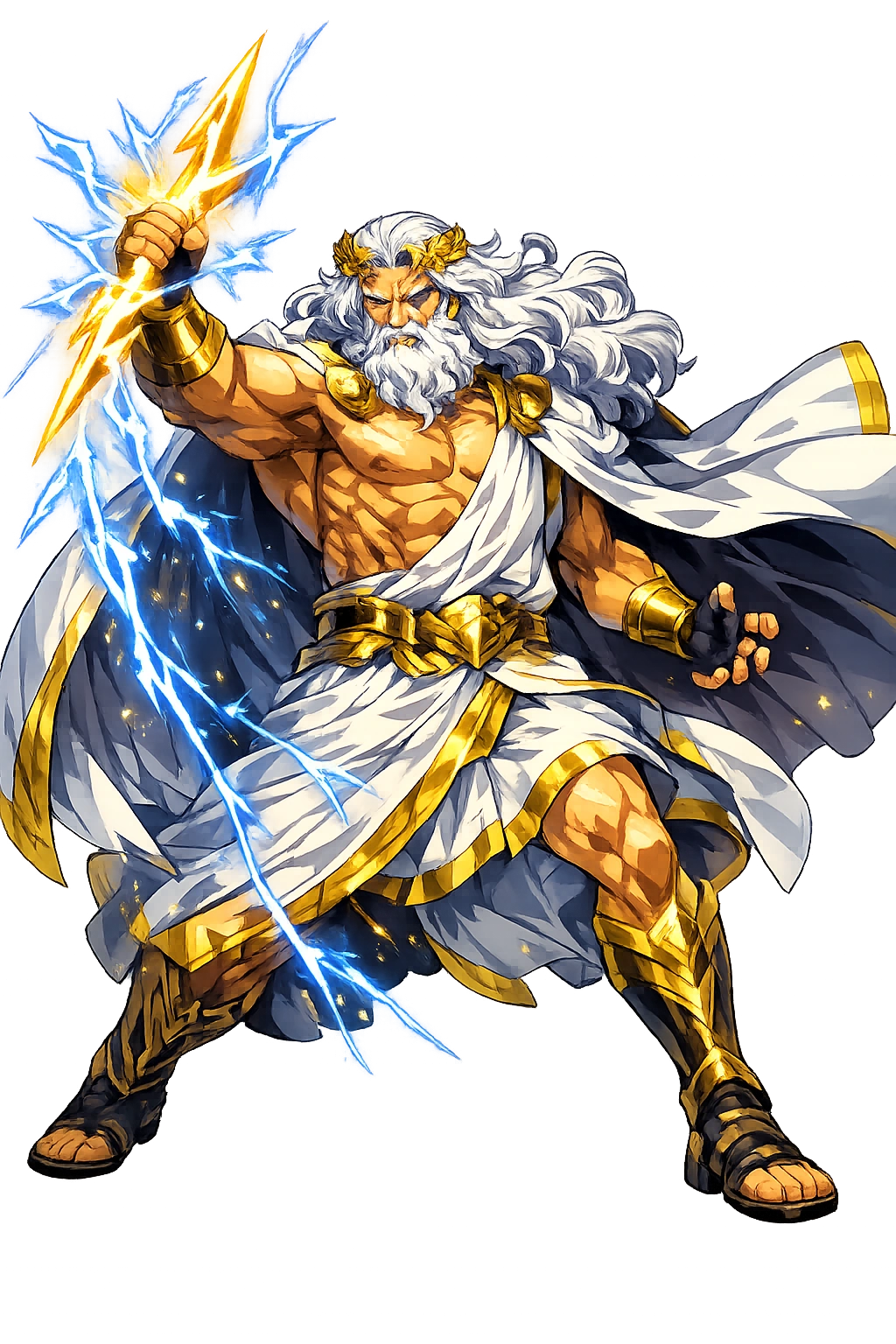
Two types ruled the image of Zeus: the standing thunderbolt-bearer and the enthroned father. The bronze statue raised from the sea off Cape Artemisium (c. 460 BCE, National Archaeological Museum, Athens) gives the striding storm-god at monumental scale, weapon arm extended. Phidias's enthroned Zeus at Olympia (c. 435 BCE), ivory and gold over a wooden core, fixed the canonical type for all antiquity — eagle-topped sceptre, thunderbolt in the right hand, Nike on the right palm — known through Pausanias's description, coins of Elis, and gem impressions. Archaic Zeus is a bearded wielder of a single bolt; after Phidias the king grows still and majestic, and Lysippus answered at Tarentum with an even larger seated colossus. The eagle, the oak wreath, and the bolt remain his recognition marks from the sixth century BCE through Roman imperial coinage.

06

Reception & Transformation

The name after its own age — transmission, translation, survival

Afterlives

Zeus entered the Middle Ages through the double door of Greek manuscripts and Roman imperial cult. Byzantine scribes preserved Homer and Hesiod, while the Capitoline temple of Iuppiter Optimus Maximus and the Jupiter-columns of the Rhineland carried his Roman form deep into the northern provinces; the enthroned father with sceptre and thunderbolt fed late-antique images of authority, including the first Christian pictures of God the Father. Medieval Europe knew him through Ovid and the Vatican Mythographers; Renaissance humanists rebuilt his image from Pausanias and coins — Boccaccio's Genealogia and Cartari's Imagini described Phidias's lost wonder, which Winckelmann then set at the summit of ancient art. The name traveled as far as the god: the genitive Diós survives in Greek names from Diodorus to Diogenes, Latin deus, dies, and Iuppiter descend from the same root family, and the eagle-and-thunderbolt type marched straight into imperial iconography and early-modern state art. In 1926 and 1928 fishermen raised the Artemisium bronze from the seabed, giving the modern world its first intact monumental Zeus.

Identifications Across Traditions

Roman religion identified Zeús directly with Iuppiter, importing his cult wholesale under the name Iuppiter Optimus Maximus; the equation was so natural that Greeks and Romans often treated them as one god with two names. In later antiquity Zeús-Iuppiter was syncretized with Semitic Baal and Egyptian Amun as a supreme sky deity, and the Hellenistic ruler cult made him the divine father of kings. Jupiter's planet and Tuesday (Germanic *Tīwaz's day) preserve his name's far-flung cognates, and the very words 'deus,' 'divine,' and 'day' descend from the same root family. The Christian God inherited much of Zeus's iconography — the enthroned father, the beard, the sky — without his mythology.

Modern Legacy

Zeús is the archetype of the father-god in Western imagination: the enthroned, thunderbolt-bearing king whose mountain court arbitrates the world. The Olympic Games, held in his honor from 776 BCE, are his most durable institution — the modern Games are their direct descendant. His colossal chryselephantine statue by Phidias was one of the Seven Wonders. In law and ethics his protection of strangers and suppliants underpinned Greek ideas of human solidarity, and the oath by Zeus remained the strongest a Greek could swear. Modern echoes range from planetary nomenclature to the operatic thunder sheet to the exclamation 'by Jove.' Restoring Zeús with its acute accent restores the name's original pitch and dignity.

07

The Meditation

What Zeús means — beyond the dictionary

Zeús is the god who says 'enough.' Where other deities have passions, Zeús has authority. His mythology is almost devoid of the humiliating episodes that afflict other Olympians; even his erotic adventures are framed as cosmic necessities. This makes him remote, even cold — but also the necessary center without which the pantheon collapses into rival passions.

In political terms, Zeús is the original model of legitimate sovereignty: not the strongest, but the one who guarantees the rules. His thunderbolt strikes the oath-breaker, not the weak. That is why every ancient city sought his patronage, and why the intuition of a single highest god — monotheism's distant ancestor — found in Zeús a ready-made image.

08

Screen & Culture

Where Zeús echoes through film, television, and games — and how

1981

Clash of the Titans

Film

Metro-Goldwyn-Mayer / United Artists

Ray Harryhausen's stop-motion epic follows Perseus as he faces the Kraken and challenges the gods of Olympus.

1997

Hercules

Animation

Walt Disney Pictures

Disney's animated musical recasts Herakles as a hero who must reclaim his godhood and rescue Mount Olympus from Hades.

2010

Clash of the Titans

Film

Warner Bros. Pictures / Legendary Pictures

A remake in which Perseus battles the Kraken and the underworld while Olympus argues over the fate of mortals.

2010

Percy Jackson & the Olympians: The Lightning Thief

Film

20th Century Fox

A modern demigod discovers he is Poseidon's son and is drawn into a conflict among the Olympian gods.

2011

Immortals

Film

Relativity Media

A stylized Greek-myth action film pitting Theseus and the gods against the ruthless Titan-aligned king Hyperion.

2014

Smite

Game

Hi-Rez Studios

A third-person MOBA that pits gods and mythological figures from multiple pantheons against one another.

2017

Wonder Woman

Film

DC Films / Warner Bros. Pictures

Diana of Themyscira enters the Great War, drawing on Amazonian and Olympian backstory tied to Zeus and Ares.

2020

Hades

Game

Supergiant Games

A roguelike action game in which Zagreus attempts to escape the Underworld, encountering most of the Olympian pantheon.

2021

Record of Ragnarok

Series

Graphinica / Warner Bros. Japan

A tournament anime pits humanity's greatest fighters against gods from many pantheons to decide mankind's survival.

2023

Percy Jackson and the Olympians

Series

Disney+

A faithful Disney+ adaptation of Riordan's novels, following Percy through Camp Half-Blood and encounters with the Greek gods.

09

Frequently Asked Questions

Common questions about Zeús, Sky, Thunder, King of Gods, and Unicode restoration

01How do you pronounce Zeús?

In reconstructed pronunciation, Zeús is /zděu̯s/ — approximately 'ZDEWS' — one syllable, beginning with a buzzing 'zd' and ending in a sharp 's', like the sound of distant thunder compressed into a name.

02What does Zeús mean?

Zeús means Bright, day (from Proto-Indo-European *dyēus) in the greek tradition.

03What are the symbols of Zeús?

Zeús is associated with Thunderbolt (The Cyclopean weapon that enforces oath and order; the single attribute shared by Zeus from the Bronze Age onward), Eagle (The bird that carries his thunderbolt and marks his omens; the eagle of Zeus appears on coins of Elis from the 6th century BCE), Oak (Sacred tree at Dodona, where his oracle answered from the rustling of the leaves and the murmur of the spring), Sceptre (Kingship and legitimate rule; the sceptre Zeus grants is the visible form of delegated authority), Aegis (The goat-skin fringed with the Gorgoneion that routs armies; he lends it to Athena at Troy (Iliad 2.446–449)).

04Why restore Zeús in Unicode?

Plain ASCII zeus strips the stress, length, and script that make the name specific. Unicode restoration returns the name to its original written dignity.

05What is the most important myth about Zeús?

“Hidden in a Cretan Cave” — the The Birth story that anchors the mythology of Zeús, told in full on the lore page.

10

Scholarly Sources

The philological foundations of this restoration

Every claim on this page is grounded in established scholarship. The orthographic restorations follow disciplinary convention. The etymological chain follows the best available reference works. This is not invention — it is resurrection through scholarship.

◈

Lexicography & Philology

  • Liddell, H. G., Scott, R., & Jones, H. S. A Greek-English Lexicon. Oxford: Clarendon Press, 9th ed. 1996.
  • Pape, W., & Benseler, G. E. Wörterbuch der griechischen Eigennamen. Braunschweig: Vieweg, 1884.
  • Beekes, R. S. P. Etymological Dictionary of Greek. Leiden: Brill, 2010.
◎

Primary Texts

  • Hesiod, Theogony 453–885
  • Homer, Iliad 1 and 15
  • Pindar, Pythian 1.15–28
  • Aeschylus, Prometheus Bound
  • Pseudo-Apollodorus, Bibliotheca 1.1–1.7
◉

Archaeology & Art History

  • Material evidence — iconography, inscriptions, and temple archaeology — for Zeús and related cults.
✦

Religious Studies

  • Burkert, Greek Religion
Return

The Surface Awaits

You have traced the name from its earliest attestation to its Unicode restoration. Now return to the myth. The story is where the name lives.

Back to Lore
Zeús mascot