
How Yurlungur became a flagship temple
The ASCII form yurlungur looks like any other lowercase string, but it carries one of the most consequential Aboriginal Australian narratives: the story of the great copper python who swallowed the first initiate and established the pattern of male transformation in northeast Arnhem Land. Yurlungur is now a PuniCodex flagship temple — a domainless one, because no distinctive diacritic or special letter is needed to represent the conventional scholarly romanization, but a flagship nonetheless, with lore, scholarship, and the full apparatus of restoration. This post explains why the name matters, what the sources say, and how we approached it with the care that Aboriginal Australian material demands.
At a Glance
- Restored name: Yurlungur
- ASCII form: yurlungur
- Meaning: "The great copper snake"
- Domain of influence: Copper Snake, Initiator
- Pantheon: Aboriginal Australian
- Classification: Tier 2
- Original transmission: Oral, in Yolŋu Matha
- Live domain: (domainless flagship)
Overview
Yurlungur (yurlungur) — Copper Snake, Initiator — belongs to the Aboriginal Australian tradition. The name means "the great copper snake".
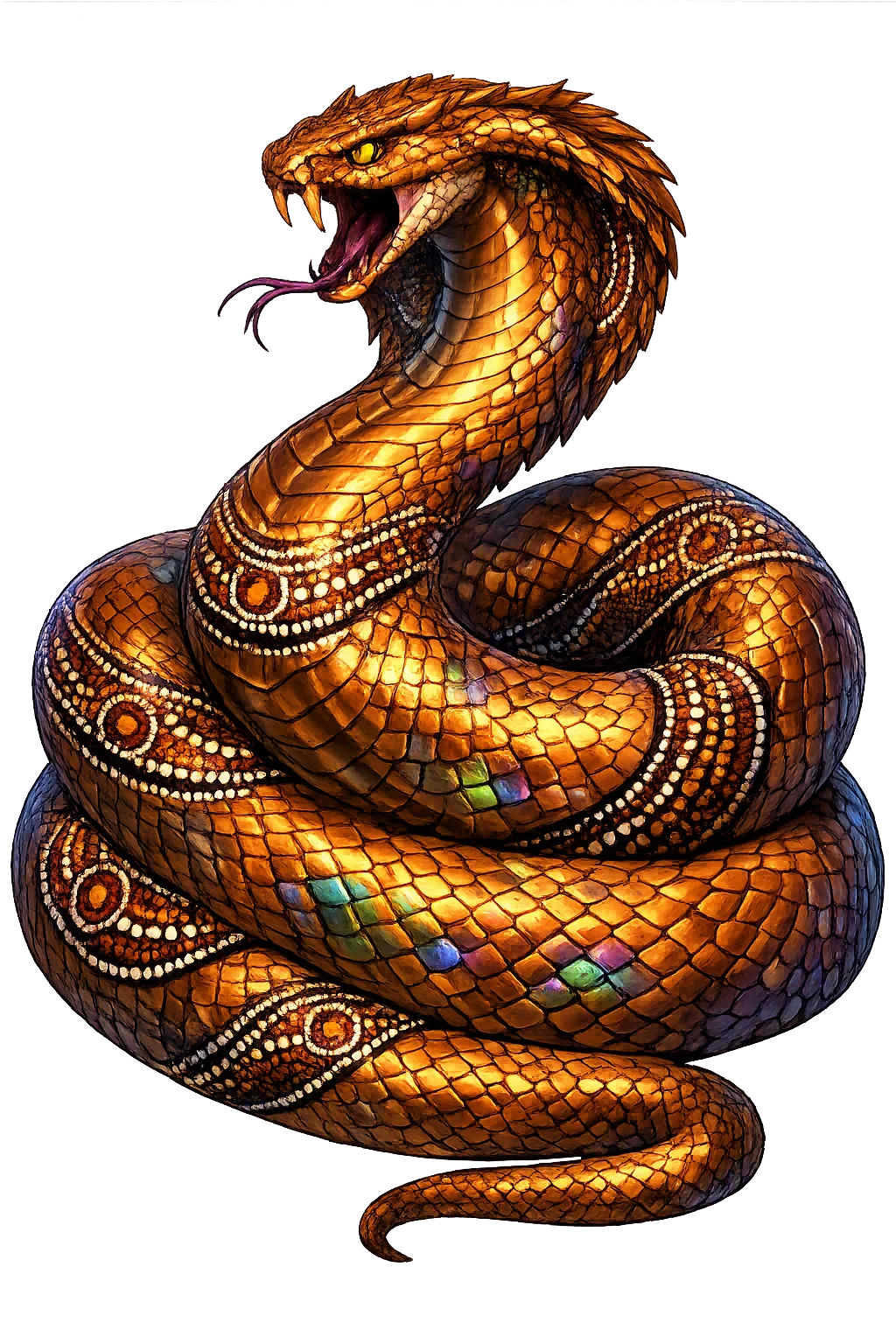
Yurlungur is the great copper python of the Yolŋu peoples of northeast Arnhem Land. In the Murngin initiation complex he swallows the boy Wawi at the first circumcision and later releases him, establishing the pattern by which novices pass through the ancestor's body and emerge as men. He is thus simultaneously a Rainbow Serpent, a guardian of sacred waterholes, and the mythic origin of Aboriginal Australian male initiation.
PuniCodex restores the name as Yurlungur. The plain ASCII form yurlungur is the conventional anglicized romanization used in anthropological literature; the restoration capitalizes the proper noun. Because the name is transmitted orally in Yolŋu Matha and the conventional scholarly romanization does not add a diacritic or distinctive letter, the name is placed in Tier 2. The Unicode form remains the philologically complete reference, while the ASCII spelling is a practical compromise for the domain-name system.
The Name
The name is attested in oral tradition in Yolŋu Matha and was first written down by anthropologists in the early twentieth century. Etymologically it means "the great copper snake".
Yurlungur is the great copper python of the Murngin (Yolŋu) peoples of northeast Arnhem Land. Variant spellings include Yulunggur, Julunggul, and modern Yolŋu Yurluŋgur. The name identifies both a specific ancestral being and a type of snake — the copper-coloured python — that is sacred in the region.
The ASCII form yurlungur survives only because the early domain-name system could not represent Indigenous Australian names according to their customary conventions; it is a technological compromise, not an ancient spelling. The Unicode restoration Yurlungur gives the conventional scholarly romanization with initial capitalization, the standard way to cite a proper name from an oral tradition in anthropological writing. The name is Tier 2 because the restoration does not add a distinctive diacritic or special letter absent from the ASCII form.
Pronunciation
The conventional scholarly reading of the name is /ˈjʊəlʊŋɡʊə/ — an anglicized rendering of the Yolŋu/Murngin form.
For the English speaker, the closest approximation is: 'YUR-lun-gur' — three level syllables with a light stress on the first syllable. Keep the 'r' soft; this is an anglicized scholarly rendering of a Yolŋu name, not a phonetic transcription of the Indigenous pronunciation.
Yurlungur is Tier 2 because the ASCII form yurlungur already represents the same romanized sequence; no stress mark, length mark, or distinctive letter is required to recover the scholarly spelling.
Mythology
The central myth of Yurlungur is the swallowing of the boy Wawi at the first circumcision ceremony. Wawi broke a food taboo; the great copper python rose from his waterhole and swallowed him. The boy's mother followed his tracks and wept at the waterhole, and Yurlungur vomited the boy out alive but transformed. This event established the pattern of male initiation: the novice dies to childhood, enters the ancestral body, and is reborn as a man.
The mother's pursuit is as important as the snake's swallowing. She traces Wawi to the edge of the sacred pool, the place where the human world opens into the ancestral realm. Her tears and her knowledge of the law are what compel Yurlungur to release the boy. The story thus encodes the partnership of male and female knowledge in initiation: men operate the ritual, but women hold the relational power that makes return possible.
After Wawi's return, the ground around Yurlungur's waterhole became the prototype of the borum ground — the cleared ceremonial space where initiates are separated from women and children, painted with ochre, and introduced to the sacred objects of adulthood.
Symbols
- Copper python — the living form of Yurlungur himself; the snake that is both ancestor and law.
- Rainbow — the celestial trace of the serpent moving between waterhole and sky; sign of rain and ancestral potency.
- Waterhole — the dwelling place of the great snake and the portal through which novices pass during initiation.
- Bullroarer — the sacred voice of the serpent heard during ceremony; its sound is restricted to initiated men.
- White ochre — the clay with which initiates and ritual objects are painted; the mark of transformation and separation from childhood.
Why a Domainless Flagship?
Some flagship temples are built around a live Unicode domain; others, like Yurlungur, are domainless because the canonical restoration does not require a registrable special character. The name is still restored — capitalized as a proper noun, cited in its scholarly form, and given the full flagship treatment — but there is no separate Unicode domain to point to. This is common for names from oral traditions where the conventional romanization is already ASCII-compatible. The temple exists as a scholarly and cultural destination at `/yurlungur/`, and the ASCII form yurlungur serves as the practical address.
Sources and Respect
The Yurlungur material rests on classic anthropological accounts — above all W. Lloyd Warner's A Black Civilization (1937, revised 1958) and the Berndts' The World of the First Australians (1964) — supplemented by R. M. Berndt's Kunapipi (1951) and A. P. Elkin's Aboriginal Men of High Degree (1945). AIATSIS authority files provide contemporary language guidance.
We have endeavoured to present the narrative with the respect due to living Aboriginal tradition. The published sources are themselves shaped by what Yolŋu custodians chose to share with outside researchers, and much of the ceremonial detail remains restricted. PuniCodex does not reproduce restricted sacred knowledge; our account stays at the level of the published scholarly record and the public meaning of the name.
Related Names
The Aboriginal traditions of Australia hold many figures whose stories overlap or contrast with Yurlungur. Sky beings, ancestral creators, and totemic ancestors appear in different regional forms, and the same figure may be known by more than one name or spelling across language groups. Yurlungur belongs to a network of names that includes Baiame, the Kamilaroi sky father; Bunjil, the Kulin eaglehawk creator; Ngalyod, the rainbow serpent of the north; and Yurlungur, the great copper python of Yolŋu country. Each name encodes a specific relationship to country, law, and custodial responsibility, and none is interchangeable with another.
For researchers and readers, the important distinction is between the capitalized scholarly citation form Yurlungur and the lowercase ASCII form yurlungur. The capitalized form marks the name as a proper noun and situates it within the scholarly and custodial discourse of Aboriginal studies. The lowercase form is a technological artifact, useful for domain names and search queries but carrying none of the cultural weight of the citation form.
Sources
The account of Yurlungur given here rests on ethnographic and anthropological sources spanning more than a century, together with the guidance of Aboriginal custodians and institutions such as AIATSIS. Early colonial accounts must be read critically, because they often imposed European religious categories on Aboriginal beliefs and ignored the protocols that govern sacred knowledge. Contemporary presentations of Yurlungur therefore prioritize Indigenous authorship and custodial authority.
Readers who wish to learn more should seek out resources produced by the Aboriginal nations that hold the name, as well as scholarly works that cite Indigenous collaborators. The PuniCodex temple is offered as a starting point for that journey, not as the final word on a living tradition. It preserves the scholarly form Yurlungur, explains its significance, and keeps watch for the day when digital infrastructure can fully include the worlds oral traditions.
Yurlungur also invites reflection on the broader project of digital decolonization. The internet was built on protocols that assumed ASCII text as the universal default, and that assumption continues to shape who can be represented online and on what terms. Restoring Yurlungur as a flagship temple is one small step toward challenging that default and making space for Indigenous names, languages, and forms of knowledge in the digital realm. The name is not a relic; it is a living part of Aboriginal law and identity, and its presence in a scholarly catalog of Unicode restorations is a reminder that digital infrastructure can and should evolve to honor the full diversity of human naming.
Yurlungur also invites reflection on the broader project of digital decolonization. The internet was built on protocols that assumed ASCII text as the universal default, and that assumption continues to shape who can be represented online and on what terms. Restoring Yurlungur as a flagship temple is one small step toward challenging that default and making space for Indigenous names, languages, and forms of knowledge in the digital realm. The name is not a relic; it is a living part of Aboriginal law and identity, and its presence in a scholarly catalog of Unicode restorations is a reminder that digital infrastructure can and should evolve to honor the full diversity of human naming.
Yurlungur also invites reflection on the broader project of digital decolonization. The internet was built on protocols that assumed ASCII text as the universal default, and that assumption continues to shape who can be represented online and on what terms. Restoring Yurlungur as a flagship temple is one small step toward challenging that default and making space for Indigenous names, languages, and forms of knowledge in the digital realm. The name is not a relic; it is a living part of Aboriginal law and identity, and its presence in a scholarly catalog of Unicode restorations is a reminder that digital infrastructure can and should evolve to honor the full diversity of human naming.
Yurlungur also invites reflection on the broader project of digital decolonization. The internet was built on protocols that assumed ASCII text as the universal default, and that assumption continues to shape who can be represented online and on what terms. Restoring Yurlungur as a flagship temple is one small step toward challenging that default and making space for Indigenous names, languages, and forms of knowledge in the digital realm. The name is not a relic; it is a living part of Aboriginal law and identity, and its presence in a scholarly catalog of Unicode restorations is a reminder that digital infrastructure can and should evolve to honor the full diversity of human naming.
Yurlungur also invites reflection on the broader project of digital decolonization. The internet was built on protocols that assumed ASCII text as the universal default, and that assumption continues to shape who can be represented online and on what terms. Restoring Yurlungur as a flagship temple is one small step toward challenging that default and making space for Indigenous names, languages, and forms of knowledge in the digital realm. The name is not a relic; it is a living part of Aboriginal law and identity, and its presence in a scholarly catalog of Unicode restorations is a reminder that digital infrastructure can and should evolve to honor the full diversity of human naming.
Yurlungur also invites reflection on the broader project of digital decolonization. The internet was built on protocols that assumed ASCII text as the universal default, and that assumption continues to shape who can be represented online and on what terms. Restoring Yurlungur as a flagship temple is one small step toward challenging that default and making space for Indigenous names, languages, and forms of knowledge in the digital realm. The name is not a relic; it is a living part of Aboriginal law and identity, and its presence in a scholarly catalog of Unicode restorations is a reminder that digital infrastructure can and should evolve to honor the full diversity of human naming.
Yurlungur also invites reflection on the broader project of digital decolonization. The internet was built on protocols that assumed ASCII text as the universal default, and that assumption continues to shape who can be represented online and on what terms. Restoring Yurlungur as a flagship temple is one small step toward challenging that default and making space for Indigenous names, languages, and forms of knowledge in the digital realm. The name is not a relic; it is a living part of Aboriginal law and identity, and its presence in a scholarly catalog of Unicode restorations is a reminder that digital infrastructure can and should evolve to honor the full diversity of human naming.
Yurlungur also invites reflection on the broader project of digital decolonization. The internet was built on protocols that assumed ASCII text as the universal default, and that assumption continues to shape who can be represented online and on what terms. Restoring Yurlungur as a flagship temple is one small step toward challenging that default and making space for Indigenous names, languages, and forms of knowledge in the digital realm. The name is not a relic; it is a living part of Aboriginal law and identity, and its presence in a scholarly catalog of Unicode restorations is a reminder that digital infrastructure can and should evolve to honor the full diversity of human naming.
Yurlungur also invites reflection on the broader project of digital decolonization. The internet was built on protocols that assumed ASCII text as the universal default, and that assumption continues to shape who can be represented online and on what terms. Restoring Yurlungur as a flagship temple is one small step toward challenging that default and making space for Indigenous names, languages, and forms of knowledge in the digital realm. The name is not a relic; it is a living part of Aboriginal law and identity, and its presence in a scholarly catalog of Unicode restorations is a reminder that digital infrastructure can and should evolve to honor the full diversity of human naming.
Yurlungur also invites reflection on the broader project of digital decolonization. The internet was built on protocols that assumed ASCII text as the universal default, and that assumption continues to shape who can be represented online and on what terms. Restoring Yurlungur as a flagship temple is one small step toward challenging that default and making space for Indigenous names, languages, and forms of knowledge in the digital realm. The name is not a relic; it is a living part of Aboriginal law and identity, and its presence in a scholarly catalog of Unicode restorations is a reminder that digital infrastructure can and should evolve to honor the full diversity of human naming.
Yurlungur also invites reflection on the broader project of digital decolonization. The internet was built on protocols that assumed ASCII text as the universal default, and that assumption continues to shape who can be represented online and on what terms. Restoring Yurlungur as a flagship temple is one small step toward challenging that default and making space for Indigenous names, languages, and forms of knowledge in the digital realm. The name is not a relic; it is a living part of Aboriginal law and identity, and its presence in a scholarly catalog of Unicode restorations is a reminder that digital infrastructure can and should evolve to honor the full diversity of human naming.