Stories of Yurlungur
The central Yurlungur myth is an initiation narrative: a boy breaks a food prohibition, is swallowed by the great copper python, and is restored to his kin only after the correct ritual response. In that single event the whole logic of Yolŋu male initiation — death to childhood, passage through the ancestor's body, rebirth as a man — is enacted for the first time. The early ethnographies differ in detail, even in the serpent's gender; the myths below follow the common structure.
At the first borum ceremony, the boy Wawi ate food that had been forbidden to him — and the great copper python, sleeping in the deep waterhole, heard the law being broken. Yurlungur rose, traveled through the earth to where the people were camped, and swallowed the boy whole. The ancestors were dismayed; the ceremony could not continue with the law's transgression unexpired. The boy's mother followed his tracks to the edge of the sacred pool, the place where the human world opens into the ancestral realm, and there she wept and sang. Moved — or shamed — by her grief, the python vomited the boy out, alive but no longer a child. From that day the pattern was set: every novice must enter the ancestral body and emerge again. Initiation is, in the myth's own terms, a controlled swallowing: the boy dies into the snake and is reborn as a man.
The mother's pursuit is as important as the snake's swallowing. She traces Wawi to the rim of the sacred pool and there does the one thing the law cannot do without her: she mourns correctly — weeping, singing, calling the ancestor by the obligations it owes her line. The ethnographers who recorded the cycle in the 1920s and 1930s (Warner, then the Berndts) heard in this scene the partnership of male and female knowledge in initiation: the men own the rite, the bullroarer, and the enclosure, but the relational power that compels the ancestor to give the child back belongs to the mother and her kin. The story thus encodes more than a punishment. It maps the division of religious labor that holds Yolŋu society together — the law swallows; the kinship system gives back — and it makes the waterhole, where the two worlds touch, the most dangerous and most necessary place in the country.
After Wawi's return, the ground around Yurlungur's waterhole became the prototype of the borum ground — the cleared ceremonial space where, in every generation since, novices are separated from women and children, painted with white ochre, shown the sacred objects of adulthood, and made to hear the bullroarer's voice, which is the serpent's own. The myth supplies the architecture: a dangerous perimeter, an ancestral interior, a transformation that cannot be undone. The novices who enter the enclosure are told, in the old men's instruction, that they too have been inside the great snake; the pain and fear of the rite are the memory of its body. A borum is therefore not an imitation of the myth but its repetition — the first swallowing carried forward, boy by boy, so that the ancestor's act at the beginning remains alive at every beginning since.
Yurlungur belongs to the Rainbow Serpent family that stretches across Aboriginal Australia — Ngalyod in western Arnhem Land, the Waugal of the southwest, Wanambi in the central deserts, and dozens of locally owned names beside. Like them he links water, fertility, and ancestral law; like them he punishes the breaking of taboo and rewards the keeping of it with rain and children. But the comparative label can mislead. 'Rainbow Serpent' is an English scholarly convenience, not an Aboriginal category, and the regional figures differ sharply: Yurlungur is specifically tied to male initiation and to the copper-coloured python that gives him his name, while Berndt's Kunapipi materials make the cognate serpent Yulunggur a female mother-ancestor of a different rite. The honest summary is that Australia does not have one rainbow snake but hundreds of owned, local ancestors who share a grammar — water, law, danger, and the crossing between worlds.
Initiation, Law, and the Rainbow Serpent
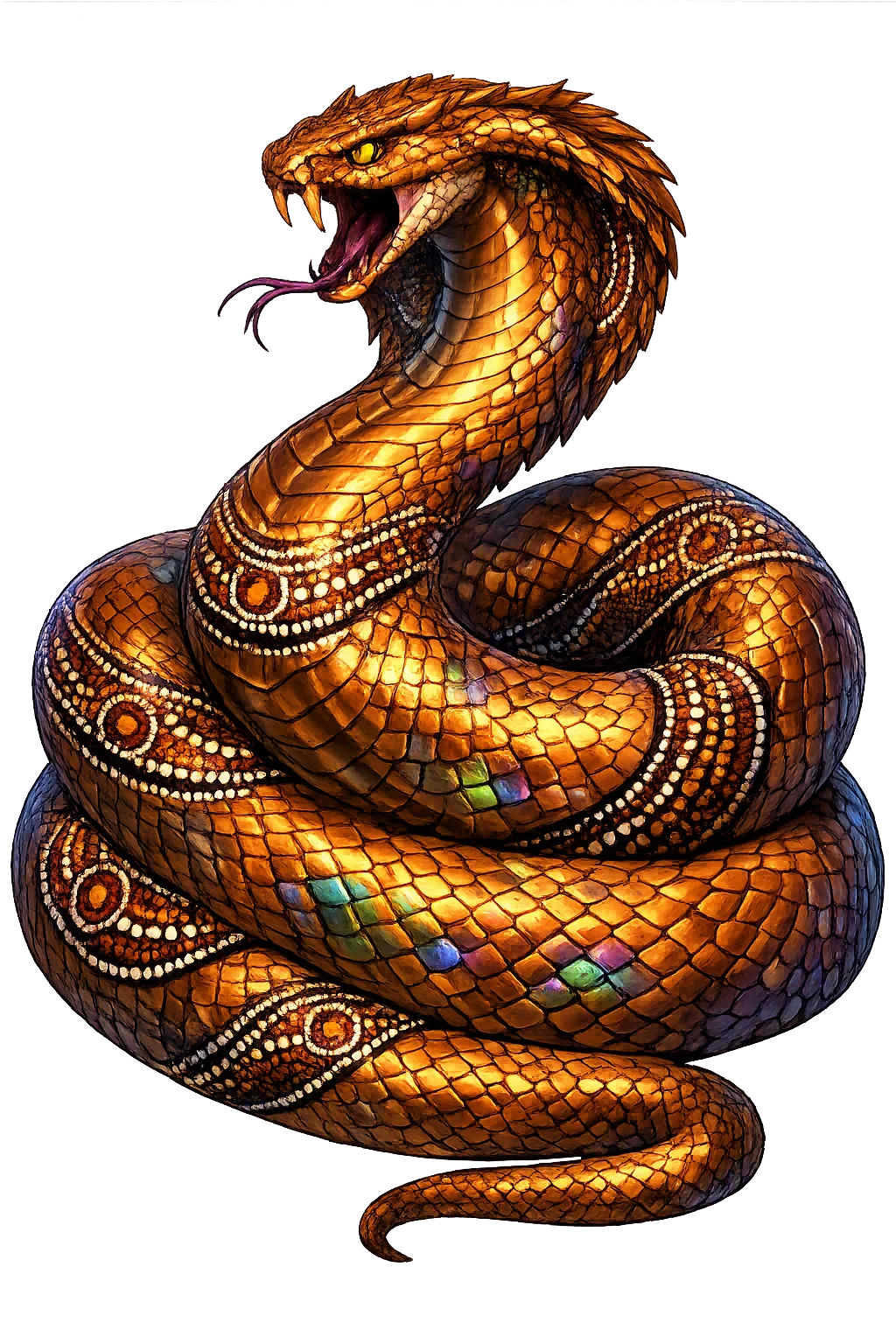
Yurlungur is the great copper python of the Yolŋu peoples of northeast Arnhem Land — a Rainbow Serpent whose swallowing of the boy Wawi at the first circumcision became the template for male initiation across the Murngin world. He is not merely a monster; he is the law itself, the waterhole guardian, and the ancestor who transforms boys into men.
Yurlungur swallows the novice and releases him as a man; his waterhole is the first borum ground.
The copper snake whose body arcs across sky and waterhole, binding rain, fertility, and ancestral power.
He dwells in the deep sacred wells; to disturb them is to risk drought, flood, and sickness.
His story encodes the rules of food taboo, kinship, and ritual obligation that hold Yolŋu society together.
From the original script to the living URL
Yurlungur
The name survives in scholarly transliteration. Yurlungur is the standard Aboriginal romanisation, documented in academic sources — “The great copper snake”. Because the spelling uses only Latin letters, the form is the same in both ASCII and Unicode.
No indigenous writing system is securely attested for individual aboriginal names. The form shown is a modern scholarly transliteration.
yurlungur
The plain yurlungur form is identical to the Unicode restoration. Because this name is already written in Latin letters, no diacritics, stress, or script information were lost — only capitalization differs.
Yurlungur
The Unicode restoration does not need to recover lost marks for Yurlungur. Its value is canonical spelling and consistent cataloguing, not the reconstruction of erased orthography. The domain is readable as-is to both DNS and humanity.
Yurlungur.com
This restoration is written entirely in ASCII letters — no Punycode encoding stands between Yurlungur and the DNS. The domain reads identically to machines and to human eyes.
Owned, ideal, and ASCII forms of Yurlungur
Yurlungur
The full Unicode restoration. yurlungur.com is not in the PuniCodex collection — it is watched for release; if it drops, this temple upgrades to an owned flagship.
How Yurlungur was spoken
How Yurlungur is preserved in writing
No indigenous writing system is securely attested for individual aboriginal names. The form shown is a modern scholarly transliteration.
Contribute scholarly provenance →The lore you have read is the living myth. Extended Lore opens the scholarly vault beneath it: the cult and its material remains, a history of the image, the name after antiquity, a meditation on what the name still means, and the full scholarly apparatus — etymology, orthography, sources.
Enter Extended Lore