Stories of Yánluó
Yánluó's mythology is procedural: not adventures but cases. His stories are judgments — and the judgments are always, the texts insist, simply the soul's own deeds read back to it.
Before he was a king of hell, Yama was the first human to die. The Ṛgveda (10.14) calls him the one who found the road away from the world of the fathers; he became the gatherer of the dead, honoured with offerings as the king who presides over the ancestors. Buddhism inherited him and sharpened him: in the Devadūta Sutta (Majjhima Nikāya 130) the newly dead stand before King Yama, who asks why they ignored the three divine messengers — an old person, a sick person, a corpse — sent to every house as warnings. Yánluó's court thus rests on an Indian foundation two millennia deep: judgment begins with mortality itself, and the first judge is the first man who had to die.
The Chinese Ten Kings system, documented from the Tang dynasty onward, receives the dead at set intervals — the seventh day after death, the hundredth day, the first and third anniversaries — distributing them among ten courts (The Scripture of the Ten Kings; trans. Teiser, 1994; the sūtra's Dunhuang manuscripts). Yánluó presides over the fifth, the great reckoning after the first four screenings. There the record books of each life are opened and the karma-mirror raised — it shows every deed as it was done, neither argued nor appealed — and the sentence is assigned: paradise, rebirth, or the numbered hells. One legend demoted him from the first court for undue leniency: even the king of the dead is audited, and mercy itself must answer to the ledger.
Chinese folklore kept electing incorruptible mortals to Yánluó's office. The greatest is Bao Zheng, the Song-dynasty magistrate — Justice Bao of a hundred operas and countless storytellings — said to judge the living by day and the dead by night as Yánluó's incarnation, identifiable by the crescent on his forehead and the iron face that fears no noble house. The tradition is a compliment to the office, not a doctrine: the perfect magistrate is already doing the underworld's work, which means the underworld is only the courtroom made honest. Yuan and Ming drama spread the identification across China until the borrowed god and the historical judge fused in the popular imagination — a god's office filled, repeatedly, by men.
The Yü-lan-p'en sūtra (Taishō 685), composed in Chinese from the seventh century, sends the monk Mulian down through the courts to find his mother starving among the hungry ghosts, and discovers that even a Buddha's disciple cannot buy her release — only the united offerings of the whole sangha on the fifteenth day of the seventh month can. The tale, performed in Dunhuang transformation texts and still staged today, is Yánluó's bureaucracy seen from below: the filial son walks past the mirror and the ledgers and finds that love, like law, needs an institution to reach the dead. The Ghost Festival it founded remains East Asia's greatest rite for the dead — judgment softened, once a year, by family.
The Ten Courts, the Record Books, and the Mirror of Deeds
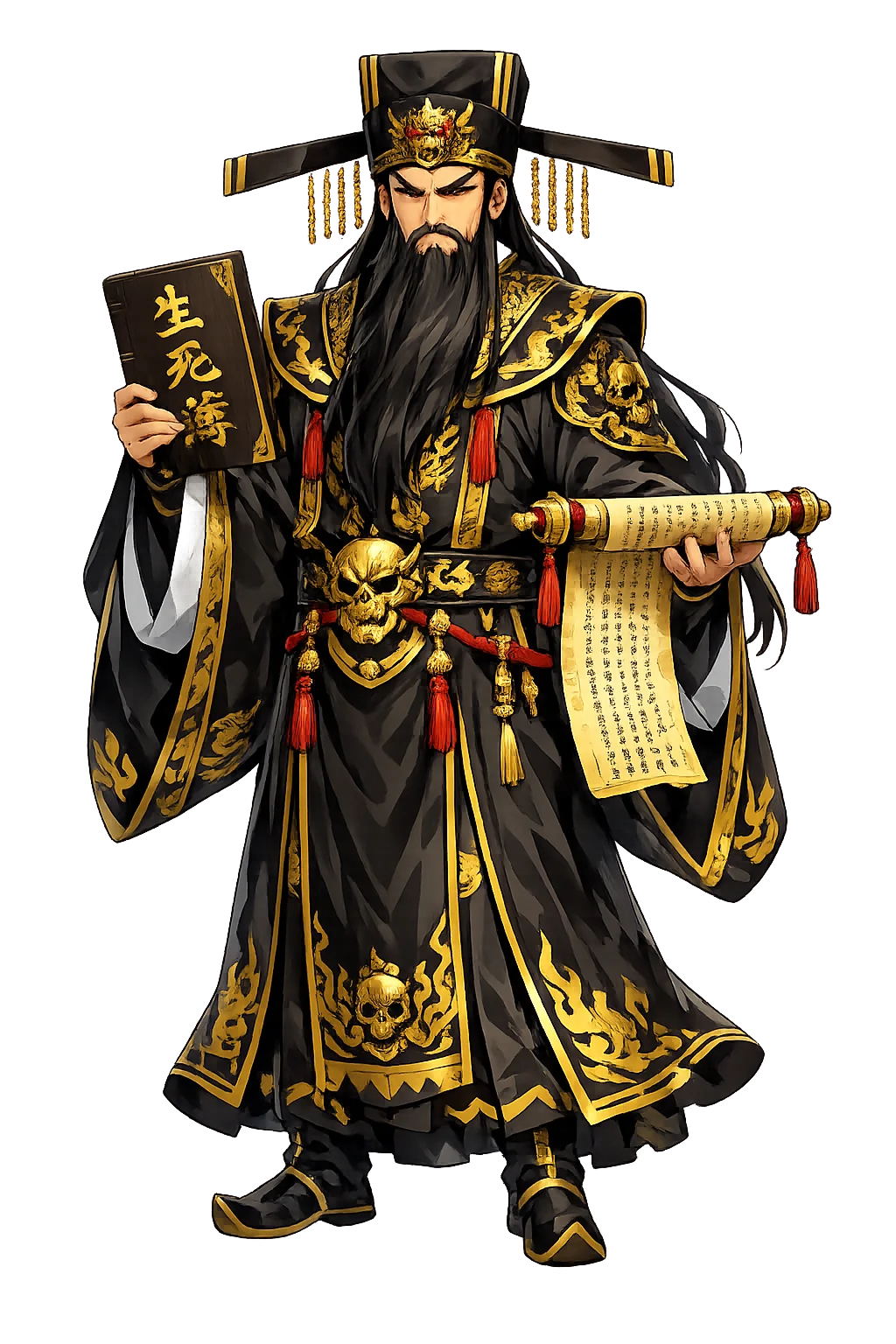
Yánluó is the magistrate at the centre of the Chinese afterlife: the Indian god Yama enthroned in a Chinese courtroom, judging the dead from their own record books. Before him, the myth insists, wealth and rank are nothing — the only evidence is what you did.
The registers of life and death: every deed entered, nothing argued away.
The karma-mirror that shows each soul its own actions — the courtroom's only witness.
Dìyù's bureaucracy: ten tribunals, his the fifth and most feared.
He holds the book of allotted years — the deadline no bribe extends.
From the original script to the living URL
閻羅王
The name in its original Chinese form. Yánluó (閻羅王) is attested in the source tradition — “'King Yan' (閻羅, from Yama), the judge of the dead”. Its acute stress marks carry the full phonetic and orthographic weight of the source tradition.
yanluo
Reduced to plain yanluo, the name loses everything that made it specific: acute stress marks. What remains is an ASCII string that machines can parse but that no longer speaks with its original voice.
Yánluó
The Unicode restoration recovers what ASCII flattened. Yánluó restores acute stress marks, returning the name to its original written dignity. The domain encodes to Punycode, but the browser displays the truth.
Yánluó.com → xn--ynlu-5na5i.com
The non-ASCII characters in Yánluó are encoded while the ASCII remains visible. To the DNS, it is Punycode. To humanity, it is Yánluó.
Owned, ideal, and ASCII forms of Yánluó
Yánluó
Restores 閻羅王. The live temple domain — yánluó.com.
yanluo
Flattens 閻羅王. The plain ASCII fallback — what DNS and legacy systems see.
How Yánluó was spoken
How Yánluó is preserved in writing
A bespoke provenance study for Yánluó is being prepared by the PUNICODEX scholarly team.
Contribute scholarly provenance →The lore you have read is the living myth. Extended Lore opens the scholarly vault beneath it: the cult and its material remains, a history of the image, the name after antiquity, a meditation on what the name still means, and the full scholarly apparatus — etymology, orthography, sources.
Enter Extended Lore