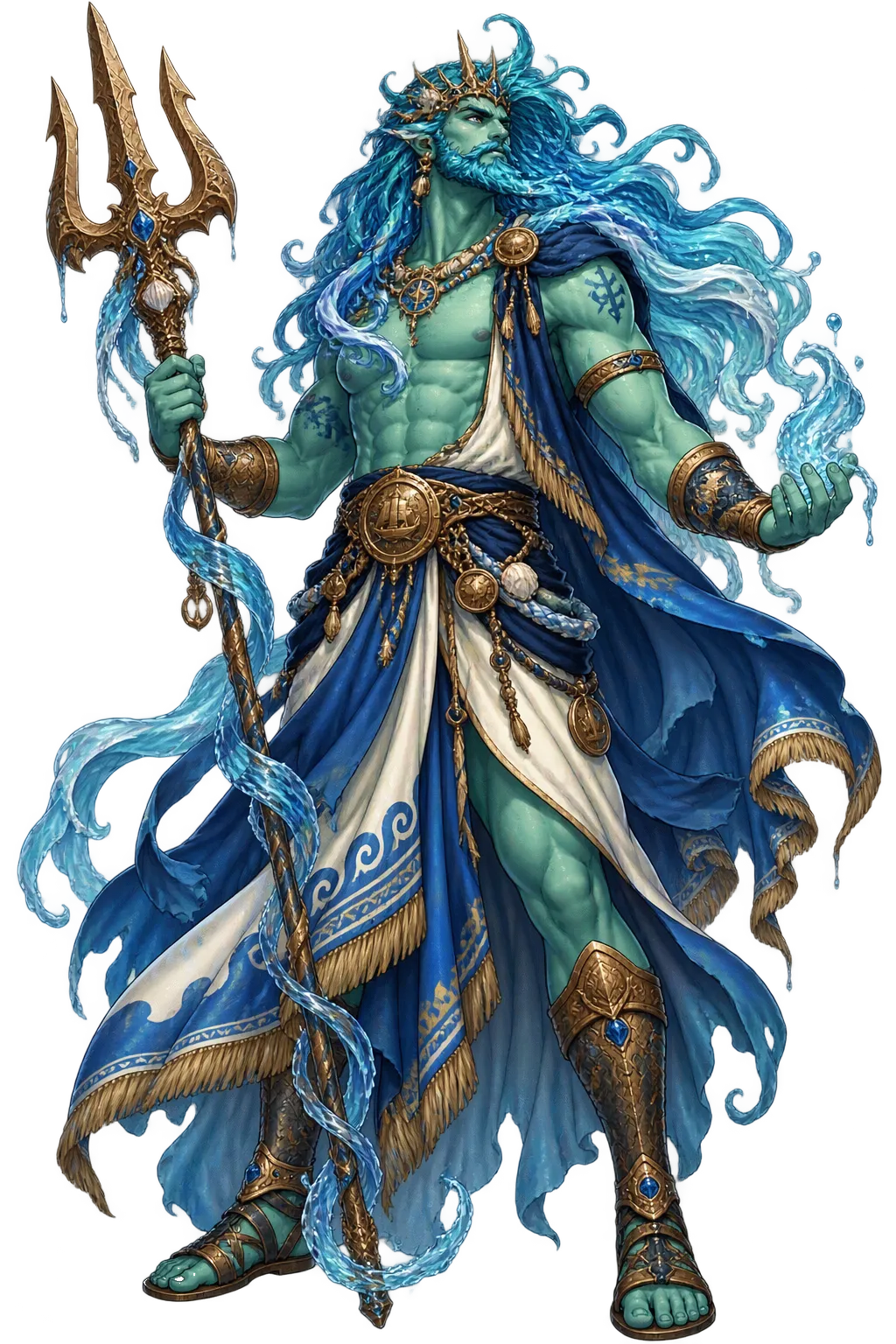
Stories of Yammu
Yammu’s mythology is the Baal Cycle’s opening act: the sea demands the storm-god’s surrender, the council wavers, and Baʿal — armed by the craftsman-god Kothar-wa-Khasis with two magic clubs — goes out to meet the flood and splits the sea’s skull between the eyes. It is the Levant’s own dragon-combat — the same pattern as Marduk and Tiamat, Indra and Vritra, told in the oldest alphabetic literature on earth.
The cycle opens with Yammu’s envoys at the divine council, demanding that Baʿal be delivered into the sea’s power. El, the aged king of the gods, wavers — and it is left to Baʿal himself, with Kothar-wa-Khasis’s weapons, to answer the demand. The scene sets the cycle’s whole theology: kingship is taken, not granted.
Kothar-wa-Khasis gives Baʿal two clubs — Yaggarish, “Chaser”, and Ayyamarri, “Driver”. Baʿal strikes Yammu between the eyes, on the skull: ‘Yammu is dead! Baʿal is king!’ The lines are the Levantine storm-god’s coronation — and the pattern that Hebrew poetry would echo in its own sea-combat, Yahweh versus Yam.
The Hebrew Bible keeps the sea-god’s name as a common noun and his defeat as a motif: ‘Thou didst divide the sea (yam) by thy strength’, ‘thou rulest the raging of the sea (yam)’. The Ugaritic tablets revealed what the Psalms were arguing against — and what they preserved: Yammu’s defeat is the Old Testament sea’s backstory.
Yammu belongs to the oldest myth-complex in the lexicon: the storm-god versus the sea. Tiamat and Marduk in Babylon, Vritra and Indra in the Rigveda, Typhon and Zeus in Greece — the pattern crosses the whole ancient world, and the Ugaritic telling is among its most vivid witnesses. The sea is always first, and always beaten.
The Defeated God of the Ugaritic Tablets
Yammu is the Canaanite sea-god: the personified ocean whose rebellion against the divine council set the Baal Cycle in motion, and whose defeat by Baʿal — with two magic clubs thrown from the storm-cloud — established the storm-god’s kingship over the gods. The Ugaritic tablets of the fourteenth century BCE, found in 1929, gave him back his name after three thousand years of silence.
His name IS the word “sea” (ym) — the ocean as the first rebel against order.
“Chaser” and “Driver”, the magic clubs Baʿal threw to shatter his skull — the cycle’s most quoted scene.
He demanded Baʿal’s surrender from the council of El; the gods’ cowardice set the war in motion.
Found at Ugarit (Ras Shamra) in 1929 — the Baal Cycle restored Canaanite religion to history.
From the original script to the living URL
𐤉𐤌
The name in its original Phoenician form. Yammu (𐤉𐤌) is attested in the source tradition — “Sea”. Its original diacritics and script distinctions carry the full phonetic and orthographic weight of the source tradition.
yammu
The plain yammu form is identical to the Unicode restoration. Because this name is already written in Latin letters, no diacritics, stress, or script information were lost — only capitalization differs.
Yammu
The Unicode restoration does not need to recover lost marks for Yammu. Its value is canonical spelling and consistent cataloguing, not the reconstruction of erased orthography. The domain is readable as-is to both DNS and humanity.
Yammu.com
This restoration is written entirely in ASCII letters — no Punycode encoding stands between Yammu and the DNS. The domain reads identically to machines and to human eyes.
The attested spelling family of Yammu
Yammu
Restores 𐤉𐤌. The full Unicode restoration. yammu.com is not in the PuniCodex collection — it is watched for release; if it drops, this temple upgrades to an owned flagship. Attested by Ugaritic texts, CIS.
How Yammu was spoken
How Yammu travels from ancient script to the modern URL
Semitic ym “sea"; Yammu is the personification of the sea and rival of Baal.
The lore you have read is the living myth. Extended Lore opens the scholarly vault beneath it: the cult and its material remains, a history of the image, the name after antiquity, a meditation on what the name still means, and the full scholarly apparatus — etymology, orthography, sources.
Enter Extended Lore