
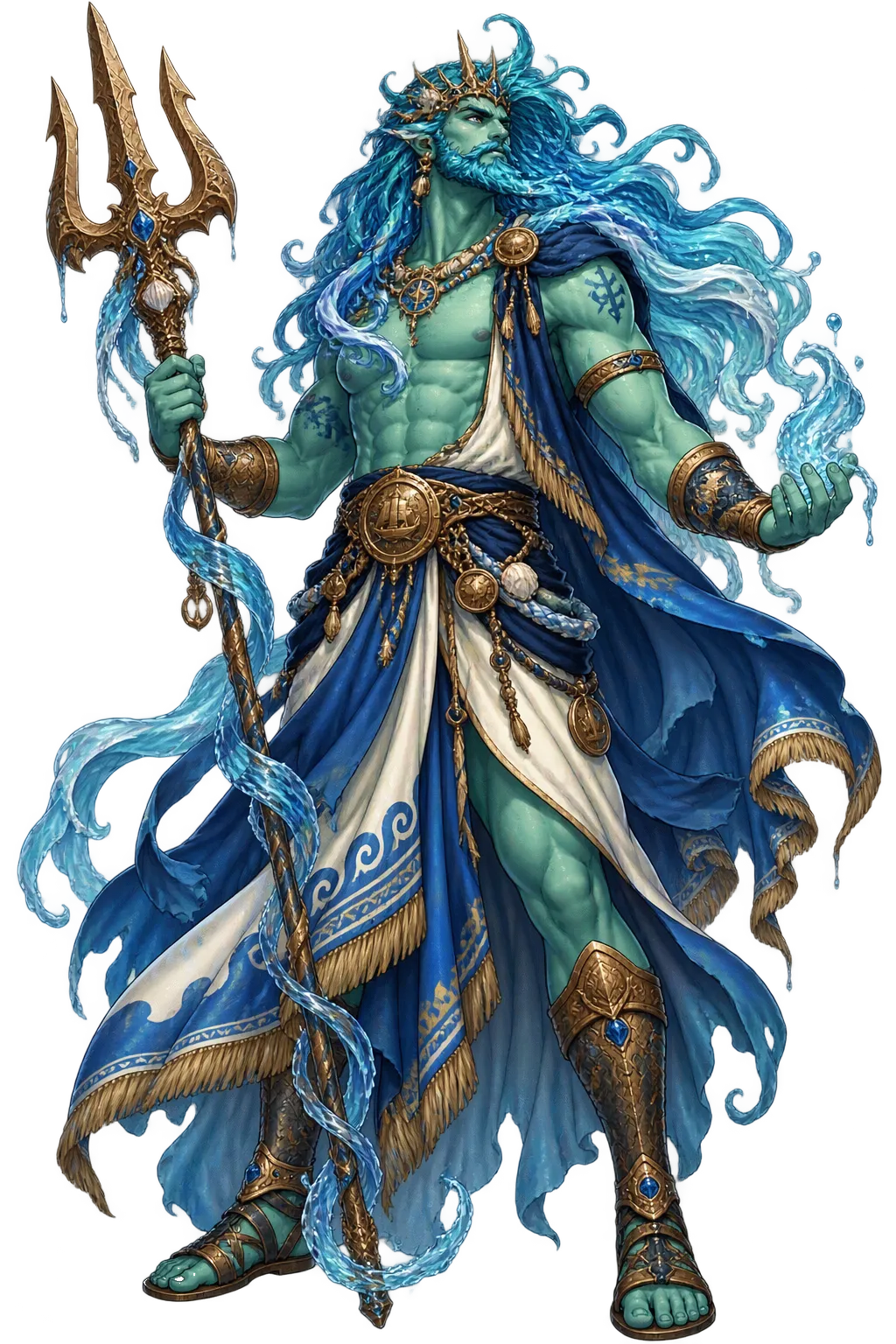
Why Yammu is spelled that way — and what it costs to get it right
There is a version of this name the early internet had to settle for: yammu. This is the file on how Yammu replaced it.
Yammu’s mythology is the Baal Cycle’s opening act: the sea demands the storm-god’s surrender, the council wavers, and Baʿal — armed by the craftsman-god Kothar-wa-Khasis with two magic clubs — goes out to meet the flood and splits the sea’s skull between the eyes. It is the Levant’s own dragon-combat — the same pattern as Marduk and Tiamat, Indra and Vritra, told in the oldest alphabetic literature on earth.
At a Glance
- Restored name: Yammu
- ASCII form: yammu
- Meaning: "Sea"
- Domain of influence: Sea, Chaos
- Pantheon: Phoenician
- Restoration: ASCII-equivalent form
- Original script: 𐤉𐤌
- Series: The Restoration Files, No. 584 of 597
The Name Before the Marks
Spoken, the name runs `/ˈjɑːmʊ/` — “YAH-moo”
The Temple That Stands Now
The restored name is not a plaque; it is an address. The temple of Yammu lives at /yammu/, with its mythology in the lore halls, its peer-reviewed record in the Scholarly Edition, and its place in the pattern atlas on the patterns floor.
aSCII-equivalent form
Where the Name Stood First
Yammu’s monuments are the tablets: the Baal Cycle’s cuneiform pages from Ras Shamrt (Ugarit), 1929 — the oldest large alphabetic texts ever found, and the foundation-stones of Northwest Semitic philology. The temple on the web is the newest of these addresses — the first one that fits in a pocket.
The Archetype at Work
The pattern atlas seats this temple in 3 industries, each match argued and weighted: Maritime, Shipping & Ocean Industries (the sea itself as god — the Ugaritic ocean whose defeat by Baal is the Levant's oldest sea-story.); Disaster Resilience & Recovery (the sea subdued — the chaos-flood as the perennial threat the storm manages.); Meteorology & Weather Intelligence (the sea Baal must break — the storm-versus-ocean combat is weather’s oldest dramatization.). The Resonance File reads those seats through the myths themselves.
The Emblems
The name does not travel alone. The Sea Itself — His name IS the word “sea” (ym) — the ocean as the first rebel against order.; The Two Clubs — “Chaser” and “Driver”, the magic clubs Baʿal threw to shatter his skull — the cycle’s most quoted scene.; The Divine Council — He demanded Baʿal’s surrender from the council of El; the gods’ cowardice set the war in motion.. Each emblem is filed in the temple's record with its own provenance, the same discipline the spelling gets.
For the Voice
“YAH-moo” The reconstructed line runs `/ˈjɑːmʊ/` — the temple's pronunciation atlas carries the phonemes one by one.
The Discipline It Answers To
This restoration belongs to Phoenician, a tradition with its own exact discipline. The rules that govern it are not house style; they are the tradition's own scholarship, applied with the same care here as in any edition — and published, with the sources, so the file can be checked the way an edition can be checked. aSCII-equivalent form
The File Continues
The temple's founding dispatch tells the name's story; its Resonance File reads the myths into the industries; the blog index holds the whole archive.
Continue the series — previous file: Yama (read it here) · next file: Yamunā (read it here).
The Restoration Files are written from the same canonical record as the temples themselves: the lexicon, the lore catalog, the pattern atlas, and the cited scholarly sources. If a file ever disagrees with its temple, the temple is right — tell us, and the file will be corrected.