
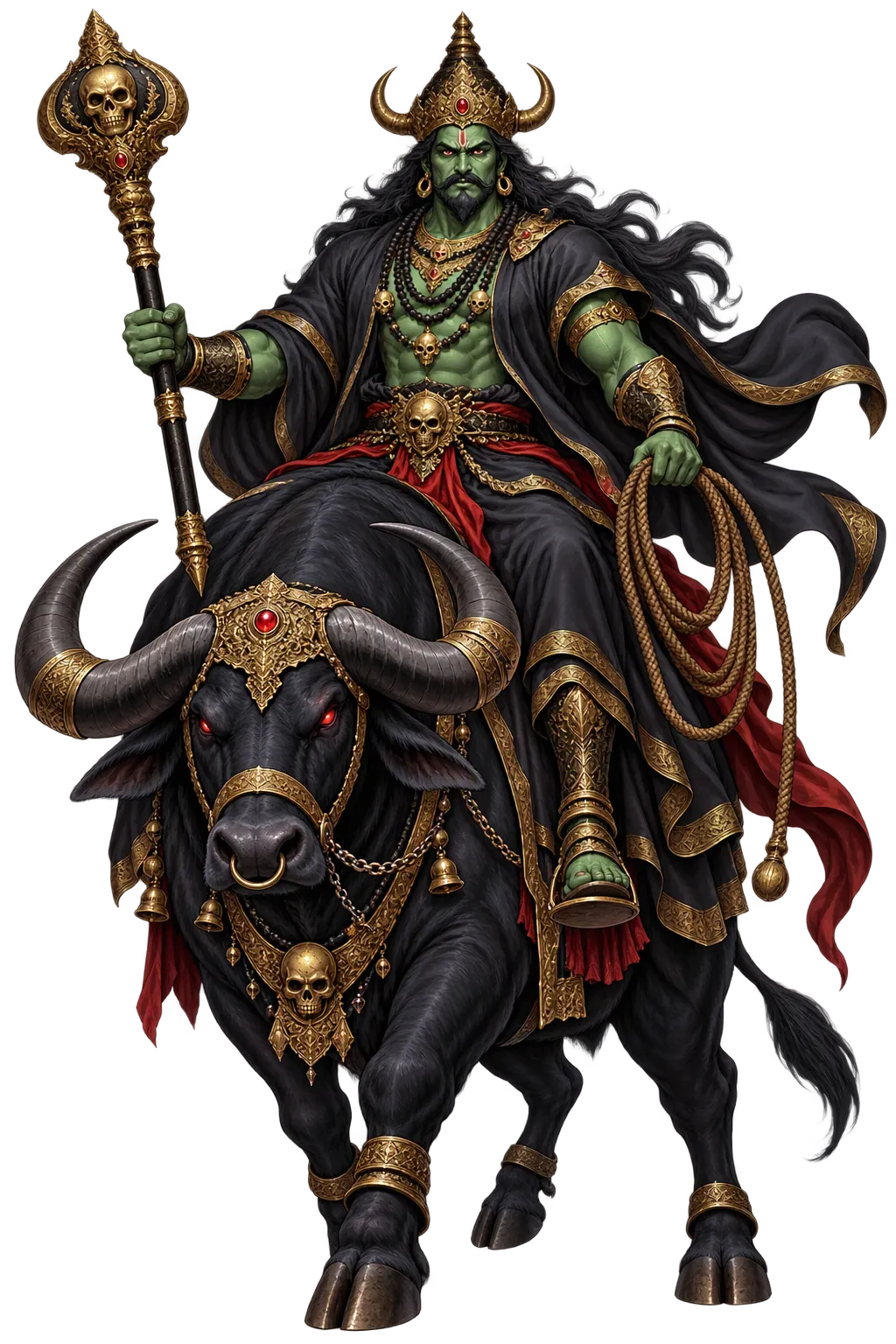
Yama: the stories first, then the spelling
You cannot weigh an accent without knowing what it carries. Here is what Yama has been carrying.
The Stories That Carry the Name
The Twin Dialogue. The oldest Yama-text is a dialogue: Yama and his twin Yamī, the first two beings, and Yamī’s love for her brother. Yama refuses — ‘the immortals watch’ — and the hymn becomes the charter of exogamy and of the incest-taboo itself, argued between the world’s first twins in the world’s first debate.
The Path of the Fathers. The funeral hymn sends the dead king along the path Yama blazed, past the two dogs and the waters, to the feast of the fathers where Yama waits with Varuṇa. ‘Leave the sin here, keep the glory’ — the formula of every Vedic funeral, spoken to the first traveller’s successor.
The King Under the Earth. In the epic’s underworld-book, Yama rules below with his city Saṃyamanī, his account read by Citragupta, his noose and his buffalo — the god of justice who once disguised himself as a crab to test a king. The epic makes him dreaded and fair: the judge who cannot be bribed because he already owns everything.
And Here Is What the Spelling Preserves
At a Glance
- Restored name: Yama
- ASCII form: yama
- Meaning: "The god who presides over the Pitṛs (the departed fathers) and rules the spirits of the dead."
- Domain of influence: Death, Justice, Underworld
- Pantheon: Sanskrit
- Restoration: ASCII-equivalent form
- Original script: यम
- Series: The Restoration Files, No. 583 of 597
The Name Travels
The Avestan Yima, king of the golden age who kept death from his realm, is Yama’s Iranian twin — the same name, opposite function: where Yima postponed death, Yama administers it. Buddhism made Yama a dharmapāla, converted in the end by the Buddha’s teaching, and carried him east as Enma in Japan, where he still judges with his mirror and staff.
The Address It Earned
The temple of Yama stands at /yama/ — lore, scholars, patterns — because a name carrying this much story deserves more than a parking page. aSCII-equivalent form
The Sources Are Open
The myths above are retold from the temple's record; the primary voices are in the Sacred Texts: Rig Veda and Ramayana. Nothing in this file outranks them.
The File Continues
Read the founding dispatch for the name's full story, the Resonance File for the archetype at work — or the whole archive in one sitting.
Continue the series — previous file: Yām (read it here) · next file: Yammu (read it here).
The Restoration Files are written from the same canonical record as the temples themselves: the lexicon, the lore catalog, the pattern atlas, and the cited scholarly sources. If a file ever disagrees with its temple, the temple is right — tell us, and the file will be corrected.