The Living Myth
Death, Justice, Underworld · Death, the First Mortal, Judge of the Dead · The god who presides over the Pitṛs
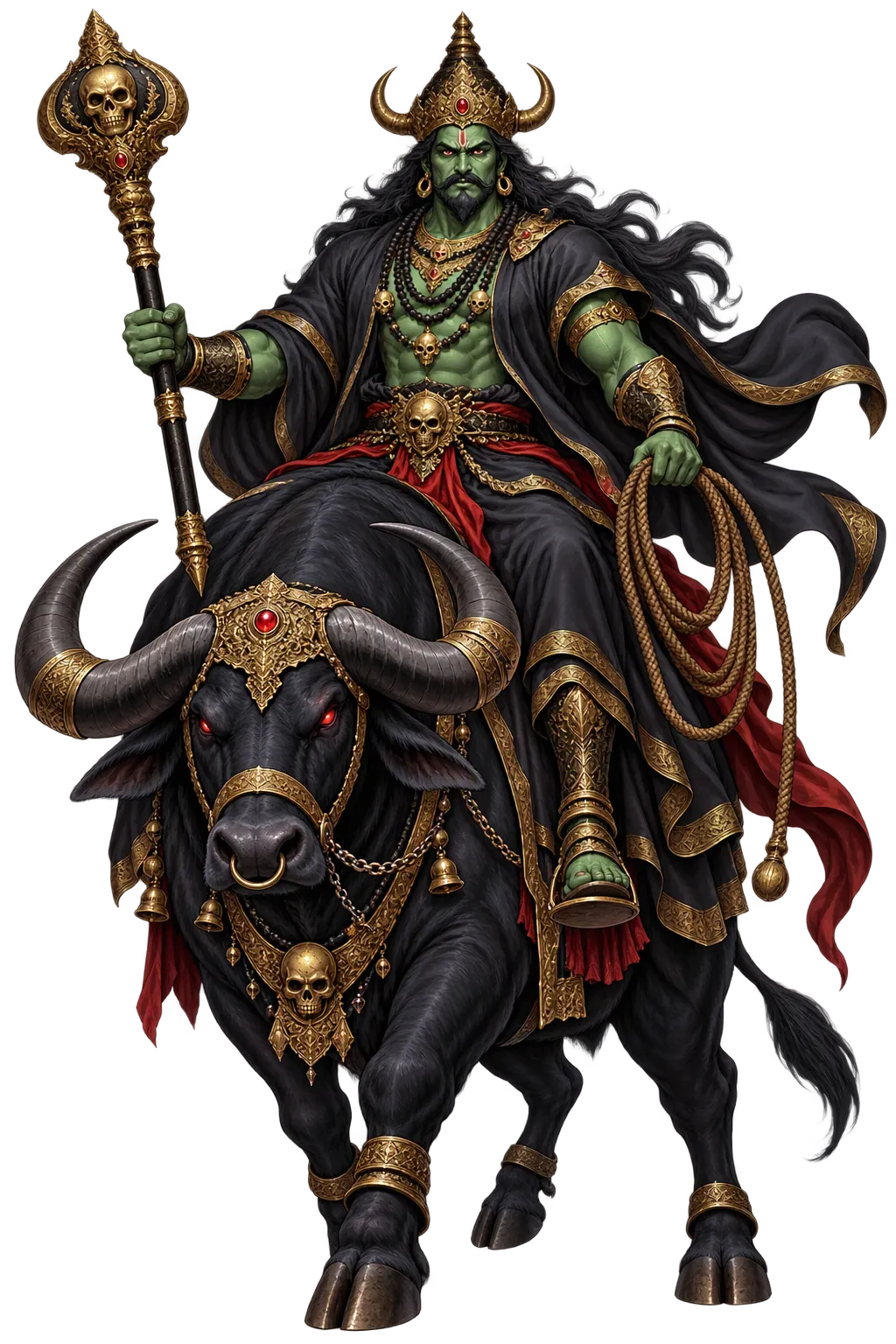
Stories of Yama
Yama’s mythology moves from Vedic pathfinder to epic judge to Purāṇic king of hells. He begins as the twin who chose to die — the first of the race to walk the path — and becomes the stern accountant whose city the dead enter by the southern gate. Buddhism and the epics gave him his tortures and his buffalo; the Veda kept his dignity.
The oldest Yama-text is a dialogue: Yama and his twin Yamī, the first two beings, and Yamī’s love for her brother. Yama refuses — ‘the immortals watch’ — and the hymn becomes the charter of exogamy and of the incest-taboo itself, argued between the world’s first twins in the world’s first debate.
The funeral hymn sends the dead king along the path Yama blazed, past the two dogs and the waters, to the feast of the fathers where Yama waits with Varuṇa. ‘Leave the sin here, keep the glory’ — the formula of every Vedic funeral, spoken to the first traveller’s successor.
In the epic’s underworld-book, Yama rules below with his city Saṃyamanī, his account read by Citragupta, his noose and his buffalo — the god of justice who once disguised himself as a crab to test a king. The epic makes him dreaded and fair: the judge who cannot be bribed because he already owns everything.
The Purāṇas enumerate eighty-four hells under Yama’s administration, each a precise torment for a precise sin — the liar’s tongue, the thief’s hands. Yet the same texts insist his justice is karma’s arithmetic, not malice: even the tortures are purification, and release comes in time.
The King of the Ancestral World
Yama is death’s king in the Indian traditions: the first man to die, who found the way to the fathers’ world and now rules it — and judges who may enter. With his noose and his two four-eyed dogs, he waits at the southern direction, the realm of the ancestors, and his account-book is the oldest audit in human literature.
He died before anyone — the twin who found the path to the fathers and became its king.
His pāśa, the noose, finds every soul at its hour; none outrun it, though all may beg.
Śyāma and Śabala, four-eyed, follow his road and report the dead; they guard the way.
In the Mahābhārata and Purāṇas he reads the record of every soul — the karma, weighed without scales.
From the original script to the living URL
यम
The name in its original Sanskrit form. Yama (यम) is attested in the source tradition — “The god who presides over the Pitṛs (the departed fathers) and rules the spirits of the dead.”. Its original diacritics and script distinctions carry the full phonetic and orthographic weight of the source tradition.
yama
The plain yama form is identical to the Unicode restoration. Because this name is already written in Latin letters, no diacritics, stress, or script information were lost — only capitalization differs.
Yama
The Unicode restoration does not need to recover lost marks for Yama. Its value is canonical spelling and consistent cataloguing, not the reconstruction of erased orthography. The domain is readable as-is to both DNS and humanity.
Yama.com
This restoration is written entirely in ASCII letters — no Punycode encoding stands between Yama and the DNS. The domain reads identically to machines and to human eyes.
The attested spelling family of Yama
Yama
Restores यम. The full Unicode restoration. yama.com is not in the PuniCodex collection — it is watched for release; if it drops, this temple upgrades to an owned flagship. Attested by MW, KEWA.
How Yama was spoken
How Yama travels from ancient script to the modern URL
The lore you have read is the living myth. Extended Lore opens the scholarly vault beneath it: the cult and its material remains, a history of the image, the name after antiquity, a meditation on what the name still means, and the full scholarly apparatus — etymology, orthography, sources.
Enter Extended Lore