
The Cult
The śrāddha offerings to the dead are his liturgy — every rice-ball given to the fathers feeds his city’s economy. The great annual rites for the dead across Asia (Obon in Japan, Pitṛpakṣa in India) are his festivals without his name.
Extended Lore
Etymology · Orthography · Cult · Iconography · Reception · Sources
Essential information about Yama, Death, Justice, Underworld
From original script to Unicode restoration
The name Yama reaches the modern world through scholarly transliteration of the sanskrit tradition. Because the conventional spelling uses only Latin letters, its Unicode and ASCII forms coincide — the tradition it carries is in the name itself, not in diacritics.
Character-by-character philological analysis
| Character | Unicode | Name | Block | Phonetic Role |
|---|---|---|---|---|
| Y | U+0059 | Latin Capital Letter Y | Basic Latin | Same |
| a | U+0061 | Latin Small Letter A | Basic Latin | Short /a/ |
| m | U+006D | Latin Small Letter M | Basic Latin | Same |
| a | U+0061 | Latin Small Letter A | Basic Latin | Short /a/ |
This restoration reflects fidelity to the attested tradition, not recovered diacritics: every character of Yama already survives in ASCII. What the restoration preserves is the canonical spelling itself — the form scholarship standardised.
How the sacred was kept — rites, sanctuaries, remains
The śrāddha offerings to the dead are his liturgy — every rice-ball given to the fathers feeds his city’s economy. The great annual rites for the dead across Asia (Obon in Japan, Pitṛpakṣa in India) are his festivals without his name.
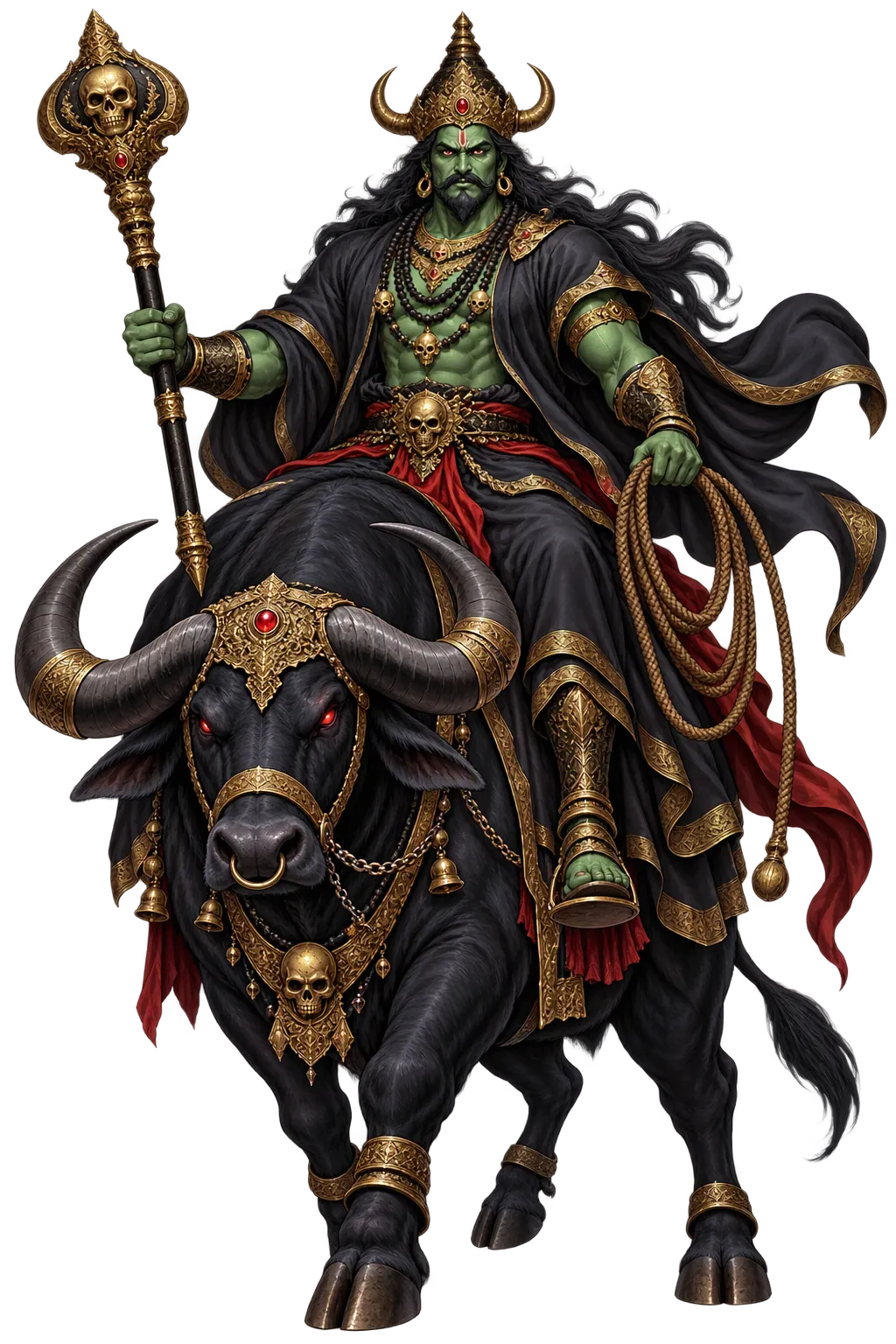
No Yama temples in the Vedic sphere — the ancestor-cult needed no image. But his buffalo and noose carved into the doorposts of death-temples across Nepal and Bali, and the Enma iconography of Japanese temples from Kamakura onward, mark the reach of his cult east.
How Yama was imaged across the ages
Green or black, riding the buffalo, noose in hand, mace or staff in the other; two four-eyed dogs at his feet; in Tibet and Japan, a mirror that shows the soul its deeds and a register that never errs. His third eye — the eye of the judge — opens in the esoteric forms.
The name after its own age — transmission, translation, survival
Comparative mythology pairs him with Osiris, Hades, and Mictlantecuhtli as the lord of the dead who began as a mortal; his twin-myth is cited in every study of the incest-taboo’s narrative origins. In modern media he is Asia’s Grim Reaper — feared, respected, and occasionally, in the karmic comedies, outwitted.
The Avestan Yima, king of the golden age who kept death from his realm, is Yama’s Iranian twin — the same name, opposite function: where Yima postponed death, Yama administers it. Buddhism made Yama a dharmapāla, converted in the end by the Buddha’s teaching, and carried him east as Enma in Japan, where he still judges with his mirror and staff.
Yama is the ancestor of every Asian judge-of-the-dead: Enma-ō in Japan, Yŏmna in Korea, Yanluo in China — a continuous iconography from the Veda to manga. The word ‘Yamī’ survives in the river Yamunā; and the maxim ‘even Yama’s writ runs by karma’ structures the moral imagination of half the world’s population.
What Yama means — beyond the dictionary
Yama: the twin’s name, the first word of mortality. Restored plainly, it reads as what it is — a name without ornament for the fact without ornament. Every other god in this lexicon borrows grandeur; Yama IS, which is why his name is the shortest sentence in Sanskrit.
Common questions about Yama, Death, Justice, Underworld, and Unicode restoration
In reconstructed pronunciation, Yama is /ˈjʌmə/ — approximately “YUM-uh”.
Yama means The god who presides over the Pitṛs (the departed fathers) and rules the spirits of the dead. in the sanskrit tradition.
Yama is associated with The First Mortal (He died before anyone — the twin who found the path to the fathers and became its king.), The Noose (His pāśa, the noose, finds every soul at its hour; none outrun it, though all may beg.), The Two Dogs (Śyāma and Śabala, four-eyed, follow his road and report the dead; they guard the way.), Judge of the Deeds (In the Mahābhārata and Purāṇas he reads the record of every soul — the karma, weighed without scales.).
Yama is written entirely in ASCII letters, so its restoration is about canonical fidelity rather than recovered diacritics: the temple fixes the name in its scholarly standard spelling, attested in the source tradition, instead of leaving it to drift.
“The Twin Dialogue” — the Rigveda 10.10 story that anchors the mythology of Yama, told in full on the lore page.
The philological foundations of this restoration
Every claim on this page is grounded in established scholarship. The orthographic restorations follow disciplinary convention. The etymological chain follows the best available reference works. This is not invention — it is resurrection through scholarship.
You have traced the name from its earliest attestation to its Unicode restoration. Now return to the myth. The story is where the name lives.
Back to Lore