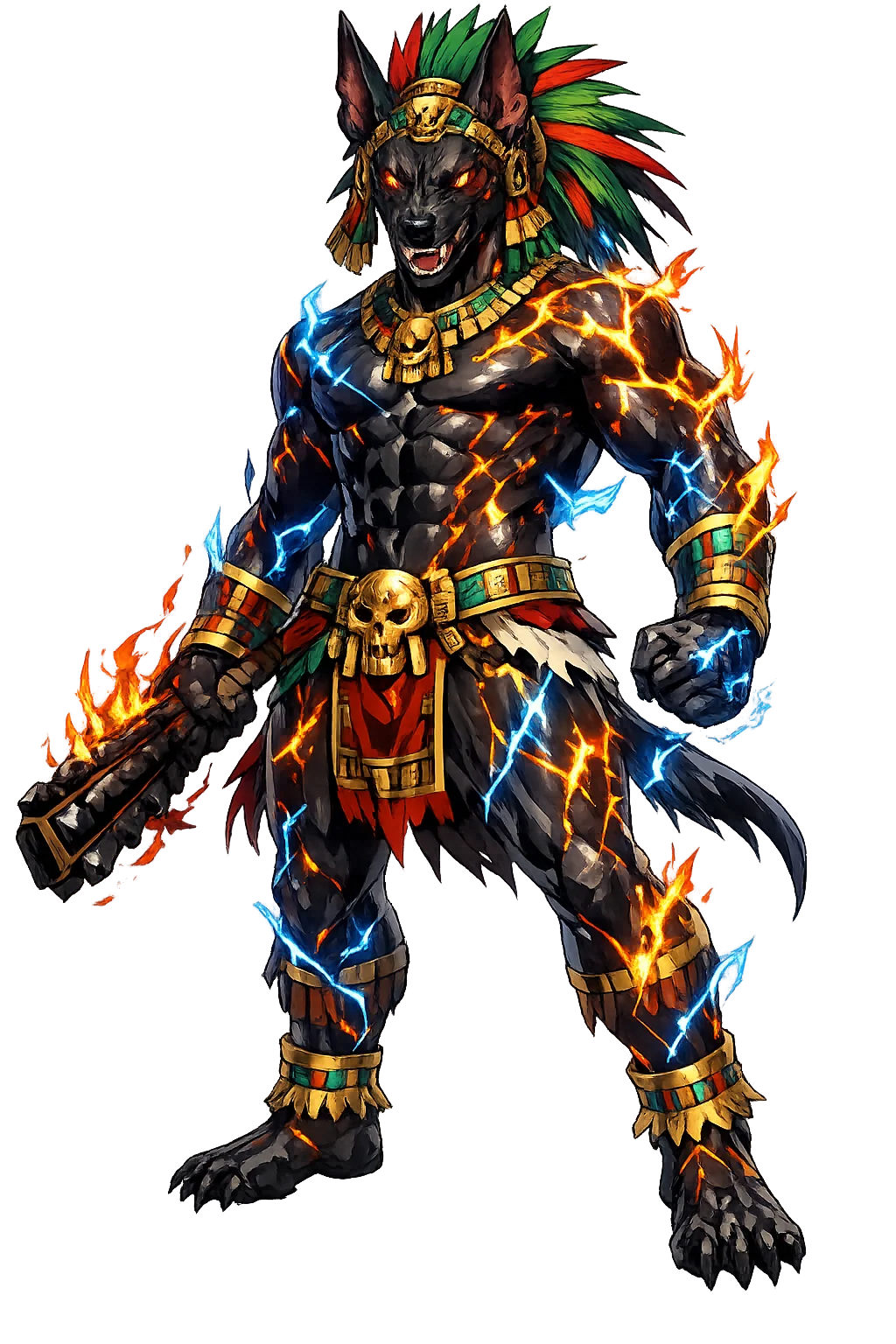
Stories of Xōlōtl
Xōlōtl's myths run on twoness: twin of the morning star, guide of the dying sun, the god who is always the second of a pair — and always the one who goes down into the dark.
The Aztec dead journeyed four years through Mictlān's nine levels, and at the deep river it was the dog — Xōlōtl's creature — who swam them across: a soul whose family had mistreated dogs in life found no ferryman, while one buried with his red dog had a guide already in the grave (Sahagún, Florentine Codex, trans. Anderson & Dibble — the funeral rites of the dead's journey). The funeral rite killed a dog 'the color of fire' and laid it with the dead to carry its master home. Among the world's psychopomps, he is the only one who comes as a pet — the escort you raised from a pup, not a paid professional of the crossing, and the myth's quiet claim is that loyalty outlasts the life that earned it.
At the creation of the fifth sun the gods gathered at Teotihuacan to sacrifice themselves and set the new sun moving (Leyenda de los Soles, Codex Chimalpopoca). Xōlōtl refused to die: he fled, weeping so hard his eyes fell from their sockets, and hid — as the twin-stalked maize, as the doubled maguey, and at last as the axolotl in the lake. They found him even there, and he died like the rest. The myth is the Aztec anatomy of the price of survival — and of the god who begged to live and serves death anyway: the one who ran is precisely the one the dead meet at the river, as if the underworld drafted its guide from the only god who had tried, with everything he had, to stay on this side of it.
Quetzalcōātl is Venus as morning star, herald of the light; Xōlōtl is Venus as evening star, which follows the sun into darkness (Sahagún, Florentine Codex, Book 7 — the star cycles and the binding of the years). The astronomy is exact — one planet, two appearances — and the myth makes it biography: one twin leads the dawn out of the night, the other escorts the day into it. Together they keep the star's whole circuit, and the world's whole hope: nothing in the Aztec sky set unaccompanied, and no light went down into the dark without the god of guides riding it.
When the fifth age needed people, Quetzalcōātl descended to Mictlān for the bones of the dead, and the later tellings send Xōlōtl with him as the one who knows the road — past Mictlāntēcutli's traps to the underworld council, where the lord of the dead set impossible conditions: sound my conch, which no breath will blow, and circle my realm four times without setting the burden down (Leyenda de los Soles; cf. the Histoyre du Mechique). The bones, ground in a bowl and sprinkled with the gods' own blood, became humankind — every Aztec child made of the dead, carried up past the watchful lord by knowledge of the road back. That the tellings choose the dog-brother for the escort is the myth's own logic: who better to know Mictlān's way than the god who ferries it daily?
Venus's Evening Star, the Dog-Guide, and the Last Transformation
Xōlōtl is the twin who goes down with the sun: brother of Quetzalcōātl, guide of the dead across the underworld's river, and the god who turned himself into maize, maguey, and finally the axolotl rather than be sacrificed. He is the Aztec soul's ferryman — and the lake that still bears his name.
His animal: the guide that leads the dead across the ninefold river of Mictlān.
Venus at dusk — his station, twin to his brother's morning star.
His final disguise: the water-monster of Xochimilco, gilled and smiling, that shares his name.
The codices show him weeping his eyes out at the gods' sacrifice — grief itself, dog-eared.
From the original script to the living URL
Xōlōtl
The name survives only in scholarly transliteration. Xōlōtl is the standard Nahuatl romanisation, documented in academic sources — “The double, the monster”. Its macron-length vowels preserve distinctions lost in plain ASCII.
No indigenous writing system is securely attested for individual nahuatl names. The form shown is a modern scholarly transliteration.
xolotl
Reduced to plain xolotl, the name loses everything that made it specific: macron-length vowels. What remains is an ASCII string that machines can parse but that no longer speaks with its original voice.
Xōlōtl
The Unicode restoration recovers what ASCII flattened. Xōlōtl restores macron-length vowels, returning the name to its original written dignity. The domain encodes to Punycode, but the browser displays the truth.
Xōlōtl.com → xn--xltl-l3ab.com
The non-ASCII characters in Xōlōtl are encoded while the ASCII remains visible. To the DNS, it is Punycode. To humanity, it is Xōlōtl.
Owned, ideal, and ASCII forms of Xōlōtl
Xōlōtl
The live temple domain — xōlōtl.com.
xolotl
The plain ASCII fallback — what DNS and legacy systems see.
How Xōlōtl was spoken
How Xōlōtl is preserved in writing
No indigenous writing system is securely attested for individual nahuatl names. The form shown is a modern scholarly transliteration.
Contribute scholarly provenance →The lore you have read is the living myth. Extended Lore opens the scholarly vault beneath it: the cult and its material remains, a history of the image, the name after antiquity, a meditation on what the name still means, and the full scholarly apparatus — etymology, orthography, sources.
Enter Extended Lore