PuniCodex

Extended Lore

Wyrd — The Deeper Record

Etymology · Orthography · Cult · Iconography · Reception · Sources

ASCII-equivalent form Wyrd
Wyrd — Fate, Destiny
01

At a Glance

Wyrd — every fact links to its home

PantheonNorse
DomainFate, Destiny
Original Scriptᚹᚣᚱᛞ →
Primary Sources4 cited →
02

Etymology & Word Family

From original script to canonical restoration — the full etymology page →

Original Script ᚹᚣᚱᛞ Wyrd — "Fate (cognate with Urðr)"
Canonical Restoration Wyrd Canonical scholarly spelling — ASCII-identical
Modern ASCII wyrd Plain-ASCII fallback

Fate (cognate with Urðr)

03

Character breakdown

Character-by-character philological analysis

CharacterUnicodeNameBlockPhonetic Role
WU+0057Latin Capital Letter WBasic LatinSame, capitalized
yU+0079Latin Small Letter YBasic LatinSame
rU+0072Latin Small Letter RBasic LatinSame
dU+0064Latin Small Letter DBasic LatinSame

This restoration reflects fidelity to the attested tradition, not recovered diacritics: every character of Wyrd already survives in ASCII. What the restoration preserves is the canonical spelling itself — the form scholarship standardised.

04

Cult & Worship

How the sacred was kept — rites, sanctuaries, remains

The Cult

No ancient cult of Wyrd is attested. In Anglo-Saxon sources the word denotes fate, event, or destiny and is only occasionally personified; it is not addressed with prayer, sacrifice, or priesthood. The Exeter Book and Beowulf preserve the word in poetic, proverbial contexts, while Latin glosses equate it with fatum, fortuna, or the Parcae. The personified Norse counterpart Urðr has a clearer cultic role at the well, but Old English Wyrd remains a linguistic and literary figure rather than a worshipped goddess.

In the Earth

Wyrd is a word of manuscripts, not monuments: no runic inscription carves it, no amulet invokes it, and no material image can be identified with a personified Wyrd. Its witnesses are codices. The Exeter Book (Exeter Cathedral Library MS 3501, written c. 975) preserves The Wanderer and Maxims II; the Nowell Codex (British Library, Cotton Vitellius A.xv, c. 1000, scorched in the Ashburnham House fire of 1731) alone preserves Beowulf; the Vercelli Book and the Corpus and CCCC manuscripts carry the homiletic prose where wyrd is debated. The Anglo-Saxon futhorc is itself materially attested — the ninth-century Thames scramasax bears the full inscribed row — and in that row the word would run ᚹᚣᚱᛞ (w-ȳ-r-d), though no surviving carving spells it. The manuscript hand's wynn (ƿ), borrowed from the runes into the book alphabet, is the last material trace of the runic world inside the word's own spelling.

05

Iconography

How Wyrd was imaged across the ages

The Image

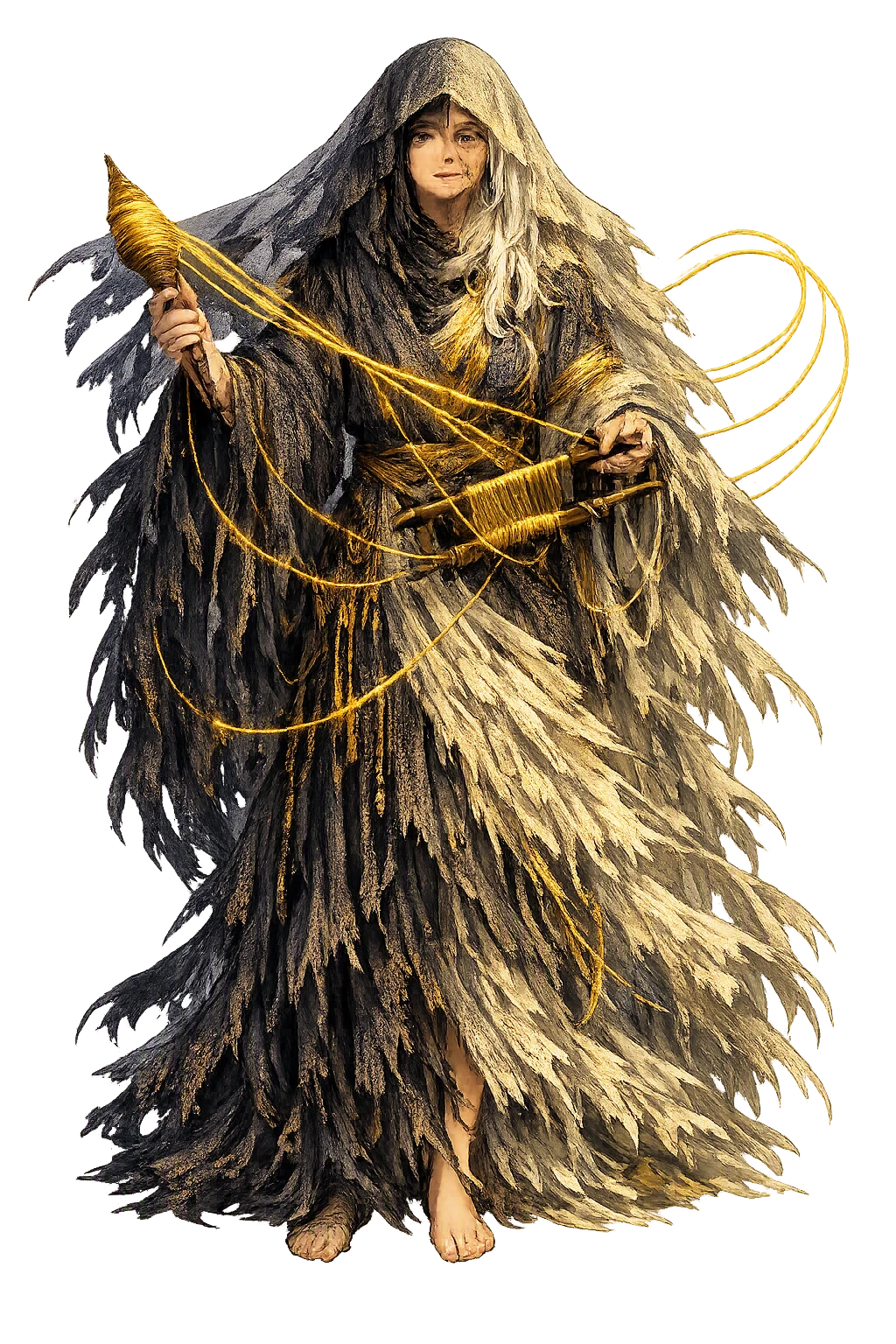
No ancient image of Wyrd survives, and none is likely to have existed in Anglo-Saxon England. The word appears in two of the most famous manuscripts of the period — the Exeter Book and the Nowell Codex — but only as text, not as illustration. Later medieval and Renaissance depictions of the Three Fates or Parcae, often shown spinning, measuring, and cutting the thread of life, have sometimes been retroactively associated with Wyrd. Modern pagan art borrows the loom, spindle, and shears as emblems, yet these are inherited from classical iconography rather than Anglo-Saxon visual culture.

06

Reception & Transformation

The name after its own age — transmission, translation, survival

Afterlives

Wyrd was transmitted through the great monuments of Old English poetry: Beowulf and the Exeter Book. The proverb "Wyrd bið ful ārǣd" became proverbial for fatalism, and the word passed into Middle and Early Modern English as "weird," first as a noun for fate and later as an adjective for the uncanny. Shakespeare's "weird sisters" in Macbeth fixed the modern sense of the word. J. R. R. Tolkien, whose philological imagination was steeped in Anglo-Saxon verse, echoed the term in his characters' speeches about doom and courage. Today Wyrd is reclaimed by Anglo-Saxon Heathenry and appears in fantasy fiction and neopagan devotional poetry, its sound still carrying both old fatalism and modern strangeness. The word thus preserves in English the old Germanic sense of an impersonal, shaping power that operates beyond human will.

Identifications Across Traditions

Wyrd's learned afterlife begins as translation. Bosworth–Toller record the word glossing Latin fatum, fortuna, and even the Parcae — the three spinning Fates — and Alfred's Boethius makes the equation systematic, putting the English word in Fortuna's place while denying her Fortune's independence. The comparison with the Greek Moirai is therefore as old as the word's manuscript life, but Timmer's classic study sounds the necessary caution: Old English wyrd is fundamentally the event-word, 'what happens', and its personification is grammatical and poetic, never cultic — no spindle, no altar, no priesthood is attested. The honest alignment is structural: with the Norns, who in Völuspá 'laid down laws and allotted life', and above all with Urðr herself, the exact cognate, the past tense of becoming enthroned beside Verðandi and Skuld. Within the corpus the related figures are the well's company: Urðr, Verðandi, Skuld, and the tree they tend, Yggdrasill.

Modern Legacy

The word's modern career is the strangest semantic journey in English. In medieval Scots and northern usage 'weird' stayed a noun of fate — to 'dree one's weird' is to endure one's destiny — and the prophetic women of Holinshed's chronicle were 'the weird sisters, that is (as ye would say) the goddesses of destinie'. Shakespeare took the phrase into Macbeth, the sisters' supernatural strangeness rubbed off on the word, and by the nineteenth century 'weird' meant simply uncanny, then merely odd: the noun of absolute fate worn down to an adjective of mild strangeness. Modern fantasy and gaming revived 'wyrd' as a deliberate archaism for deep fate; runic revivalism added the so-called 'wyrd rune', a blank stone invented in the 1980s with no medieval attestation — a modern ornament the inscriptions do not know. Through all of it the old word keeps its dignity in the Exeter Book and Beowulf, where it still means what it meant: what happens, wholly fixed, and faced with courage.

07

The Original Script Note

What the written record preserves — and what it does not

Original Script

The manuscripts write the word in Latin letters with wynn: ƿyrd; normalized Old English orthography prints it wyrd. In the Anglo-Saxon futhorc the word would have been carved ᚹᚣᚱᛞ (w-ȳ-r-d) — a normalized reconstruction, since no runic inscription of the word survives. Because the normalized form is pure ASCII, its domain was registered in the ordinary way long ago: wyrd.com lies outside the PuniCodex collection and is watched for release — no form of the name is currently owned, and this temple claims none.

08

The Meditation

What Wyrd means — beyond the dictionary

Wyrd is the rare fate-word that never pretends to be a person. The Greeks spun fate into three women with shears; the Icelanders gave her a name and a well; the English kept her a common noun — the shape of what happens, grammatically feminine by accident of declension, addressed by no prayer and moved by no sacrifice. And yet the Beowulf poet finds the loophole that keeps the word honest: fate often spares the undoomed man when his courage avails. Doom is real, but it is not everything; between the fixed decree and the falling sword there is a space the size of a man's ellen, his courage, and in that space the whole heroic ethic of the poem lives. The Wanderer ends where Alfred ends: the decree turns the world under heaven, and the one fastness is not in the turning but above it. A word for fate that leaves room for courage and for God — that is the Anglo-Saxon settlement, and no tradition stated it more economically.

09

Frequently Asked Questions

Deep-dives into the cult, attestation, reception, and sources of Wyrd

01How do we know how Wyrd was worshipped?

Wyrd is a word of manuscripts, not monuments: no runic inscription carves it, no amulet invokes it, and no material image can be identified with a personified Wyrd. The full cult record →

02Where do the earliest attestations of Wyrd come from?

The record rests on Beowulf, ll. 455 ('Gǣð ā wyrd swā hīo sceal') and 572–573 ('Wyrd oft nereð unfǣgne eorl, þonne his ellen dēah') — Klaeber's Beowulf, 4th ed., ed. Fulk, Bjork & Niles (Toronto, 2008), The Exeter Book (ASPR III): The Wanderer 5 ('Wyrd bið ful ārǣd') and 106–107 (wyrda gesceaft); Maxims II 5 ('Wyrd byð swīðost'); Solomon and Saturn (the proverb of fate hard to turn), Bosworth–Toller, An Anglo-Saxon Dictionary, s.v. wyrd — the senses 'event, fate, destiny', the personified uses, and the Latin glosses fatum, fortuna, Parcae, among 6 cited works. The full source apparatus →

03How did later traditions reinterpret Wyrd?

Wyrd was transmitted through the great monuments of Old English poetry: Beowulf and the Exeter Book. Reception & transformation →

04What do the surviving images of Wyrd actually show?

No ancient image of Wyrd survives, and none is likely to have existed in Anglo-Saxon England. The iconography →

05What does the written record of Wyrd actually preserve?

The manuscripts write the word in Latin letters with wynn: ƿyrd; normalized Old English orthography prints it wyrd. The Original Script note →

10

Scholarly Sources

The philological foundations of the record

Every claim on this page is grounded in established scholarship. The orthographic restorations follow disciplinary convention. The etymological chain follows the best available reference works. This is not invention — it is resurrection through scholarship.

◈

Lexicography & Philology

  • Bosworth-Toller
◎

Primary Texts

  • Beowulf
  • Beowulf, ll. 455 ('Gǣð ā wyrd swā hīo sceal') and 572–573 ('Wyrd oft nereð unfǣgne eorl, þonne his ellen dēah') — Klaeber's Beowulf, 4th ed., ed. Fulk, Bjork & Niles (Toronto, 2008)
  • King Alfred's Old English Version of Boethius, De consolatione philosophiae, ed. Sedgefield (1899); ed. Godden & Irvine (2009) — wyrd translating Fortuna, fate re-founded as God's instrument
  • Völuspá 19–20 (Poetic Edda) and Snorri Sturluson, Gylfaginning 15–16 — Urðr, Verðandi, and Skuld at the well beneath Yggdrasill, the Old Norse cognate personified
◉

Archaeology & Art History

  • Foote, P., & Wilson, D. M. The Viking Achievement; Graham-Campbell, J. Viking Art.
✦

Religious Studies

  • The Exeter Book (ASPR III): The Wanderer 5 ('Wyrd bið ful ārǣd') and 106–107 (wyrda gesceaft); Maxims II 5 ('Wyrd byð swīðost'); Solomon and Saturn (the proverb of fate hard to turn)
  • Bosworth–Toller, An Anglo-Saxon Dictionary, s.v. wyrd — the senses 'event, fate, destiny', the personified uses, and the Latin glosses fatum, fortuna, Parcae
  • B. J. Timmer, 'Wyrd in Anglo-Saxon Prose and Poetry', Neophilologus 26 (1941) — the classic semantic study of the word between event, destiny, and half-personified power
Return

The Surface Awaits

You have traced the name from its earliest attestation to its canonical restoration. Now return to the myth. The story is where the name lives.

Back to Lore
Wyrd mascot