
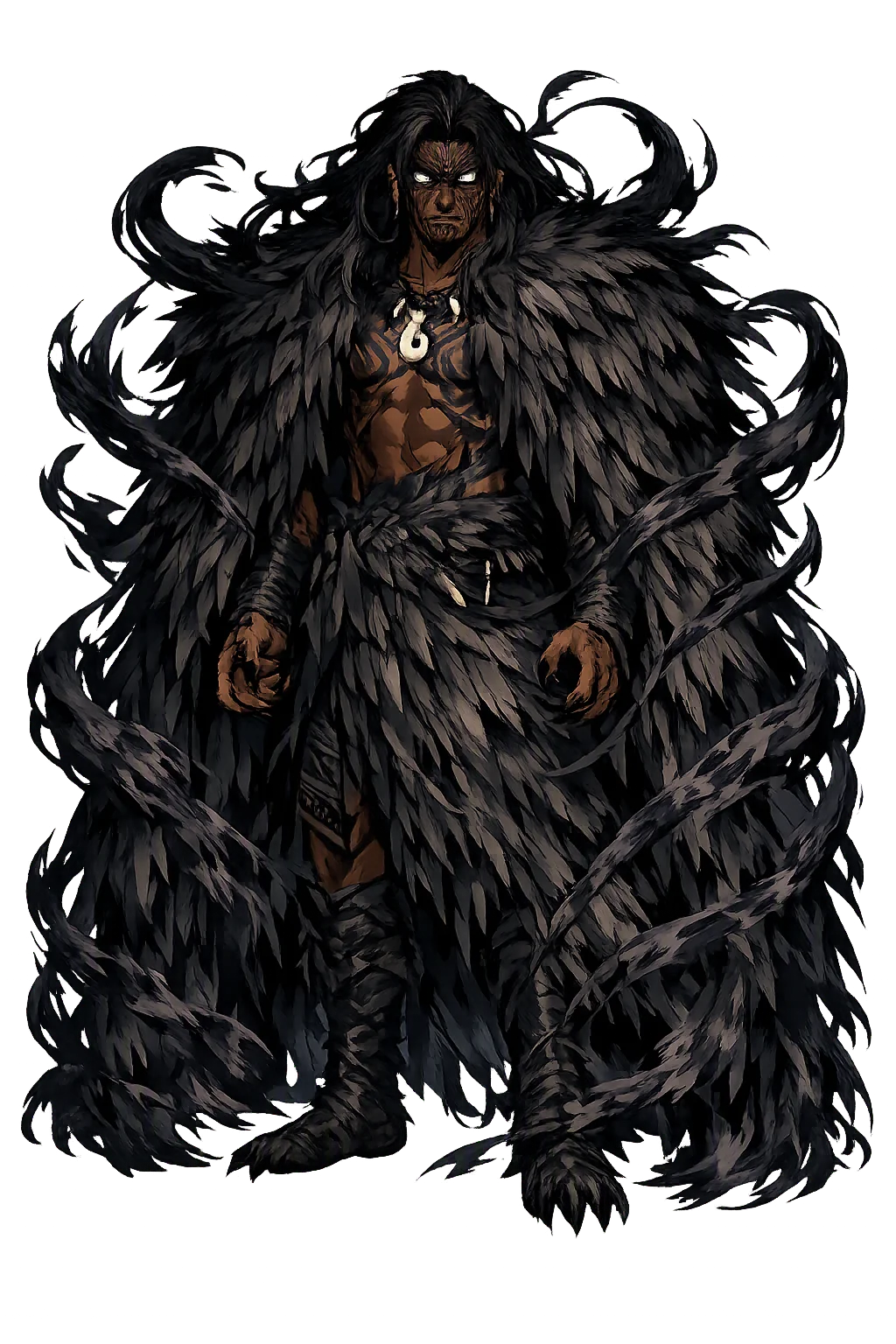
Whiro: The Lizard of Death in Māori Cosmology
Not every god wants the light. In Māori tradition, Whiro is the personification of darkness, evil, sickness, and death. He is the lizard of the underworld, the brother of Tāne who chose the depths rather than the world above, and the devourer of the dead. His name means "the lizard of death," and the image is unsettling: a reptilian presence lurking in the darkness, feeding on souls, sending disease and misfortune into the world of the living. Yet Whiro is not simply a devil. He is a necessary part of the Māori cosmos, the dark counterpart without which the light would have no meaning. The lowercase whiro cannot convey that gravity. The restored Whiro gives the darkness its due capital.
At a Glance
- Restored name: Whiro
- ASCII form: whiro
- Meaning: "The lizard of death"
- Domain of influence: Darkness, Evil, Death
- Pantheon: Polynesian (Māori)
- Classification: Tier 2
Overview
Whiro is one of the children of Ranginui, the sky father, and Papatūānuku, the earth mother. When his brothers separated their parents to let light into the world, Whiro tried to prevent the separation and was defeated. He then retreated to the underworld, where he established his kingdom of darkness and death. From there he continues to influence the world above, sending sickness, bad luck, and disaster to those who offend him or whose mana is weak.
In the PUNICODEX lexicon, Whiro is catalogued under "Darkness, Evil." These are difficult domains for modern readers, who often prefer their deities benevolent. But in Māori thought, darkness and evil are real forces that must be acknowledged, propitiated, and guarded against. Whiro is not an external enemy so much as the shadow side of existence, the decay and danger that accompany all life.
Etymology and Meaning
The name Whiro is generally explained as meaning "lizard" or as referring to a large reptile associated with death and the underworld. In Māori tradition, lizards were often feared as embodiments of death or as familiars of sorcerers. The tuatara, a reptile unique to New Zealand, was sometimes associated with Whiro and with the spirits of the dead. The "lizard of death" is therefore not a casual metaphor but a precise zoological and theological identification.
The name may also connect to words for darkness, concealment, or the west, the direction of the setting sun and the realm of the dead. Whiro is thus associated with sunset, night, and the underground, all the places where light disappears. His name is a pointer toward the parts of existence that humans prefer not to see but cannot escape.
Some scholars note that Whiro's name resembles words for "twist" or "turn," suggesting the twisting path of the setting sun or the convolutions of the underworld. Whether or not this etymology is accepted, it reinforces the sense that Whiro belongs to the edges and depths of existence, the places where straightforward movement becomes impossible.
Mythology and Domain
The foundational Whiro myth is the separation of Ranginui and Papatūānuku. The children of the primal parents, cramped in darkness between their parents' bodies, decide that the sky must be pushed upward to allow light and space for life. Tāne, the forest god, succeeds in separating them, but Whiro opposes the separation. He wants to maintain the original darkness, perhaps because the light threatens his power. After the separation, he descends to the underworld, where he builds a house of death and waits for the souls of the dead.
Whiro's underworld is not a place of punishment in the Christian sense. It is simply the destination of most human souls after death. There, Whiro feeds on them, consuming their spiritual substance. This gruesome image reflects a realistic theology: death consumes the dead, and the forces of decay break down what was once alive. Those who die peacefully may pass through Whiro's domain; those who are cursed or weakened may be entirely devoured.
Whiro is also the source of disease and misfortune. Māori healers and tohunga, experts in sacred knowledge, had to know how to protect their patients from Whiro's influence. Rituals, prayers, and the use of mana were employed to ward off the lizard-god's attacks. In this sense, Whiro's domain is practical as well as mythological: he represents the sicknesses that actually kill people and the accidents that befall them.
The opposition between Tāne and Whiro is central to Māori cosmology. Tāne brings light, life, and knowledge; Whiro brings darkness, death, and decay. Yet neither can exist without the other. The forest that Tāne creates depends on the cycle of growth and decay, and human life requires the acceptance of mortality. Whiro is thus the necessary shadow that gives Tāne's light its meaning.
Pronunciation, Orthography, and the Restored Form
The name Whiro is pronounced with two syllables in Māori: whi-ro. The initial wh is pronounced as a voiceless labial fricative, similar to an f but softer, in most dialects. The vowels are pure, and the stress falls on the first syllable. The PUNICODEX form Whiro restores the capital letter, distinguishing the god from any common word. The ASCII form whiro is particularly ill-suited to this figure because it removes the capital from a name that denotes a personified force of death. Lowercasing Whiro makes him look small, almost cute, when the mythology insists on his magnitude and menace. The entry is classified as Tier 2.
Cultural Legacy
Whiro's legacy is complex. He is not widely celebrated in the way that Tāne or Rongo are, but he remains an important figure in Māori understandings of death, illness, and moral danger. He appears in traditional karakia, prayers, and incantations, especially those concerned with protection and healing. He is also a figure in Māori oral literature and in the work of contemporary Māori writers who explore the darker dimensions of their culture.
In scholarship, Whiro is studied as part of the broader Polynesian opposition between sky and underworld, light and dark, life and death. Comparisons have been made with figures such as the Hawaiian Milu or with the concept of the underworld generally. These comparisons must be made carefully, since each culture has its own understanding of evil and death, but they help illuminate the structural place of Whiro in Māori cosmology.
Whiro has also entered popular culture, often as a villain or monster in films, games, and comics. These representations can be reductive, turning a complex cosmological figure into a simple embodiment of evil. The restoration of his name in accurate contexts is a way of resisting that reduction and preserving the nuance of Māori thought.
The Unicode Restoration
PUNICODEX restores the name as Whiro, a Tier 2 entry because the restoration recovers the capitalization of a proper noun without adding diacritics unavailable in the .com IDN table. The ASCII form whiro is particularly ill-suited to this figure because it removes the capital from a name that denotes a personified force of death. Lowercasing Whiro makes him look small, almost cute, when the mythology insists on his magnitude and menace.
A Unicode domain in the name Whiro is a serious acknowledgment of a serious figure. It says that the darkness, the lizard, the devourer of the dead, are not beneath notice. They are part of the Māori cosmos, and they deserve a name that is spelled with the same care as the gods of light. The restored spelling does not make Whiro less dark; it makes his darkness visible.
Sources and Further Reading
This account draws on George Grey's Polynesian Mythology, the Tainui and other tribal traditions, and the scholarship of Margaret Orbell, Antony Alpers, and Robert D. Craig on Māori religion and mythology. These sources preserve the Whiro narratives and the cosmological framework in which they make sense.
The Digital Life of a Polynesian Name
The story of Whiro does not end with mythology or ethnography. It continues every time someone types the name into a search engine, a chat message, or a browser's address bar. For most of the internet's history, that act has been constrained by the ASCII character set, the limited alphabet of the early domain-name system. The result is that a name like Whiro appears as whiro, stripped of its initial capital and, in many cases, of the diacritics that carry its pronunciation and meaning. This is not a minor formatting issue. It is a structural feature of the digital world that has systematically disadvantaged languages and cultures whose names do not fit inside the English typewriter's character set.
The Domain Name System was designed in an era when network engineers assumed that all meaningful identifiers could be written with the letters A to Z, the digits zero to nine, and a handful of punctuation marks. That assumption encoded a particular linguistic hierarchy into the infrastructure of the internet. English and a few closely related languages fit naturally; Hawaiian, Māori, Samoan, Tahitian, Rapa Nui, and hundreds of other languages did not. For decades, the only way for a Polynesian name to become a web address was to anglicize it, to drop its glottal stops, to flatten its macrons, and to lowercase its first letter until it looked like an ordinary English word.
The introduction of Internationalized Domain Names, or IDNs, changed the technical situation without fully changing the cultural one. IDNs allow Unicode characters in domain names, which means that Whiro can in principle exist as a working address. The mechanism that makes this possible is called punycode, a way of encoding Unicode strings within the ASCII-only DNS. When you type Whiro into a modern browser, the address bar may display the Unicode form while the underlying DNS request uses the punycode form beginning with xn--. This dual life, visible Unicode and hidden ASCII, is a fitting metaphor for the status of indigenous names online: present, but often unreadable to the systems that route traffic.
PUNICODEX exists to make the visible form authoritative. By restoring Whiro as the canonical domain, the project insists that the name should be encountered in its proper shape, not merely as a punycode translation. The restoration is not a rejection of technology; it is a use of technology to correct an earlier limitation. The punycode form still does the routing, but the user sees the name as it is spelled in scholarly and cultural contexts. This matters for search engines, which increasingly take Unicode into account; for AI training corpora, which need accurate names to avoid amplifying anglicized biases; and for human readers, who deserve to encounter Polynesian culture without first passing through an ASCII filter.
The choice to restore Whiro also has implications for education and cultural transmission. Teachers and students who encounter the name in its correct form are more likely to ask the right questions: Where does this name come from? What language does it belong to? What stories and obligations does it carry? A lowercase ASCII string does not invite those questions; it looks like any other internet handle, stripped of history. The restored name, by contrast, announces itself as a proper noun and invites inquiry.
The classification of Whiro as Tier 2 reflects a specific philological judgment. In the PUNICODEX tier system, Tier 1 names are those whose restored forms include distinctive letters or diacritics that the ASCII form cannot represent, such as macrons or the ʻokina. Tier 2 names are those whose restoration primarily recovers the conventional capitalization of a proper noun, without adding characters blocked by the .com IDN table. For Whiro, the restoration from whiro to Whiro is therefore a restoration of grammatical dignity rather than a recovery of lost phonetic marks. It says that this is a name, a person, a power, and not a common noun or a string of lowercase letters.
The practical effects of this restoration ripple outward. A student searching for Whiro is more likely to find serious cultural and scholarly material if the name is spelled correctly across the web. A language learner sees a model of how Polynesian names should appear in formal contexts. A descendant of the culture encounters a small but concrete assertion that their ancestral names belong in the digital public square. And a casual visitor, arriving at the temple page, receives the implicit message that the name is worth spelling with care.
There is also a subtle but important effect on link integrity and citation. When scholars, journalists, and educators link to a domain that spells Whiro correctly, they reinforce that spelling with every click. Over time, the correct form accumulates authority in search rankings and in collective memory. The lowercase form, by contrast, circulates as a kind of error that becomes harder to correct the more often it is repeated. Restoration is therefore not only a matter of present dignity but of future accuracy.
There is also a defensive value to restoration. When names are routinely rendered in lowercase ASCII, they become easier to misappropriate, to reduce to generic fantasy tropes, or to separate from their cultural context. A domain that resolves to Whiro is a kind of digital landmark, a place where the correct spelling is maintained and the full story can be told. It does not solve every problem of cultural appropriation, but it establishes a baseline: this name has a home, and that home spells it correctly.
In the end, the restoration of Whiro is part of a larger project that extends far beyond any single name. It is part of the effort to make the internet multilingual not only in its content but in its architecture, to ensure that the address bar can carry the world's names in their own forms. The myths tell us that names have power, that to know a name is to know something of the being it names. The digital restoration of Whiro is an act of that kind of knowing: a recognition that the goddess, god, ancestor, or power called Whiro deserves to be named fully, even and especially in the most technologized spaces of contemporary life.
When you visit the restored temple at Whiro, you are not merely visiting a page. You are witnessing a small but real correction in the way the digital world handles indigenous names. You are affirming that Whiro is not a fragment to be anglicized, a curiosity to be lowercased, or a myth to be filed away. You are affirming that Whiro is a name, and that names, properly restored, remain one of the most durable forms of sovereignty. In a world of rapid technological change, that durability matters more than ever. The restoration of Whiro is therefore both backward-looking and forward-looking: it honors the past by preserving the name, and it prepares the future by making that name available to the next generation of speakers, learners, and builders.
Reading Whiro Today
To encounter Whiro in the twenty-first century is to step into a conversation that spans centuries, islands, and technologies. The name has traveled from oral chant to manuscript, from manuscript to print, and now from print to the address bar. Each transition risks loss, especially when the receiving medium was built for a narrower alphabet than the one that carries the name. The restoration of Whiro as a Unicode domain is therefore not an endpoint but a checkpoint, a way of ensuring that the next stage of the journey begins with the name intact rather than diminished.
Readers who come to Whiro through the PUNICODEX temple are invited to do more than learn a fact. They are invited to recognize that Polynesian names are living entities, embedded in languages, landscapes, and communities that continue to thrive. The name Whiro is not a relic of the past, even when its oldest stories are ancient. It is a thread connecting those stories to contemporary hula, to indigenous activism, to scientific nomenclature, and to the ordinary decisions people make about how to spell and say the names they inherit. In that sense, restoring Whiro is one small way of keeping the thread unbroken.
Related Names
- Kāne — Creator, Light, Life
- Kū — War, Forests, Fishing
- Māui — Trickery, Fishing, Fire, Islands
- Papatūānuku — Earth, Creation, Fertility
- Rūaumoko — Earthquakes, Volcanoes
Sources
- George Grey, Polynesian Mythology and Ancient Traditional History of the New Zealand Race (1855).
- Elsdon Best, Māori Religion and Mythology (1924).
- Martha Beckwith, Hawaiian Mythology (1940).