
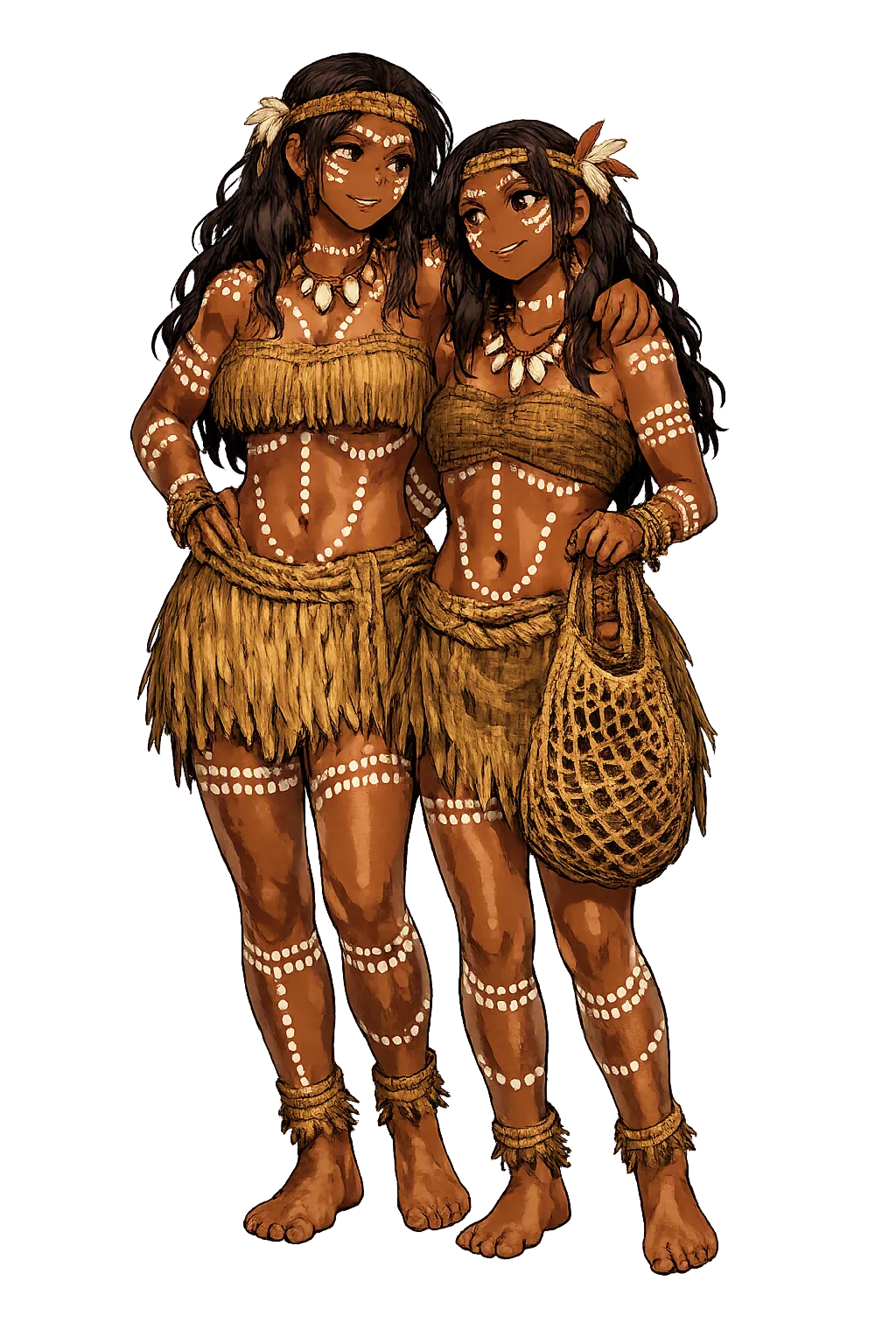
How Wawalag got its capital back
The ASCII form wawalag looks like a typo waiting to happen. Wawalag restores the simplest mark a name can lose: the capital letter that tells the reader, 'this is a proper noun, a person, a story, a place.' That single capital is not ornament; it is the difference between a common string and the name of two ancestral sisters whose journey created the law and landscape of Arnhem Land.
This post explains what the restoration preserves: the Aboriginal source traditions, the recorded variants of the name, the myth of the sisters and the Rainbow Serpent, and the classification logic that places Wawalag in Tier 2.
At a Glance
- Restored name: Wawalag
- ASCII form: wawalag
- Meaning: 'The two sisters'
- Domain of influence: Two Sisters, Creators
- Pantheon: Aboriginal (Arnhem Land / Yolŋu)
- Classification: Tier 2
- Key figure: The Rainbow Serpent Yurlunggur / Ngalyod
Overview
Wawalag (wawalag) — Two Sisters, Creators — belongs to the Aboriginal traditions of Arnhem Land. The name refers to two ancestral women who travel across country with their mother and a newborn child. At a waterhole, blood from childbirth enters the water, rousing the Rainbow Serpent Yurlunggur, who swallows them and later releases them. From this encounter come the divisions of clan, moiety, and marriage class, and the rituals that renew the monsoon.
The story is not a single fixed text. It is a song cycle performed in ceremony, recorded in rich detail by anthropologists Ronald and Catherine Berndt, W. Lloyd Warner, and A. P. Elkin, and documented by AIATSIS as a foundational narrative of Yolŋu religion. Each episode of the journey is tied to a real place: a camp site, a waterhole, a seasonal flood. To know the story is to know the country.
PuniCodex restores the name as Wawalag. The plain ASCII form wawalag is the only form the early domain-name system could carry; it strips away the initial capital that marks a proper name in English scholarly citation. Because the source traditions are oral and the romanization carries no distinctive diacritic or special letter, the restoration is Tier 2: the Unicode form is the complete reference, while the ASCII spelling is a practical DNS compromise.
The Name
The name is attested in Yolŋu Matha and related Arnhem Land languages as Wawalag, with variant romanizations Wauwalak and Wawilak appearing in older ethnographic literature. Etymologically it means 'the two sisters' — a plural/dual proper name rather than a transparent descriptive compound.
The ASCII form wawalag survives only because the domain-name system was limited to unaccented basic Latin letters. It is a technological compromise, not an ancient spelling. The Unicode restoration Wawalag gives the scholarly citation form with initial capitalization, the standard convention for a proper name in English-language anthropology and religious studies.
The Myth
The Wawalag sisters travel from the interior toward the coast, carrying their mother and a child. At each camp they name the country, gather food, and perform actions that will later be repeated in ritual. The younger sister gives birth, and the blood from childbirth enters a waterhole.
That blood is sacred power. It awakens Yurlunggur, the great Rainbow Serpent, who rises and swallows the sisters, the child, and their mother. Inside the serpent the sisters continue to sing, and their songs become part of the sacred repertoire that men later receive in initiation. Eventually Yurlunggur releases them, and from this act of swallowing and regurgitation come the divisions of clan and moiety, the pattern of marriage, and the rights to country.
The flood that accompanies the serpent's rising is the monsoon. The Wawalag narrative therefore encodes meteorological knowledge: the arrival of the rains, the filling of waterholes, the renewal of plant and animal life, and the calendar of ceremony.
Why Tier 2?
PuniCodex classifies a restoration as Tier 1 only when the Unicode form recovers a distinctive feature that the ASCII form loses: a stress mark, a length mark, a special letter, or a distinctive diacritic. Wawalag does not add any of those things. The ASCII string wawalag contains the same letters as the scholarly romanization. The restoration only restores the initial capital that identifies the string as a proper name.
That capital matters. It tells a search engine, a reader, and a future dataset that this is not a random sequence of letters but the name of two ancestral sisters. But because the phonemic and orthographic information is already present in the ASCII form, the name remains Tier 2.
Sources and Respect
The Wawalag cycle is one of the best-documented Aboriginal creation narratives, but its deepest meanings belong to initiated custodians. Public scholarship, including this restoration, follows the lead of community-controlled archives, AIATSIS guidelines, and the ethnographic record. The sources used here include Berndt and Berndt's The Speaking Land, Warner's A Black Civilization, Elkin's Aboriginal Men of High Degree, and Morphy's Ancestral Connections.
The goal of the restoration is not to expose restricted knowledge but to give the scholarly name its proper citation form in the public, searchable record.
The Meaning Behind the Name
The name Wawalag encodes more than a simple label. In the Aboriginal tradition that holds it, the name carries the history of the country, the authority of ancestral law, and the obligations of the living custodians. The plain ASCII form wawalag is a modern technological convenience: it allows the name to travel through the domain-name system and other digital infrastructure, but it cannot represent the full cultural weight that the name carries in ceremony and song.
PuniCodex restores the name as Wawalag because the capitalized scholarly form is the standard way to cite a proper noun from an oral tradition. This restoration is not a cosmetic change. It marks the name as belonging to a living culture and asserts that digital infrastructure should be able to honor such names rather than flatten them into lowercase ASCII strings.
Mythology and Worldview
The stories of Wawalag are not entertainment or simple explanations of natural phenomena. They are title deeds to country, instructions for ceremony, and maps of moral responsibility. In the accounts recorded by anthropologists and preserved by custodians, Wawalag appears as a figure whose actions shaped the land and established the patterns that human beings must follow.
These stories are held under traditional protocols. Some details are appropriate for public discussion, while others are restricted to initiated members of the community or to specific kin groups. The public scholarly record therefore gives only the outer layer of a much deeper body of knowledge. Even so, it is enough to show that Wawalag is not a static mythological curiosity but a living presence in Aboriginal law and identity.
Cultural Significance Today
In contemporary Australia, Wawalag continues to appear in Aboriginal art, dance, environmental management, and public ceremony. Indigenous artists depict the figure in bark paintings, rock-art renewals, and digital media, always in ways that respect the custodial protocols of the communities that hold the name. Welcome-to-country ceremonies, language-revival programs, and land-care initiatives all draw on the authority of ancestral figures such as Wawalag.
At the same time, the name reminds us that the digital world was built on assumptions that privilege ASCII text. Domain names, file systems, search engines, and social-media handles all tend to treat lowercase English letters as the default. Restoring Wawalag as a flagship temple is a small but concrete step toward challenging that default and making space for Indigenous names in the digital realm.
Why This Restoration Matters
PuniCodex classifies Wawalag as a Tier 2 restoration. This means that the ASCII form wawalag already represents the same phonemic and orthographic sequence as the restored form; no diacritic or special letter is required to recover the scholarly spelling. The restoration therefore focuses on the proper-noun convention: the capitalized form Wawalag is the respectful citation form, while wawalag remains a practical compromise for digital systems that cannot yet honor Indigenous typographic conventions.
Even without a registered Unicode domain, Wawalag deserves a flagship temple. The domain-name market may make the exact string unavailable, but the name itself remains a vital part of human heritage. By building a temple around it, PuniCodex preserves the scholarly form, explains its significance, and keeps watch for the day when the digital infrastructure of names can fully include the world's oral traditions.
A Note on Sources and Respect
The scholarly record on Wawalag draws on nineteenth- and twentieth-century ethnography, more recent anthropological fieldwork, and the guidance of Aboriginal custodians and institutions such as AIATSIS. Early colonial accounts must be read critically: they often imposed European religious categories on Aboriginal beliefs and ignored the protocols that govern the transmission of sacred knowledge. Contemporary presentations of Wawalag therefore prioritize Indigenous authorship and custodial authority.
Readers who wish to learn more should seek out resources produced by the Aboriginal nations that hold the name, as well as scholarly works that cite Indigenous collaborators. The PuniCodex temple is offered as a starting point for that journey, not as the final word on a living tradition.
Related Names
The Aboriginal traditions of Australia hold many figures whose stories overlap or contrast with Wawalag. Sky beings, ancestral creators, and totemic ancestors appear in different regional forms, and the same figure may be known by more than one name or spelling across language groups. Wawalag belongs to a network of names that includes Baiame, the Kamilaroi sky father; Bunjil, the Kulin eaglehawk creator; Ngalyod, the rainbow serpent of the north; and Yurlungur, the great copper python of Yolŋu country. Each name encodes a specific relationship to country, law, and custodial responsibility, and none is interchangeable with another.
For researchers and readers, the important distinction is between the capitalized scholarly citation form Wawalag and the lowercase ASCII form wawalag. The capitalized form marks the name as a proper noun and situates it within the scholarly and custodial discourse of Aboriginal studies. The lowercase form is a technological artifact, useful for domain names and search queries but carrying none of the cultural weight of the citation form.
Sources
The account of Wawalag given here rests on ethnographic and anthropological sources spanning more than a century, together with the guidance of Aboriginal custodians and institutions such as AIATSIS. Early colonial accounts must be read critically, because they often imposed European religious categories on Aboriginal beliefs and ignored the protocols that govern sacred knowledge. Contemporary presentations of Wawalag therefore prioritize Indigenous authorship and custodial authority.
Readers who wish to learn more should seek out resources produced by the Aboriginal nations that hold the name, as well as scholarly works that cite Indigenous collaborators. The PuniCodex temple is offered as a starting point for that journey, not as the final word on a living tradition. It preserves the scholarly form Wawalag, explains its significance, and keeps watch for the day when digital infrastructure can fully include the worlds oral traditions.
Wawalag also invites reflection on the broader project of digital decolonization. The internet was built on protocols that assumed ASCII text as the universal default, and that assumption continues to shape who can be represented online and on what terms. Restoring Wawalag as a flagship temple is one small step toward challenging that default and making space for Indigenous names, languages, and forms of knowledge in the digital realm. The name is not a relic; it is a living part of Aboriginal law and identity, and its presence in a scholarly catalog of Unicode restorations is a reminder that digital infrastructure can and should evolve to honor the full diversity of human naming.
Wawalag also invites reflection on the broader project of digital decolonization. The internet was built on protocols that assumed ASCII text as the universal default, and that assumption continues to shape who can be represented online and on what terms. Restoring Wawalag as a flagship temple is one small step toward challenging that default and making space for Indigenous names, languages, and forms of knowledge in the digital realm. The name is not a relic; it is a living part of Aboriginal law and identity, and its presence in a scholarly catalog of Unicode restorations is a reminder that digital infrastructure can and should evolve to honor the full diversity of human naming.
Wawalag also invites reflection on the broader project of digital decolonization. The internet was built on protocols that assumed ASCII text as the universal default, and that assumption continues to shape who can be represented online and on what terms. Restoring Wawalag as a flagship temple is one small step toward challenging that default and making space for Indigenous names, languages, and forms of knowledge in the digital realm. The name is not a relic; it is a living part of Aboriginal law and identity, and its presence in a scholarly catalog of Unicode restorations is a reminder that digital infrastructure can and should evolve to honor the full diversity of human naming.
Wawalag also invites reflection on the broader project of digital decolonization. The internet was built on protocols that assumed ASCII text as the universal default, and that assumption continues to shape who can be represented online and on what terms. Restoring Wawalag as a flagship temple is one small step toward challenging that default and making space for Indigenous names, languages, and forms of knowledge in the digital realm. The name is not a relic; it is a living part of Aboriginal law and identity, and its presence in a scholarly catalog of Unicode restorations is a reminder that digital infrastructure can and should evolve to honor the full diversity of human naming.
Wawalag also invites reflection on the broader project of digital decolonization. The internet was built on protocols that assumed ASCII text as the universal default, and that assumption continues to shape who can be represented online and on what terms. Restoring Wawalag as a flagship temple is one small step toward challenging that default and making space for Indigenous names, languages, and forms of knowledge in the digital realm. The name is not a relic; it is a living part of Aboriginal law and identity, and its presence in a scholarly catalog of Unicode restorations is a reminder that digital infrastructure can and should evolve to honor the full diversity of human naming.
Wawalag also invites reflection on the broader project of digital decolonization. The internet was built on protocols that assumed ASCII text as the universal default, and that assumption continues to shape who can be represented online and on what terms. Restoring Wawalag as a flagship temple is one small step toward challenging that default and making space for Indigenous names, languages, and forms of knowledge in the digital realm. The name is not a relic; it is a living part of Aboriginal law and identity, and its presence in a scholarly catalog of Unicode restorations is a reminder that digital infrastructure can and should evolve to honor the full diversity of human naming.