
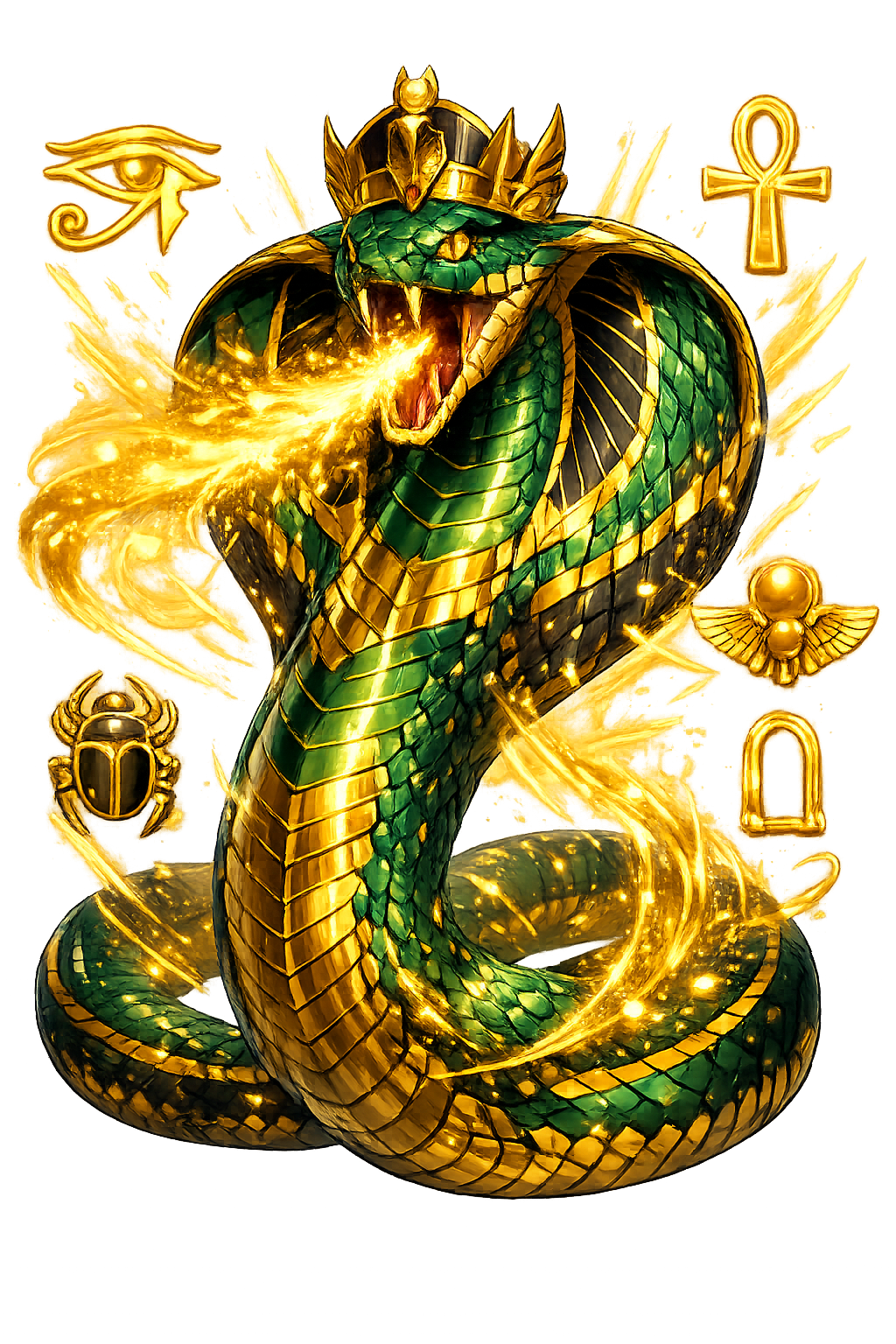
Wꜣḏyt — the one true spelling, and the forms that fail it
Court is in session. In the matter of Wꜣḏyt, the register hears the evidence — the attestation, the marks, and the forms that stand accused.
At a Glance
- Canonical form: Wꜣḏyt
- Original script: 𓇅𓏏𓆗
- Pantheon: Egyptian
- Convention: Egyptological transliteration — ꜣ, ꜥ, ḥ, ḏ, ṯ as the grammars record them
- False forms on record: 2
- Contested forms: none attested
- Series: The Canonical Register, No. 522 of 546
The Charge
That the name Wꜣḏyt is routinely written in forms that move, drop, or invent its marks — and that each such form teaches the reader a different, lesser name. The register's task is to separate the honest fallback from the outright false.
The Defense of the Canonical Form
The attested form is 𓇅𓏏𓆗, from the tradition's own record. The canonical transliteration is Wꜣḏyt.
No diacritics are required here: the canonical form is the exactness of the spelling itself, the form Egyptological transliteration — ꜣ, ꜥ, ḥ, ḏ, ṯ as the grammars record them demands.
The Character Witness
The plain form wadjet is not false — it is a fallback, and the register is exact about what that means. In systems that cannot carry diacritics (legacy databases, older tooling, parts of the address-bar pipeline) the flattened form is the accepted vehicle, and the rulebook names it explicitly as the final rung of the fallback hierarchy: full restoration first, circumflex where attested, macron-only by the academic standard, an attested variant, and only then plain ASCII.
What the fallback status forbids is promotion: wadjet may carry the name where marks are impossible, but it may not represent the name where marks are possible. A fallback is a vehicle, never the primary.
Cross-Examination
The witness Wadyt
Where it comes from: the publisher compromise — older books and hurried websites that print the "English equivalent" as if it were the name itself. Why it cannot stand: every substitution here (ꜣ→a, ḏ→d) is a romanization of convenience, not an attested spelling — it teaches the reader to guess, not to read.
The witness Wâḏyt
Where it comes from: the near-miss — a form that looks right at a glance and circulates on wikis and forums. Why it cannot stand: the aleph ꜣ is a consonant (a glottal/vocalic reed), not a long vowel â.
Mitigating Circumstances
No alternate form of this name carries documented scholarly support in the lexicon's record. The convention here — Egyptological transliteration — ꜣ, ꜥ, ḥ, ḏ, ṯ as the grammars record them — produces exactly one defensible transliteration: Wꜣḏyt. Forms that differ from it are not contested; they are simply wrong.
The Convention's Own History
When Champollion read the Rosetta Stone in the 1820s, he recovered a consonantal script — hieroglyphs record consonants and leave vowels to the reader. That single fact explains the whole transliteration apparatus: ꜣ and ꜥ are consonants (the glottal reed and the pharyngeal ayin), and ḥ, ḫ, ḏ, ṯ mark gutturals and emphatics that Egyptian distinguished and English merges. Egyptology settled these marks in the Manuel de Codage so every scholar writes the same name the same way. The register keeps them for the same reason: an Egyptian name without its consonants is not a simpler name — it is a shorter, wronger one.
Registration, Honestly
Three facts govern every domain this project registers. One: IDNA 2008 welcomes the marks — punycode encodes them legally and browsers show them faithfully. Two: welcome is not availability — registrars hold partial inventory, so the ideal form of a name may exist in the protocol yet not in the shop window today. Three: typeability is a separate virtue — a form no one can type on a phone is a form no one will visit, however canonical.
Hence the hierarchy the rulebook enforces: take the most complete form that is both attested and actually registrable, and never accept a wrong mark for the sake of availability. The wrong accent is not a rung on that ladder; it is off the ladder entirely.
The Verdict
So the register finds: Wꜣḏyt, canonical; wadjet, a sanctioned fallback; the contested forms, recorded with their support; the false forms, ruled against with their violations named. Every line of that finding cites its evidence, and the evidence is open to any reader — the register asks to be checked, not trusted. The temple keeps the canonical form at /wadjet/.
The docket for this ruling: 2 false forms ruled against, Wadyt first on the docket; no contested forms attested; the attestation rests on 7 cited sources — Allen, Middle Egyptian (2014), Faulkner, A Concise Dictionary of Middle Egyptian, s.v. wꜣḏ, Wörterbuch der ägyptischen Sprache I, s.v. wꜣḏ.
The Register Continues
Entry 522 of 546 in the Canonical Register. Around it: the temple's founding dispatch, the Restoration File on the marks themselves, the Resonance File on the archetype at work, and the Rulebook behind all of it.
Continue the register — previous entry: Vulcānus (read it) · next entry: Wamani (read it).
The Canonical Register is written from the same canonical record as the lexicon itself. If a false form is missing from this page, it is because the evidence does not support calling it false — or because we have not seen it yet. Show us, with a citation, and the register will answer.