
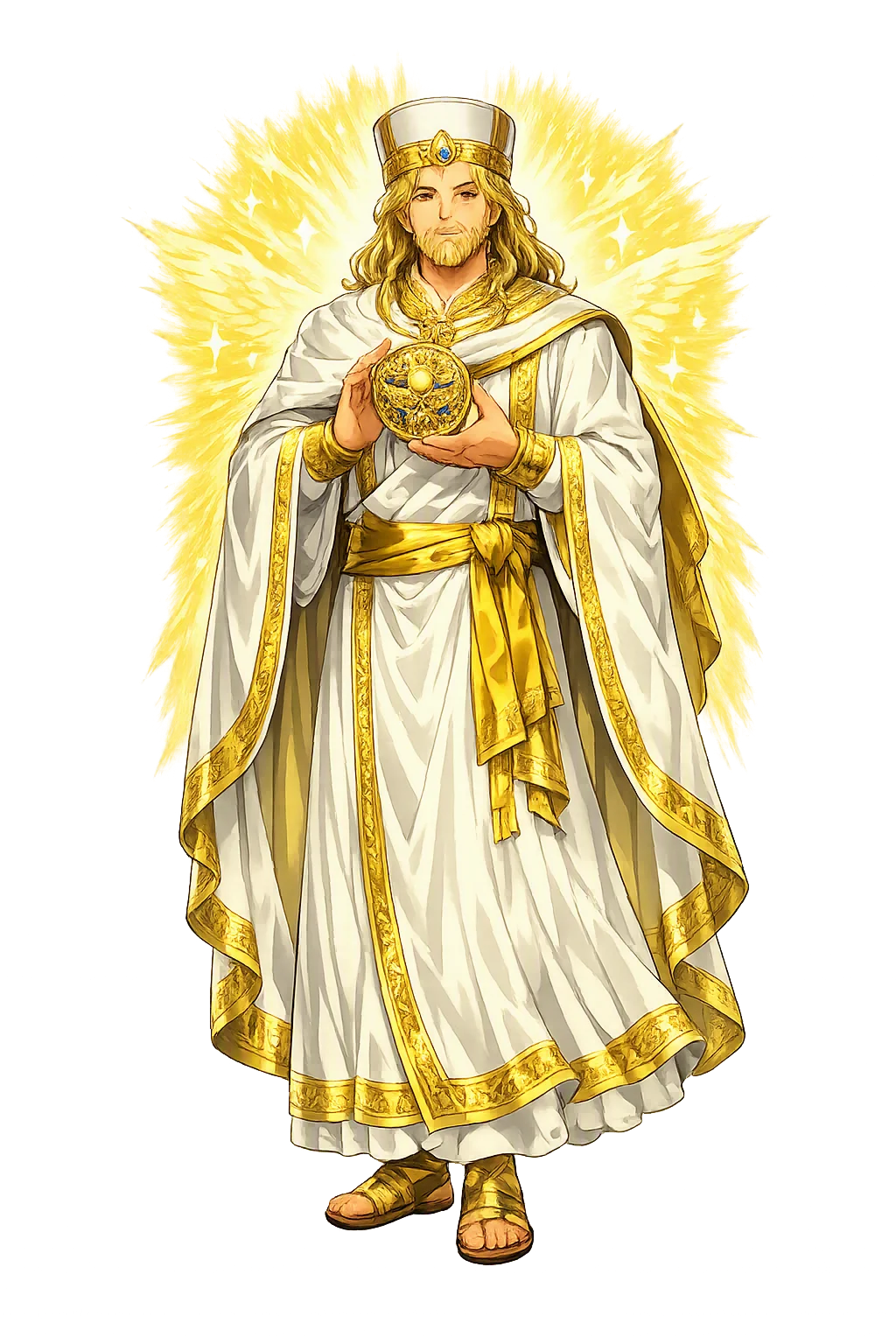
VohuManah: Good Thought, Sacred Cattle, and the Ethical Heart of Zoroastrian Worship
Among the names that Zoroastrian tradition holds most dear, VohuManah occupies a special place. It means "good thought" or "good mind," and it names one of the six great divine powers who surround Ahura Mazda, the wise lord of creation. But VohuManah is more than a member of a celestial council. He is the power by which human beings think rightly, choose truth, and participate in the moral order of the cosmos. In a world overflowing with information and opinion, the idea that good thought is itself a sacred force feels urgently relevant. The restored spelling VohuManah is not a decorative flourish. It is a way of ensuring that this ancient name, and the ethical ideal it represents, is recognized as a proper name rather than treated as a disposable lowercase token.
At a Glance
- Restored name: VohuManah
- ASCII form: vohumanah
- Meaning: "Good thought"
- Domain of influence: Good Mind, Cattle
- Pantheon: Zoroastrian
- Classification: Tier 2
- Original script: 𐬬𐬊𐬵𐬎 𐬨𐬀𐬥𐬀𐬵 (Avestan)
Overview
VohuManah is one of the Amesha Spentas, the "Bounteous Immortals" who embody the fundamental qualities of Ahura Mazda's creation. Each Amesha Spenta is associated with a particular aspect of existence: truth, good thought, holy devotion, dominion, wholeness, and immortality. VohuManah corresponds to good thought and is linked in tradition to the animal kingdom, especially cattle. This pairing of intellect and creaturely life may seem surprising at first, but it makes sense within Zoroastrian ethics. Good thought is not abstract speculation; it is the practical wisdom that enables human beings to care for the good creation, beginning with the animals under their protection.
The domain assigned to VohuManah in the lexicon is "Good Mind, Cattle," and that pairing captures the figure's double role. As good mind, VohuManah is the divine prototype of every right intention and true judgment. As patron of cattle, he is the protector of one of the most valued forms of life in ancient Iranian society. Cattle represented wealth, nourishment, and the settled agricultural order that Zoroastrian religion sought to defend against the depredations of nomadic raiders, predators, and the destructive spirit Ahriman. To worship VohuManah was therefore to commit oneself both to intellectual integrity and to the responsible stewardship of life.
Etymology and the Name
The Avestan name Vohu Manah is transparent. The first element, vohu-, means "good" or "excellent." It is the positive counterpart to a range of negative terms and is closely associated with benefit, beauty, and moral worth. The second element, manah-, means "mind," "thought," "intention," or "disposition." In English we might translate the compound as "good thought," "good mind," or "good intention," depending on the context. None of these translations is wrong, and each captures a different facet of the name.
The word manah is cognate with words for mind and thought in several Indo-European languages, including the English word "mind" itself. This deep linguistic kinship reminds us that the Zoroastrian ideal of good thought is not an exotic doctrine but part of a broader family of reflections on the nature of consciousness and moral agency. To have vohu manah is to have a mind oriented toward truth, benefit, and the good creation.
In Middle Persian, the name appears as Vohuman. Later Zoroastrian literature preserves the figure under this form, and it remains familiar in scholarly and devotional contexts. The PuniCodex restoration uses the Avestan-based form VohuManah with internal capitalization to mark the compound structure and to distinguish it from ordinary words. This is the form the project defends as philologically complete.
Mythology and Domain
The mythology of VohuManah is closely tied to the figure of Zarathustra, the prophet of Zoroastrianism. In one of the most important narratives, Ahura Mazda communicates his truth to Zarathustra through VohuManah. The prophet sees a radiant being who brings him into the divine presence and reveals the path of truth. This means that VohuManah is not only a quality to be cultivated; he is a mediator. He is the bridge between the human mind and the divine mind, the one who makes revelation possible because the human being has prepared a place for good thought.
In the Gathas, the oldest Zoroastrian hymns, Zarathustra calls upon his listeners to choose vohu manah. The choice is presented as the fundamental religious decision. Those who embrace good thought align themselves with Ahura Mazda and the forces of creation, truth, and life. Those who reject it align themselves with the destructive spirit and the forces of falsehood. The language is cosmic, but the application is intimate. Every thought, word, and deed is an opportunity to choose the side of good thought or to fall away from it.
VohuManah's association with cattle is developed in later texts. Cattle are one of the good creations of Ahura Mazda, and their welfare is a measure of the health of the world. In the ancient Iranian environment, cattle-raiding was a constant threat, and predators such as wolves were seen as agents of the destructive spirit. VohuManah, as the protector of cattle, is therefore a defender of civilization itself, the agricultural and pastoral order that makes human flourishing possible. This is why cruelty to animals is not merely a private failing in Zoroastrian ethics but a cosmic offense. It participates in the disorder that VohuManah opposes.
The domain of good mind also has implications for how truth is sought and spoken. In Zoroastrian tradition, asha is the truth that structures reality, and druj is the lie that distorts it. Good thought is the mental disposition that perceives asha and speaks accordingly. It is therefore the foundation of the famous triad of good thoughts, good words, and good deeds. The triad is not a list of unrelated virtues but a sequence. Right action begins with right thought; right speech expresses right thought; and right action completes it. VohuManah stands at the beginning of this sequence as the divine source of right thinking.
The Amesha Spenta and the Structure of Creation
To understand VohuManah fully, it helps to place him within the larger system of the Amesha Spentas. In Zoroastrian theology, these six divine powers are not separate gods in a polytheistic sense. They are aspects or emanations of Ahura Mazda's own being, each responsible for a domain of creation. Asha Vahishta presides over truth and fire. VohuManah presides over good thought and cattle. Khshathra Vairya presides over dominion and metals. Spenta Armaiti presides over devotion and the earth. Haurvatat presides over wholeness and water. Ameretat presides over immortality and plants. Together, they form a complete picture of the good creation and the qualities needed to sustain it.
VohuManah's place in this system is especially important because good thought is the precondition for all the other virtues. Without a mind oriented toward truth, one cannot recognize Asha. Without right intention, one cannot exercise dominion justly. Without good thought, devotion becomes empty and the care of creation becomes careless. In this sense, VohuManah is not just one Amesha Spenta among others. He is the one who makes the others accessible to human consciousness. The mythology of Zarathustra's revelation, in which VohuManah leads the prophet into the divine presence, reflects this foundational role.
The association of each Amesha Spenta with a created thing also has ethical implications. Cattle are not merely a symbol for VohuManah; they are the domain in which good thought must be practiced. A farmer who cares for his herd, a ruler who protects his people from famine, and a priest who studies the sacred texts are all, in their different ways, servants of VohuManah. The name thus links the highest mental activity with the most concrete material responsibilities.
VohuManah and the Ethics of Choice
The centrality of VohuManah in Zoroastrian ethics reflects a distinctive understanding of human freedom. Human beings are not pawns in a cosmic game already decided by the gods. They are active participants who must choose, again and again, between truth and falsehood, life and destruction, good thought and its opposite. This emphasis on choice gives Zoroastrian ethics a dynamic and personal character. Religion is not only about belief or ritual; it is about the constant orientation of the mind toward the good.
This orientation has practical consequences. A person who cultivates good thought will speak truthfully, act justly, care for the poor, protect animals, and honor the elements. A person who cultivates bad thought will lie, exploit, pollute, and destroy. The distinction is not always easy to maintain, and Zoroastrian tradition acknowledges the difficulty of the struggle. But it also insists that the struggle itself is meaningful. Every choice for good thought weakens the power of the lie and strengthens the good creation.
The figure of VohuManah thus provides a theological foundation for what we might call moral psychology. He represents the possibility that the human mind can be trained, habituated, and purified until it naturally inclines toward truth. This is not a naive optimism. It is a disciplined hope, grounded in the belief that the cosmos itself is on the side of truth and that human beings can align themselves with it through sustained effort and divine assistance.
Cultural Legacy
The ideal of good thought has left a deep mark on the moral and religious history of Iran and beyond. Zoroastrianism is often described as one of the earliest forms of ethical monotheism, and VohuManah is one of the reasons for that description. The religion does not merely teach that there is one supreme god. It teaches that human beings are morally responsible agents whose thoughts and choices matter for the outcome of the cosmos. This emphasis on individual moral responsibility influenced the development of later religious and philosophical traditions in the Near East.
The figure of VohuManah also raises enduring questions about the relationship between human beings and animals. In a tradition that associates one of its highest divine powers with the protection of cattle, animal welfare is not an afterthought. It is woven into the structure of the sacred. Modern readers may find in this tradition resources for thinking about ecological responsibility, the ethics of food production, and the dignity of non-human creatures. The ancient pairing of good mind and cattle turns out to be surprisingly contemporary.
In the Islamic period, the name VohuManah was less prominent in public discourse than the names of some other Zoroastrian figures, partly because Islamic theology understood the Amesha Spentas differently than Zoroastrian theology did. But the underlying ethical ideal survived. Persian literature, Sufi thought, and philosophical ethics all continued to place a high value on right intention, truthful speech, and just action. The vocabulary changed, but the aspiration remained.
Modern Zoroastrian communities continue to honor VohuManah. The name appears in prayers and rituals, and the associated day in the Zoroastrian calendar is considered auspicious. Scholars of religion study VohuManah as a key to understanding the origins of Zoroastrian ethics and the development of the Amesha Spenta theology. And in interfaith conversations, VohuManah often serves as an accessible entry point for discussing Zoroastrianism's emphasis on thought, choice, and responsibility.
VohuManah and the Contemporary Mind
The ancient ideal of good thought has unexpected resonance in the contemporary world. We live in an age of information overload, in which the mind is constantly bombarded by messages designed to capture attention rather than to serve truth. In such an environment, the cultivation of good thought becomes a form of resistance. To think well is to slow down, to question, to verify, and to choose one's mental habits deliberately. The figure of VohuManah offers a theological framing for this discipline. Good thought is not just a personal preference or a cognitive skill; it is a cosmic responsibility.
Modern psychology and ethics have also explored the themes that VohuManah embodies. Research on cognitive bias, moral reasoning, and the formation of habits all points to the importance of the mind's initial orientation. If the mind is habitually trained toward suspicion, resentment, or distraction, it will produce corresponding words and deeds. If it is trained toward truth, care, and attention, the results are different. VohuManah represents the conviction that this training matters not only for individual well-being but for the health of the world.
The connection to cattle also has contemporary relevance in discussions of animal ethics and environmental sustainability. Industrial agriculture, habitat destruction, and climate change have made the relationship between human beings and animals one of the urgent moral questions of our time. A tradition that places the protection of cattle under the patronage of good thought challenges us to reconsider how we treat the creatures we depend upon. VohuManah does not offer a simple policy prescription, but he does offer a moral orientation: the good mind is the one that cares for life.
In educational and interfaith settings, VohuManah can serve as a bridge between ancient theology and contemporary ethics. Children learning about Zoroastrianism can grasp the idea that good thoughts lead to good words and good deeds before they encounter more complex doctrines. Adults engaged in moral philosophy can find in VohuManah an early articulation of the idea that cognition and virtue are inseparable. The name thus works on multiple levels at once, accessible to beginners and rich enough for advanced study.
The Unicode Restoration
The PuniCodex entry for VohuManah is classified as Tier 2. The restored form VohuManah differs from the ASCII form vohumanah in capitalization, including the internal capitalization that marks the compound. This is a small typographical detail, but it signals that the name is a proper noun with a recognizable structure. The plain ASCII form vohumanah reduces the name to a continuous lowercase string, erasing the visual boundary between vohu and manah and making the name look like a random identifier rather than a meaningful theological term.
Unicode IDNs make the restored form addressable. When the PuniCodex temple at its temple is reached through its restored URL, the name appears with the dignity of a proper noun. This matters for the same reason that capitalization matters in ordinary writing: it tells the reader that what they are looking at is a name, with a history and a claim on our attention. In the context of the web, where billions of strings compete for attention, that small signal can make the difference between being noticed and being ignored.
The restoration also embodies the value that VohuManah himself represents. Good thought, in the Zoroastrian view, is attentive to truth and careful in expression. The Unicode restoration is an exercise in good thought applied to the digital representation of a cultural name. It refuses the easy compromise of the stripped-down ASCII form and insists on the more accurate, more respectful spelling. In this way, the technical choice to restore VohuManah becomes a small ethical act consistent with the name's meaning.
Conclusion
VohuManah teaches that the moral life begins in the mind. Before there can be good words or good deeds, there must be good thought. This ancient Zoroastrian insight has lost none of its force in a world shaped by algorithms, notifications, and the constant flow of information. The restored form VohuManah is a reminder that the names we use shape the thoughts we think. When the internet treats a sacred name as just another lowercase string, it quietly encourages a kind of carelessness. When it preserves the name in its proper form, it invites a kind of attention. The PuniCodex temple for VohuManah is an invitation to pay that attention: to think well, to name rightly, and to honor the good creation that good thought is meant to protect.
Related Names
- AhuraMazdā — Supreme Creator, Wisdom, Light
- Amərətāt — Immortality, Plants
- Anāhitā — Fertility, Water, Wisdom
- Aša — Truth, Righteousness, Cosmic Order
- Ašavahišta — Truth, Righteousness, Fire
Sources
- Mary Boyce, Zoroastrians: Their Religious Beliefs and Practices (1979).
- J. Darmesteter (trans.), The Zend-Avesta, Sacred Books of the East vols. 4 & 23 (1880–1883).
- Prods Oktor Skjærvø, The Zoroastrian Oral Tradition as Reflected in the Texts (2003).