The Living Myth
Preservation, Protection, Universe · The Preserver of All Things
Stories of Viṣṇu
Viṣṇu's mythology grows from a minor Vedic solar figure into the preserver of the cosmos. Its center is movement: the three strides that measure the worlds, the ten descents that enter history, and the long sleep between universes in which everything begins again. No Hindu god has a richer narrative literature — the two great epics are, at bottom, his autobiography.
In the Ṛgveda's hymn to the strides (1.154), Viṣṇu plants three steps and measures the universe: the first covers earth, the second the midspace, and the third — 'where the pious dwell, where the Sun marches in step' — reaches past the reach of birds, past the very gods. 'Wide of stride did Viṣṇu stride out; three times he set down his footstep' (RV 1.154.2–3). In the Vedic dawn this is the sun's arc across the sky, the god who is small enough to stand on earth and vast enough to plant his foot beyond heaven. The image was too potent to stay small: the Brahmanas and Purāṇas spent a thousand years unfolding it into the dwarf Vāmana who asked Bali for three paces of ground. The myth means that measurement is mastery — to pace out a world is to own it, and the universe turns out to be exactly three footsteps wide.
The Śatapatha Brāhmaṇa (1.2.5) tells it with ritual brevity; the Purāṇas make it an epic. The demon king Bali — grandson of Prahlāda, ruler of the three worlds through flawless righteousness — had conquered the gods not by sin but by his charity. Viṣṇu came to his sacrifice as a dwarf brahmin boy and asked for as much ground as he could cover in three strides. Bali's guru Śukra cried warning, but the king had already poured the water of the gift and would not break his word. Vāmana grew — the Purāṇas delight in the colossal Trivikrama filling the sky — covered earth and heaven in two steps, and asked where the third might land. Bali offered his own head, and Viṣṇu set his foot there, pressing the generous asura down into the underworld he is allowed to rule — while Prahlāda's pleas win him the boon of returning each year. The myth means that virtue untempered by discernment is a door for fraud: the one king generous enough to give away everything is exactly the one who must lose it.
The tyrant Hiraṇyakaśipu had extorted from Brahmā a boon engineered against every conceivable death: not by man or beast, neither inside nor outside, neither day nor night, neither on earth nor in the sky, by no weapon made or unmade (Bhāgavata Purāṇa 7.2–3). Armed with this loophole, he demanded worship as God. His own son Prahlāda refused, insisting Viṣṇu was everywhere — even, the boy said, in the pillar of the hall. 'Then let him come from that pillar,' Hiraṇyakaśipu sneered, striking it with his mace. The pillar burst, and out came the man-lion: neither man nor beast, at twilight, in the doorway, on the demon's own lap — and with claws, no weapon — Narasiṃha disemboweled the tyrant while the boy looked on. The gods poured flowers. The myth means that boons breed their own nemesis: a contract written against every weapon is defeated by the one form the contract's language could not exclude — and devotion, not loopholes, is what saves.
When the gods, diminished by a curse, needed the nectar of immortality (amṛta) that had been lost in the deluge, Viṣṇu proposed the great churn: Mount Mandara as the rod, the serpent-king Vāsuki as the rope, the gods pulling the tail and the demons the head, the mountain pivoted on Viṣṇu's own back as the tortoise Kūrma (Mahābhārata 1.15–17; Viṣṇu Purāṇa 1.9). From the seething ocean rose, one by one, the treasures of the cosmos — the wish-cow, the jewel Kaustubha, the apsarases, the moon, the physician Dhanvantari bearing the amṛta, and first of all a poison, halāhala, so terrible that Śiva drank it to save creation, staining his throat blue. Then Viṣṇu, as the enchantress Mohinī, served the nectar to the gods alone, beheading the demon Rāhu who had slipped into the line. The myth means that cooperation between rivals extracts what neither side can reach alone — and that the referee of the cosmos always ends up holding the cup.
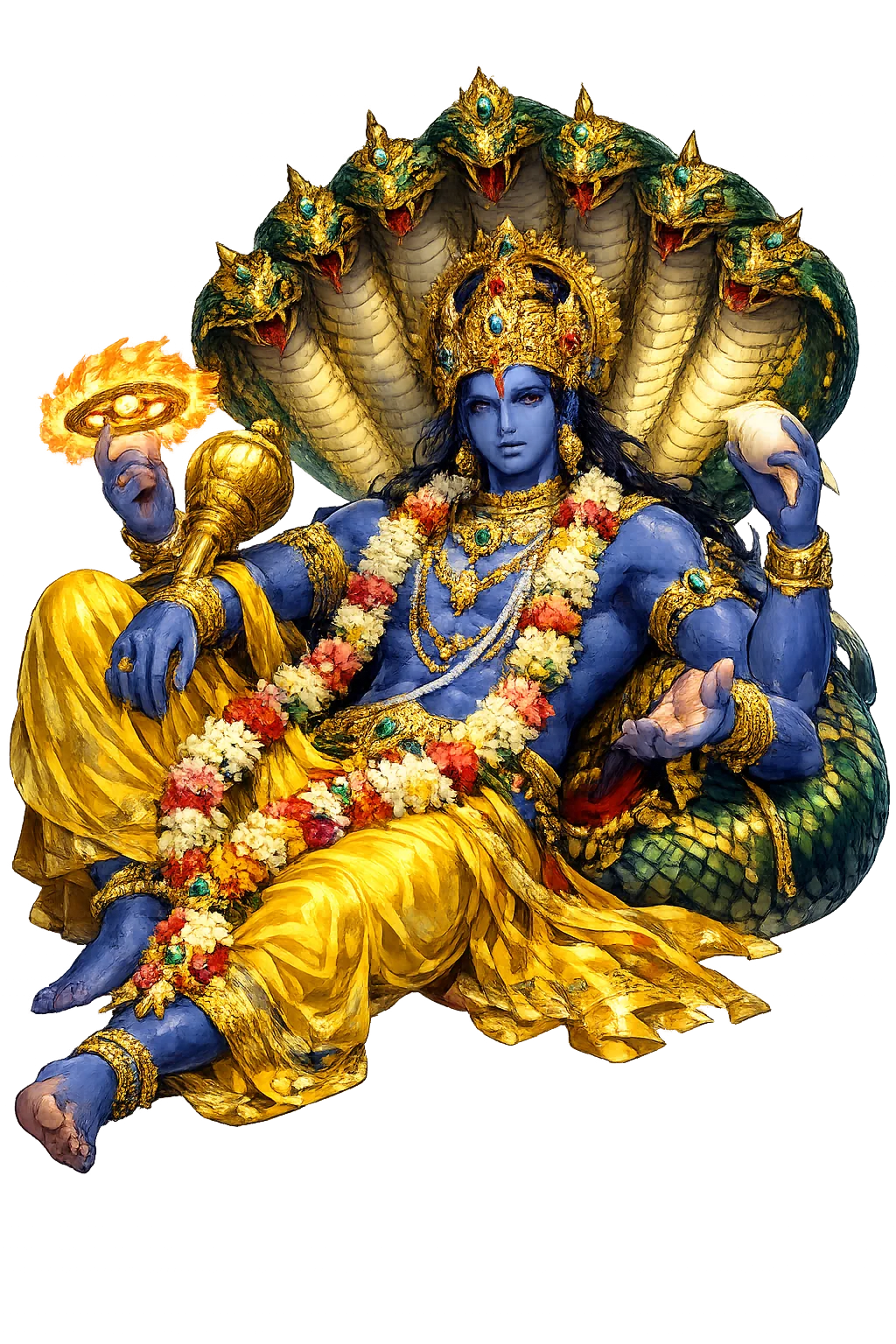
Between one universe and the next, Viṣṇu withdraws all things into himself and sleeps upon the thousand-hooded serpent Śeṣa, floating on the causal ocean (Viṣṇu Purāṇa 1.2; Bhāgavata Purāṇa 3.8). From his navel sprouts a lotus; on the lotus sits Brahmā, born bewildered, unable to find the lotus's root — until a voice from within instructs him to perform austerity, and only then does he become fit to create. From Brahmā proceed the worlds, the gods, and time itself, while beneath everything the sleeper breathes. The image condenses the whole Vaishnava cosmology into one picture: creation as dreaming, the creator as a flower on a stem, and the preserver as the vast body on whom both rest. The myth means that preservation outranks creation — Brahmā has a beginning, a bewilderment, and a teacher, but the one on the serpent simply is: the cosmos is what happens while Viṣṇu breathes out.
Preservation, Descent, and the Three Strides
Viṣṇu is the second great power of the Hindu triad, the one who sustains what Brahmā creates and what Śiva will one day dissolve. But preservation is not passivity. It requires constant intervention, which is why Viṣṇu descends again and again as an avatāra — a deliberate crossing-down into history, whenever dharma declines and adharma rises.
He maintains cosmic order (dharma) across the ages — the Gītā's promise that whenever virtue decays, he will come (Bhagavad Gītā 4.7).
As Trivikrama he measures earth, sky, and heaven in three steps; as Vāmana the dwarf he wins them back from Bali (Ṛgveda 1.154).
Fish, tortoise, boar, man-lion, dwarf, and the rest: ten descents, each engineered against a specific form of evil (Purāṇas).
Between cycles he sleeps on Śeṣa, the thousand-hooded serpent, a lotus from his navel bearing Brahmā, the next creator (Viṣṇu Purāṇa 1).
From the original script to the living URL
विष्णु
The name in its original Sanskrit form. Viṣṇu (विष्णु) is attested in the source tradition — “The Preserver — the principal Hindu deity who descends as avatāras to sustain cosmic order (from √viṣ, 'to pervade')”. Its emphatic consonants, nasal retroflexes, and palatal/retroflex sibilants carry the full phonetic and orthographic weight of the source tradition.
vishnu
Reduced to plain vishnu, the name loses everything that made it specific: emphatic consonants, nasal retroflexes, and palatal/retroflex sibilants. What remains is an ASCII string that machines can parse but that no longer speaks with its original voice.
Viṣṇu
The Unicode restoration recovers what ASCII flattened. Viṣṇu restores emphatic consonants, nasal retroflexes, and palatal/retroflex sibilants, returning the name to its original written dignity. The domain encodes to Punycode, but the browser displays the truth.
Viṣṇu.com → xn--viu-j5ytg.com
The non-ASCII characters in Viṣṇu are encoded while the ASCII remains visible. To the DNS, it is Punycode. To humanity, it is Viṣṇu.
Owned, ideal, and ASCII forms of Viṣṇu
Viṣṇu
Restores विष्णु. The live temple domain — viṣṇu.com.
vishnu
Flattens विष्णु. The plain ASCII fallback — what DNS and legacy systems see.
How Viṣṇu was spoken
How Viṣṇu travels from ancient script to the modern URL
Sanskrit Viṣṇu; from the root viṣ- “to pervade"; the all-pervading preserver deity.
Preservation, Protection, Universe
The IAST form Viṣṇu uses registrable Latin diacritics; the Devanagari form is not supported in .com.
The lore you have read is the living myth. Extended Lore opens the scholarly vault beneath it: the cult and its material remains, a history of the image, the name after antiquity, a meditation on what the name still means, and the full scholarly apparatus — etymology, orthography, sources.
Enter Extended Lore