PuniCodex

Extended Lore

विष्णु Viṣṇu

Etymology · Orthography · Cult · Iconography · Reception · Sources

Tier 1 Viṣṇu.com
Viṣṇu — Preservation, Protection, Universe
01

Quick Facts

Essential information about Viṣṇu, Preservation, Protection, Universe

Original Scriptविष्णु
Unicode RestorationViṣṇu
Reconstructed Pronunciation/ʋɪʂ.ɳʊ/
PantheonSanskrit
DomainPreservation, Protection, Universe
MeaningThe Preserver — the principal Hindu deity who descends as avatāras to sustain cosmic order (from √viṣ, 'to pervade')
ClassificationTier 1
Primary DomainViṣṇu.com
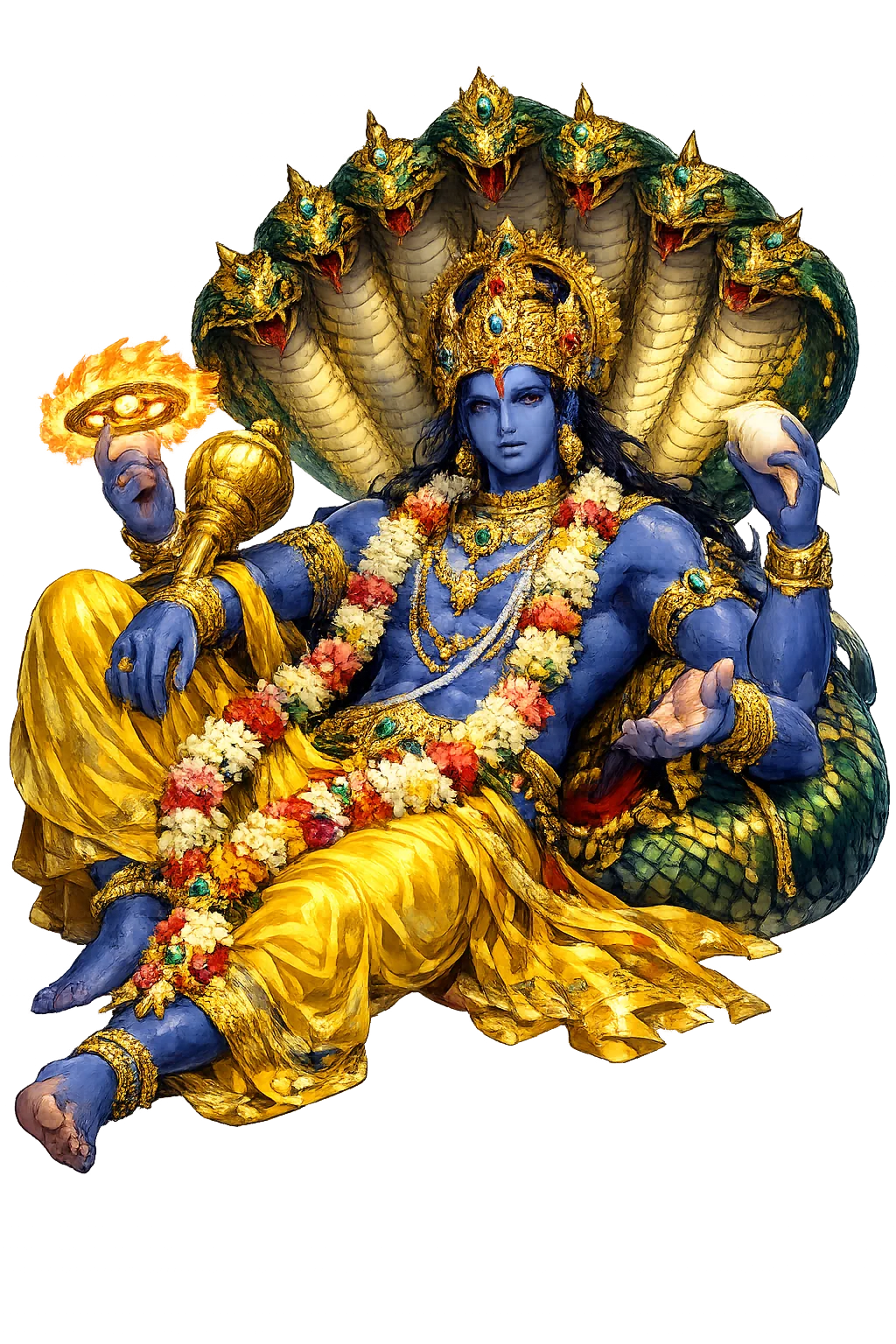
Sacred SymbolsDiscus (cakra), Conch (śaṅkha), Mace (gadā), Lotus (padma), Garuda
02

Etymology & Word Family

From original script to Unicode restoration

Original Script विष्णु Viṣṇu — "The Preserver — the principal Hindu deity who descends as avatāras to sustain cosmic order (from √viṣ, 'to pervade')"
Unicode Restoration Viṣṇu Restored stress, length, and script
Modern ASCII vishnu Plain-ASCII fallback

From Sanskrit viṣṇu- 'all-pervading', traditionally derived from the root viṣ- 'to pervade, be active'; a secure Proto-Indo-European reconstruction and the name's prehistory remain disputed.

03

Unicode Character Breakdown

Character-by-character philological analysis

CharacterUnicodeNameBlockPhonetic Role
VU+0056Latin Capital Letter VBasic LatinSame
iU+0069Latin Small Letter IBasic LatinShort /i/
ṣU+1E63Latin Small Letter S with Dot BelowUnknownS-dot-under: retroflex /ʂ/
—N/ADropped characterSanskrit orthographyDropped: digraph simplified
ṇU+1E47Latin Small Letter N with Dot BelowUnknownN-dot-under: retroflex /ɳ/
uU+0075Latin Small Letter UBasic LatinShort /u/

The Tier 1 classification reflects how much of the original phonology this restoration preserves — stress and vowel length for Greek names, distinctive letters and diacritics for every other tradition.

04

Cult & Worship

How the sacred was kept — rites, sanctuaries, remains

The Cult

Viṣṇu’s cult is one of the largest living devotional traditions in South Asia. The earliest epigraphic witness is the Heliodorus pillar at Besnagar (Vidisha, c. 110 BCE), whose Garuda capital marks a Greek ambassador’s dedication as a Bhāgavata. Gupta-period rock-cut temples at Udayagiri enshrine Varāha and Anantaśāyī Viṣṇu, while major pilgrimage centers such as Śrīraṅgam, Tirupati, and Badarīnātha attract millions annually. The Bhāgavata Purāṇa and the Divya Prabandham shape temple liturgy, and festivals including Janmāṣṭamī and Vaikuṇṭha Ekādaśī structure the ritual year. From the Chola bronze cult images of South India to the modern ISKCON movement, Viṣṇu worship has combined royal patronage, temple procession, and personal bhakti into a continuous tradition spanning more than two millennia.

In the Earth

The earliest material evidence of Viṣṇu devotion is the Heliodorus pillar at Besnagar (Vidisha, c. 110 BCE), whose Garuda capital and Brahmi inscription identify Heliodorus, a Greek ambassador, as a Bhāgavata — proof that Vaishnavism had Greek converts within a century of the Mauryas. Gupta-period monuments give the mythology stone: the Varāha panel at Udayagiri Cave 5 (c. 400 CE) and the Anantaśāyin relief at Deogarh, the earliest great narrative images of the sleeping god. The Changu Narayan temple in Nepal (5th century CE) is among the oldest standing Vaishnava shrines, and medieval sites from Tirupati to Angkor Wat testify to a temple culture that carried Viṣṇu's worship across South and Southeast Asia.

05

Iconography

How Viṣṇu was imaged across the ages

The Image

Viṣṇu’s standard iconography presents him standing or reclining, four-armed, holding the conch (śaṅkha), discus (cakra), mace (gadā), and lotus (padma), crowned and adorned with the śrīvatsa mark and Kaustubha jewel. The Gupta Varāha panel at Udayagiri Cave 5 (c. 400 CE) shows him as the man-boar lifting the earth goddess, while the Anantaśāyī image depicts him sleeping on the serpent Ananta at the cosmos’s dissolution. His avatāras dominate later art: Narasiṃha man-lion, Vāmana dwarf, Paraśurāma, Rāma, and Kṛṣṇa. Chola bronze processional images, Pahari and Rajput paintings, and modern calendar prints have multiplied these forms into one of the most visually prolific traditions in world religion.

06

Reception & Transformation

The name after its own age — transmission, translation, survival

Afterlives

Viṣṇu rose from a minor Vedic solar figure to the supreme deity of Vaishnavism. The Bhagavad Gītā and the Bhāgavata Purāṇa made his avatāra doctrine central to Hindu theology, while the Āḻvār poets of Tamil Nadu and the Śrī Vaiṣṇava ācāryas built a temple-based devotional movement. Southeast Asian kings from the Khmer to the Cham adopted Viṣṇu as a royal protector, leaving masterpieces such as Angkor Wat. In medieval and modern North India, Rāma and Kṛṣṇa became focal points of bhakti poetry and political identity; Gandhi’s use of Rāmāyaṇa themes turned the deity into a national symbol. Since the twentieth century, ISKCON and diaspora communities have carried Viṣṇu worship worldwide, while scholarship continues to debate the historical passage from Vedic Viṣṇu to Bhāgavata theism.

Identifications Across Traditions

Viṣṇu absorbed countless regional deities: Kṛṣṇa of the Yādava cowherds, Rāma of the Ikṣvāku line, Nārāyaṇa of the Vedic waters, and the cosmic Puruṣa of speculative Brahmanism. In South India he merges with Śrī (Lakṣmī) and Bhū (earth) in temple theology; in Bengal, he is the serene Nārāyaṇa beside the fierce Kālī. Sri Lankan Buddhism honors him as the guardian deity Upulvan, identified with Viṣṇu; Jainism honors him as a śalakāpuruṣa of the coming age. Vaishnavism became one of the largest religious communities on earth, spanning philosophical schools from the non-dualist Śaṅkara (who read the Gītā as the highest scripture) to the dualist Madhva and the devotional Gaudīya tradition of Bengal — a single god sheltering arguments that refuse to be reconciled.

Modern Legacy

Viṣṇu's presence is woven into the texture of South Asian civilization. The Rāmāyaṇa and Mahābhārata are national epics, performed in village plays, televised during festivals, and cited in political speech — the Gītā's 'whenever dharma decays, I create myself' (4.7) is India's most quoted line of scripture. The Hare Kṛṣṇa movement carried Gaudīya Vaishnavism to the West; ISKCON temples now stand on every continent. His symbols — the conch, the discus, the tilaka mark — identify millions of devotees, and the ideal of the avatāra, a divine descent to restore justice, has shaped Indian political thought, literature, and popular cinema for a century. In an unstable world, Viṣṇu remains the god who promises to come again.

07

The Meditation

What Viṣṇu means — beyond the dictionary

Viṣṇu teaches that the highest power is not the power that destroys but the power that keeps things going. Maintenance is harder than creation; it requires patience, repetition, and the willingness to return to the same task age after age. Every parent who wakes in the night, every farmer who plants again after a flood, every healer who stays with a patient long after the drama has faded — they are images of Viṣṇu.

His three strides remind us that the cosmos is measured, not random. His avatāras remind us that when order collapses, the sacred does not abandon the world but enters it — small, absurd, unrecognizable: a dwarf asking for three paces. His sleep on the serpent reminds us that endings are also wombs. To call on Viṣṇu is to choose the long work of preservation over the short thrill of annihilation. It is to believe that the world, for all its wounds, is worth saving.

08

Frequently Asked Questions

Common questions about Viṣṇu, Preservation, Protection, Universe, and Unicode restoration

01How do you pronounce Viṣṇu?

In reconstructed pronunciation, Viṣṇu is /ʋɪʂ.ɳʊ/ — approximately 'VISH-noo' — the first syllable has a crisp, tongue-tip sh; the second is short and resonant.

02What does Viṣṇu mean?

Viṣṇu means The Preserver — the principal Hindu deity who descends as avatāras to sustain cosmic order (from √viṣ, 'to pervade') in the sanskrit tradition.

03What are the symbols of Viṣṇu?

Viṣṇu is associated with Discus (cakra) (Sudarśana, the wheel of divine will that cuts through illusion and evil.), Conch (śaṅkha) (The primeval sound Oṃ, announcing divine presence and the dissolution of boundaries.), Mace (gadā) (The power of knowledge; often identified with Kāmadeva or the force of cosmic law.), Lotus (padma) (Purity and the unfolding of creation; Brahmā is born from the lotus rising from Viṣṇu's navel.), Garuda (The eagle-king, his mount, symbolizing the Vedas and the swiftness of divine knowledge.).

04Why restore Viṣṇu in Unicode?

Plain ASCII vishnu strips the stress, length, and script that make the name specific. Unicode restoration returns the name to its original written dignity.

05What is the most important myth about Viṣṇu?

“The Three Strides of the Wide-Strider” — the Vedic story that anchors the mythology of Viṣṇu, told in full on the lore page.

09

Scholarly Sources

The philological foundations of this restoration

Every claim on this page is grounded in established scholarship. The orthographic restorations follow disciplinary convention. The etymological chain follows the best available reference works. This is not invention — it is resurrection through scholarship.

◈

Lexicography & Philology

  • MW
  • KEWA
◎

Primary Texts

  • Ṛgveda Saṃhitā 1.154; 7.99 (Viṣṇu hymns; the wide-strider)
  • Śatapatha Brāhmaṇa 1.2.5 (Vāmana's three strides)
  • Mahābhārata 1.15–17 (the churning); Bhagavad Gītā 4.7 (the promise of descent)
  • Bhāgavata Purāṇa 7 (Hiraṇyakaśipu and Narasiṃha); 3.8 (the lotus from the navel)
  • Viṣṇu Purāṇa 1.2, 1.9 (the cosmic sleep; the churning)
◉

Archaeology & Art History

  • Material evidence — iconography, inscriptions, and temple archaeology — for Viṣṇu and related cults.
✦

Religious Studies

  • Monier-Williams, Sanskrit-English Dictionary; Mayrhofer, EWAia s.v. viṣṇu-
Return

The Surface Awaits

You have traced the name from its earliest attestation to its Unicode restoration. Now return to the myth. The story is where the name lives.

Back to Lore
Viṣṇu mascot