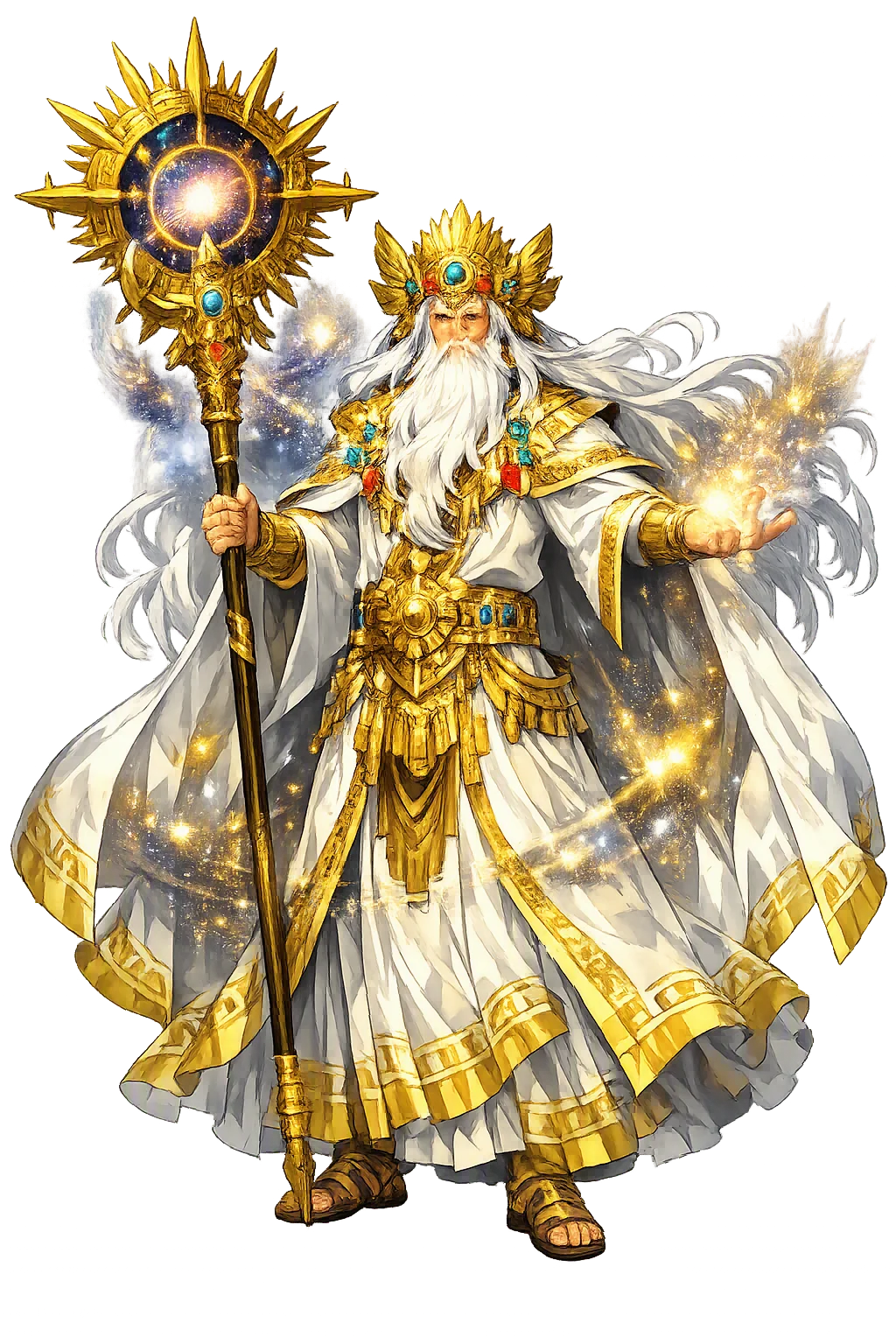
Stories of Wiraqucha
Wiraqucha's mythology reaches us only through the reports of conquered lords to Spanish chroniclers — Betanzos, Cobo, Sarmiento — yet it holds together a coherent cosmic biography: the making of the world, the flood that erased its first people, the shaping of the nations at Tiwanaku, and a final journey westward that ended in disappearance.
Juan de Betanzos, whose Suma y Narración de los Incas (1551) is the fullest early account, tells that Wiraqucha made the first people at Tiwanaku and gave them the world to keep; but they grew proud and lived without worship, so he resolved to undo them. He sent a great flood — unu pachakuti, a watery overturning of the world — that drowned the first race, the wari, while he himself rose into the sky above Titicaca. Yet he spared two, a man and a woman, calling them from the waters onto a float of totora reeds near the island, and commissioning them as the ancestors of a new humanity. The myth fixes the shape of Andean time: catastrophe and renewal in cycles, a world unmade and remade, with the creator always watching from above. It is also a charter for the lake itself — Titicaca is not scenery but the hinge where the first world ended and the second began.
Father Bernabé Cobo's Historia del Nuevo Mundo (Book 13) preserves the imperial version: after the flood, Wiraqucha set to work at Tiwanaku, where he sculpted the forms of all the nations to come — each with its own face, dress, language, songs, and seeds — and brought them to life. When the work was done he dispatched them, calling them out of caves, springs, and rivers to find their homelands: one nation he sent by way of a cave, another along a river's course, and to the Inca ancestors he gave the special charge that would lead them at last to Cusco. Pedro Sarmiento de Gamboa's Historia Indica (ch. 6–7) gives the same program and adds the full titulature: Ticci Uiracocha Pachayachachic, 'ancient foundation, creator of the world.' The myth is a map of the Andes read backward — every people is the deliberate work of the same hand, and the Inca are simply the nation that remembered best who made them.
The same accounts make Wiraqucha the maker of the sky. On the island of Titicaca in the great lake he fashioned the Sun — Inti — and the Moon, and set the stars in their courses, appointing the Sun the most honored of all, 'like a rich ornament' among the rest (Sarmiento de Gamboa, ch. 7; Cobo 13.3). In imperial theology Inti then became the visible ancestor of the Inca dynasties, while Wiraqucha remained the invisible maker behind the visible god — a two-tier heaven in which the sun was, as it were, the son, and the emperor the sun's line. The pairing let Cusco worship a present, national god without ever forgetting the older, unbounded one above and behind him. It is one of the few world mythologies in which the supreme creator deliberately steps back from the machinery of daily rule, delegating the visible sky to his own workmanship and reserving for himself only the authorship of everything.
Betanzos closes the biography with Wiraqucha's departure. The maker walked the length of the Andes in the dress of a poor traveler, staff in hand, teaching as he went and weeping at springs; in the province of the Canchis he wept, foretelling that men dressed exactly as he was — bearded strangers from across the sea — would one day come and overturn the land. He came as far as the region of Manta on the coast and then, Betanzos says, passed into the sea and was gone. The detail is breathtaking in hindsight: a colonial-era text, written within twenty years of Pizarro, preserving a native prophecy that fits the conquest like a glove — and whatever its origin, the story made Wiraqucha the god who knew the strangers before they arrived. A maker who weeps over the future of his own work is a rare figure in any pantheon; the Andes kept him.
Creator
Wiraqucha is the maker of the Inca cosmos: sky father, creator of sun and moon, and the weeping wanderer who once walked the length of the Andes and was never seen again. The chroniclers knew him as the invisible god who made the world and then withdrew from it — and his name still survives in the politest word an Andean elder can offer a stranger: wiraqucha, sir, gentleman, lord.
The name compounds Quechua wira, 'fat, foam,' and qucha, 'lake, sea'; the chroniclers glossed it 'lake of fat,' more evocatively 'foam of the sea.'
Maker of the sun, moon, and stars and of every nation; to the Andes he is Pachayachachic, 'creator of the world.'
Honored at Titicaca, Tiwanaku, and Cusco; his cult outlived the empire and endures in solstice pilgrimage, shrine, and everyday address.
Preserved as a flagship temple; the scholarly restoration Wiraqucha replaces the colonial spelling Viracocha with modern Quechua orthography.
From the original script to the living URL
Wiraqucha
The name survives in scholarly transliteration. Wiraqucha is the standard Incan romanisation, documented in academic sources — “Sea of fat”. Because the spelling uses only Latin letters, the form is the same in both ASCII and Unicode.
No indigenous writing system is securely attested for individual incan names. The form shown is a modern scholarly transliteration.
viracocha
The plain viracocha form is identical to the Unicode restoration. Because this name is already written in Latin letters, no diacritics, stress, or script information were lost — only capitalization differs.
Wiraqucha
The Unicode restoration does not need to recover lost marks for Wiraqucha. Its value is canonical spelling and consistent cataloguing, not the reconstruction of erased orthography. The domain is readable as-is to both DNS and humanity.
Wiraqucha.com
This restoration is written entirely in ASCII letters — no Punycode encoding stands between Wiraqucha and the DNS. The domain reads identically to machines and to human eyes.
Owned, ideal, and ASCII forms of Wiraqucha
Wiraqucha
The full Unicode restoration. wiraqucha.com is not in the PuniCodex collection — it is watched for release; if it drops, this temple upgrades to an owned flagship.
viracocha
The plain ASCII fallback — what DNS and legacy systems see.
How Wiraqucha was spoken
How Wiraqucha is preserved in writing
No indigenous writing system is securely attested for individual incan names. The form shown is a modern scholarly transliteration.
Contribute scholarly provenance →The lore you have read is the living myth. Extended Lore opens the scholarly vault beneath it: the cult and its material remains, a history of the image, the name after antiquity, a meditation on what the name still means, and the full scholarly apparatus — etymology, orthography, sources.
Enter Extended Lore