PuniCodex

Extended Lore

Wiraqucha

Etymology · Orthography · Cult · Iconography · Reception · Sources

Tier 2 Wiraqucha
Wiraqucha — Creator, Sky, Sea Foam
01

Quick Facts

Essential information about Wiraqucha, Creator, Sky, Sea Foam

Scholarly TransliterationWiraqucha
Unicode RestorationWiraqucha
Reconstructed Pronunciation/viracocha/
PantheonIncan
DomainCreator, Sky, Sea Foam
MeaningSea of fat
ClassificationTier 2
Primary DomainWiraqucha
Sacred SymbolsSea foam of the lake, The staff and traveler's bundle, The reed float, The stone models of Tiwanaku, The golden image of Cusco
02

Etymology & Word Family

From original script to Unicode restoration

Scholarly Transliteration Wiraqucha Wiraqucha — "Sea of fat"
Unicode Restoration Wiraqucha Canonical scholarly spelling — ASCII-identical
Modern ASCII viracocha Plain-ASCII fallback

The name Wiraqucha reaches the modern world through scholarly transliteration of the incan tradition. Because the conventional spelling uses only Latin letters, its Unicode and ASCII forms coincide — the tradition it carries is in the name itself, not in diacritics.

03

Unicode Character Breakdown

Character-by-character philological analysis

CharacterUnicodeNameBlockPhonetic Role
WU+0057Latin Capital Letter WBasic LatinW
iU+0069Latin Small Letter IBasic LatinSame
rU+0072Latin Small Letter RBasic LatinSame
aU+0061Latin Small Letter ABasic LatinSame
qU+0071Latin Small Letter QBasic LatinQ
uU+0075Latin Small Letter UBasic LatinU: quechua qu cluster
cU+0063Latin Small Letter CBasic LatinSame
hU+0068Latin Small Letter HBasic LatinSame
aU+0061Latin Small Letter ABasic LatinSame

The Tier 2 classification here reflects fidelity to the attested tradition, not recovered diacritics: every character of Wiraqucha already survives in ASCII. What the restoration preserves is the canonical spelling itself — the form scholarship standardised.

04

Cult & Worship

How the sacred was kept — rites, sanctuaries, remains

The Cult

Wiraqucha was worshipped at the places where the world was made. The great temple at Cacha (Raqchi), south of Cusco — the largest roofed structure in the Inca world, whose central adobe mass still stands — was his, housing a colossal statue the chroniclers describe as jeweled and gilded; tradition made it the very shrine where the weeping god appeared at the springs. In Cusco the Coricancha kept a solid-gold image of the creator, described by Cobo and Murúa and melted within years of 1532. And the geography itself served as his cult calendar: the sacred rock on the Island of the Sun, where the new humanity was called from the flood, drew state processions and ordinary pilgrims alike, and Betanzos describes shrine-keeping around the lake. No festival in his name survives in the record — his were the rites of state pilgrimage rather than a fixed feast — and no priesthood of the creator is separately attested. The architecture tells the theology: the biggest temple in the empire for the god who made it, then withdrew.

In the Earth

Wiraqucha's archaeology is the archaeology of his stage. Tiwanaku, the great center of the altiplano (c. 500–1000 CE), holds the Kalasasaya platform, the monumental Gateway of the Sun, and the precision-cut blocks of Puma Punku — the ruins later tradition named as his workshop, where the myth says he modeled the nations in stone. On the Island of the Sun and Island of the Moon in Lake Titicaca, Inca pilgrims' shrines — the Chincana labyrinths, the sacred rock, the sanctuary terraces — mark the myth's exact geography, and Copacabana's basilica stands on the shore where the ritual boats once left. In Cusco, the chroniclers describe a solid-gold image of the god in the Coricancha (Cobo; Murúa), melted down within years of 1532. No pre-Columbian inscription names him: the ruins give the stage, and the chronicles give the script.

05

Iconography

How Wiraqucha was imaged across the ages

The Image

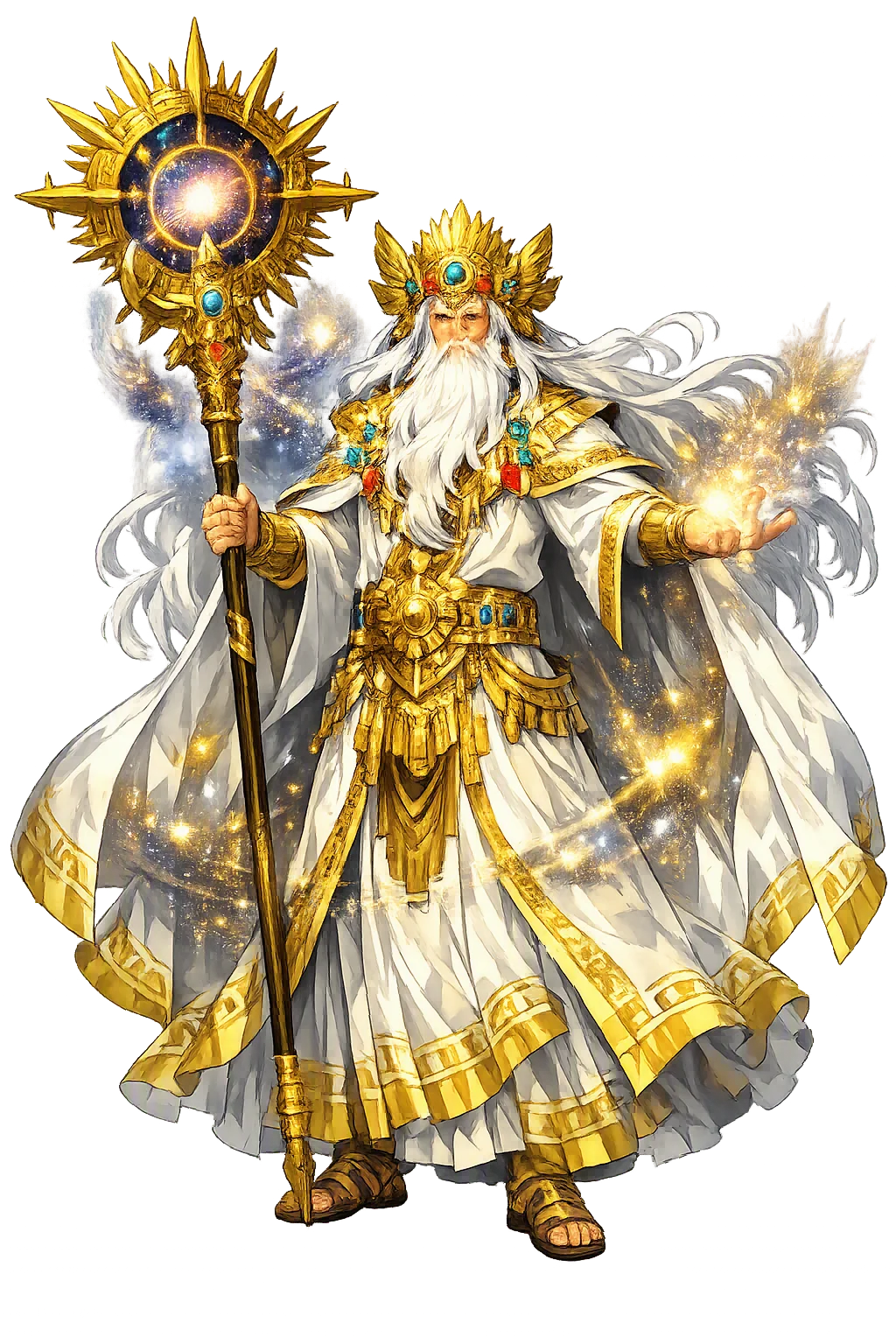
Wiraqucha's canonical portrait is a bearded staff-bearer — and every element of it is contested. The chroniclers describe the cult images: the golden, boy-sized figure in the Coricancha; the great jeweled statue at Cacha, described as weeping. Juan de Santa Cruz Pachacuti Yamqui saw the god painted on the temple walls of Cusco itself — a creation cycle in which Wiraqucha calls forth the sun, moon, and nations — a mural program the conquest destroyed within a generation. Whether the pre-Columbian god was truly bearded, or the beard is a colonial retrofit matching the prophesied strangers, no surviving image can settle: not one pre-1522 depiction bears his name. The famous staff-bearing figure on Tiwanaku's Gateway of the Sun has been called Wiraqucha since early-twentieth-century antiquarians made the identification — the gate is centuries older than the name, and the reading remains an act of devotion, not demonstration. His truest image may be the one Betanzus gives: not a face at all, but a poor traveler with a staff, weeping at a spring.

06

Reception & Transformation

The name after its own age — transmission, translation, survival

Afterlives

Wiraqucha reached Europe by deposition. The conquerors' reports — Betanzos' narrative, taken down in 1551, Sarmiento's inquiry of 1572, Cobo's history of 1653 — were written under colonial rule and mostly kept in manuscript: Garcilaso's Comentarios reales (1609) gave Europe its first book-length account of the Inca creator, while Cobo waited for Jiménez de la Espada's edition of 1890–93, Sarmiento for 1906, Murúa for 1922. The Enlightenment read him as natural theology's exhibit — a New World creator without revelation, argued over by deists and ethnographers — and Humboldt's Vues des Cordillères (1810) set Tiwanaku's ruins, by then his 'workshop,' before the European public. Nineteenth-century linguistics took up his name, and the debate over the element wira — fat, foam, or blood — runs to this day, a small philological mirror of the larger argument about how much of the mythology predates the empire. Twentieth-century scholarship rebuilt the context the chronicles had flattened: the Leiden school's reading of Inca ritual landscapes, Bauer's mapping of the Cusco sanctuaries, and the Tiwanaku excavations that turned a colonial report into a dig site. Modern Quechua linguistics now debates even the spelling — Wiraqucha against the colonial Viracocha — which is the old prophecy fulfilled a second time: the strangers who came dressed like him are still arguing about his name.

Identifications Across Traditions

Spanish missionaries moved quickly to identify Wiraqucha with the Christian God: Father Bernabé Cobo reports Andean lords hearing the gospel and concluding that this Dios must be their own Pachayachachic, finally named. The identification stuck — in Andean parishes 'Dios Pachayachachic' is still a natural sentence — and it let the old shrine centers be absorbed rather than erased, most completely at Copacabana on Titicaca's shore, where the basilica of the Virgin stands where pilgrims once took ship for the island shrines. More remarkably, the god's name became a title for the conquerors themselves: from the earliest chronicles onward, viracocha meant a Spaniard, a gentleman, a lord — the word a conquered people used for strangers who arrived dressed, as Betanzos' prophecy said, exactly like their departing god. Even Tiwanaku's sculpted Gateway of the Sun is popularly read as his image, though that identification is a modern antiquarian conjecture — the gate predates the name by centuries.

Modern Legacy

Wiraqucha never lost his mountain. Pilgrims still cross to the Island of the Sun and Moon on Titicaca, and each June solstice thousands gather at Tiwanaku to watch the sun rise through the Gate of the Sun — a rite older than any written version of the myth it now frames. In modern Quechua and Aymara, wiraqucha remains an honorific — sir, elder, gentleman — a fragment of the god carried in everyday address. The modern Inti Raymi festival at Sacsayhuamán keeps the creator in public view, and the story of the weeping god who foresaw the bearded strangers is still told as the Andes' own prophecy of the conquest. The empire that carried his name fell in a generation; the name outlived the empire by five centuries and is still a polite word for a stranger on a mountain road.

07

The Meditation

What Wiraqucha means — beyond the dictionary

Wiraqucha is the absent creator — the maker who finished his work, wept once over what was coming, and left. Andean theology has no jealous guardian and no returning savior: the world was handed over, and what happens in it is, up to a point, the world's own business. That withdrawal is the deepest note in his mythology. Where other high gods demand attention, Wiraqucha demands only remembrance — his name spoken in honorifics, his lake crossed at the solstice, his ruined workshop kept as pilgrimage ground.

And the weeping is the detail that keeps scholars returning. A god who cries at a spring, foretelling bearded men in his own dress, is a god who has read the ending of the story he began. The chronicles that preserve the scene were written under colonial rule, which should make us careful — but even as colonial construction it is extraordinary: a conquered people explaining the conquest in the voice of their own god, who saw it coming and left before it arrived. Absence, prophecy, grief: the maker's last gifts were the ones no one could take.

08

Frequently Asked Questions

Common questions about Wiraqucha, Creator, Sky, Sea Foam, and Unicode restoration

01How do you pronounce Wiraqucha?

In reconstructed pronunciation, Wiraqucha is /viracocha/ — approximately Say "viracocha" with the stress and length implied by the scholarly restoration "Wiraqucha".

02What does Wiraqucha mean?

Wiraqucha means Sea of fat in the incan tradition.

03What are the symbols of Wiraqucha?

Wiraqucha is associated with Sea foam of the lake (The etymon wira-qucha, 'foam (or fat) of the lake' — the foam from which the name, and the god, emerged), The staff and traveler's bundle (He crossed the Andes as a staff-carrying beggar, weeping at springs and prophesying — the god as itinerant stranger), The reed float (The totora-reed float that bore the two survivors of the flood — the seed of the remade world), The stone models of Tiwanaku (The sculpted prototypes of every nation, from which Wiraqucha shaped humankind at his workshop), The golden image of Cusco (The solid-gold statue in the Coricancha, described by Cobo and Murúa and melted down within years of the conquest).

04Why restore Wiraqucha in Unicode?

Wiraqucha is written entirely in ASCII letters, so its restoration is about canonical fidelity rather than recovered diacritics: the temple fixes the name in its scholarly standard spelling, attested in the source tradition, instead of leaving it to drift.

05What is the most important myth about Wiraqucha?

“The Flood of Unu Pachakuti” — the Betanzos ch. 1 story that anchors the mythology of Wiraqucha, told in full on the lore page.

09

Scholarly Sources

The philological foundations of this restoration

Every claim on this page is grounded in established scholarship. The orthographic restorations follow disciplinary convention. The etymological chain follows the best available reference works. This is not invention — it is resurrection through scholarship.

◈

Lexicography & Philology

  • Cerrón-Palomino
◎

Primary Texts

  • Primary sources in the incan tradition for Wiraqucha.
◉

Archaeology & Art History

  • Material evidence — iconography, inscriptions, and temple archaeology — for Wiraqucha and related cults.
✦

Religious Studies

  • Juan de Betanzos, Suma y Narración de los Incas (1551), chapters 1–2 (the flood, the creation of nations, the weeping journey)
  • Bernabé Cobo, Historia del Nuevo Mundo, Book 13, chapter 3 (creation and Titicaca)
  • Pedro Sarmiento de Gamboa, Historia Indica, chapters 6–7 (the 1572 inquiry of Cusco)
  • Martín de Murúa, Historia general del Piru (1616), on the Coricancha image and the name
  • Bauer, The Sacred Landscape of the Inca (1998)
  • D'Altroy, The Incas (2002), chapter on Inca religion
Return

The Surface Awaits

You have traced the name from its earliest attestation to its Unicode restoration. Now return to the myth. The story is where the name lives.

Back to Lore
Wiraqucha mascot