The Living Myth
Abhidharma, Yogacara · The celebrated Buddhist scholar — author of the Abhidharmakośa, co-founder of the Yogācāra school
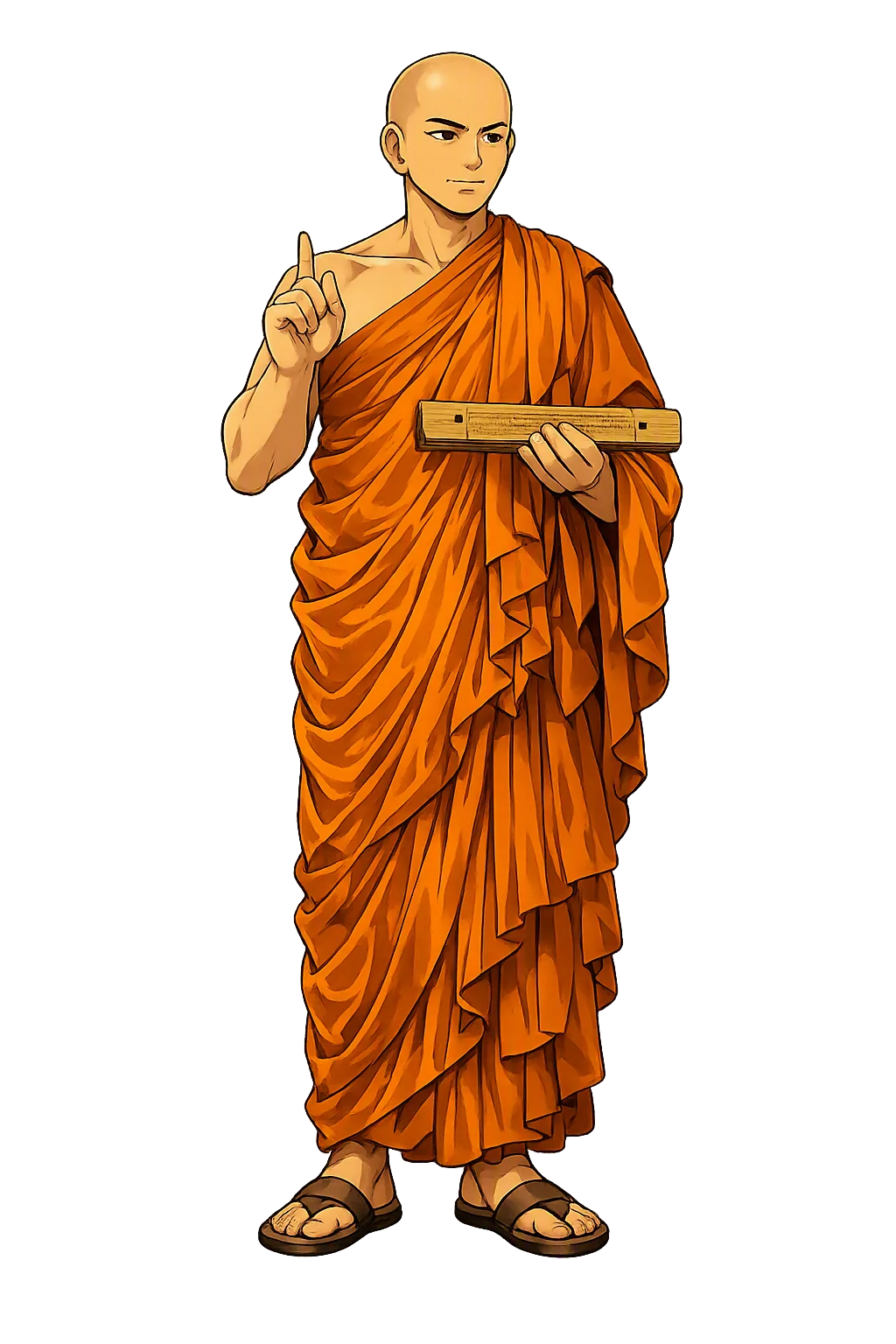
Stories of Vasubandhu
Vasubandhu was a historical philosopher, not a mythological figure — a monk of Puruṣapura (Peshawar) who, the early Tibetan biographies say, wrote the Abhidharmakośa as a Sarvāstivādin critic and then embraced the Yogācāra Mahāyāna of his half-brother Asaṅga. His 'myths' are the legends his tradition grew around a real life.
The Tibetan biographies recount that Vasubandhu withdrew into seclusion to master the Abhidharma of the Kashmir Sarvāstivādins, and emerged with the Abhidharmakośa — six hundred verses (kārikā) of flawless eight-syllable metre that summarized the entire system. When the Kashmir masters admired the verses but missed their own subtlety, he added an auto-commentary (bhāṣya) of his own in which, tradition says, he quietly refuted them. The Kośa became what it remains: the one Abhidharma text every later school — Theravāda, Mahāyāna, and the Tibetan lineages — had to study, debate, or answer, translated in its entirety into Chinese by Xuanzang and memorized in fragments by generations of monks from Kashmir to Kyoto. Its author's own allegiance was already drifting as he wrote: the commentary, tradition says, shows the Sautrāntika reservations that would later make his conversion credible. To condense a library into verse, and the verse into a single lifetime, is the legend's whole point: scholarship can be a kind of asceticism.
Vasubandhu had mocked the Mahāyāna as a corruption of the Buddha's teaching, calling its scriptures fabrications. His elder half-brother Asaṅga, already a great Yogācāra teacher, sent him no rebuttal — only a note reporting that he was dying, and begging Vasubandhu to recite the Mahāyāna sūtras for him. Struck by the affection of the request, Vasubandhu read them, found them profound, and entered the Mahāyāna himself. The story is hagiography — no Indian source records it independently — yet it encodes the tradition's own account of its greatest conversion: Vasubandhu did not abandon analysis for devotion. He turned the same razor-sharp mind to the 'mind-only' philosophy, composing the Twenty Verses (Viṁśikā) and the Thirty Verses (Triṁśikā) that define the Yogācāra, and the two halves of his career became one continuous argument about how carefully the world must be taken apart before it can be seen whole.
The biographies carry Vasubandhu to the courts of northern India, where the grammarian-philosopher Vasurāta, champion of an opposing school, had humiliated all comers. Vasubandhu entered the contest — the tradition describes a great assembly of rival teachers and lay patrons gathered to watch — and his opponent was worsted. After the debate he was offered a great patron's gold — and the legends insist that, as a monk, he spent the wealth on works of benefit to the saṅgha and on gifts to the poor. The story matters less as history than as the template it sets: the philosopher's victory is measured not in refutation but in what the victor refuses to keep. Every medieval debate culture of the Buddhist world — Nālandā's, Tibet's, Japan's — repeated this scene with Vasubandhu's name in it, and his reputation as the undefeated champion of two successive orthodoxies made the later conversion legend necessary: only love, the tradition decided, could have beaten him.
Modern scholarship has had to ask whether one man could have written both the Kośa's analytical Abhidharma and the Yogācāra's visionary metaphysics. Erich Frauwallner (1951) argued the dates fit a single long life; others have proposed two Vasubandhus — the Yogācāra co-founder and a later Kośa author — and the question is still argued in the journals. The tradition itself never doubted: one Vasubandhu, brother of Asaṅga, whose conversion joined the two oeuvres into a single career — and the hagiographies even extend that life into legend, saying he ended it in the Pure Land of Amitābha, or in Nepal, depending on which strand one follows. The modern debate is itself a tribute: few ancient authors are so prolific and so consistent in brilliance that posterity must ask whether they were two people.
Abhidharma
Vasubandhu is the great systematizer of Buddhist philosophy: author of the Abhidharmakośa, the encyclopedia of Abhidharma that every later school had to answer, and, with his half-brother Asaṅga, co-founder of the Yogācāra, the 'Mind-Only' school that reshaped Mahāyāna thought from India to Japan.
Six hundred verses of Abhidharmakośa kārikā summarizing the entire Sarvāstivāda analysis of mind, matter, and liberation.
His auto-commentary made the Kośa the standard curriculum: studied in Nālandā, debated in Tibet, translated in China by Xuanzang.
The Twenty and Thirty Verses argue the world is 'mind-only' — the doctrine his Kośa-era Sautrāntika readers found hardest to accept.
Legend says his brother Asaṅga sent him a begging letter: compassion, not argument, turned the Kośa's author toward the Mahāyāna.
From the original script to the living URL
वसुबन्धु
The name in its original Buddhist form. Vasubandhu (वसुबन्धु) is attested in the source tradition — “The celebrated Buddhist scholar — author of the Abhidharmakośa, co-founder of the Yogācāra school”. Its original diacritics and script distinctions carry the full phonetic and orthographic weight of the source tradition.
vasubandhu
The plain vasubandhu form is identical to the Unicode restoration. Because this name is already written in Latin letters, no diacritics, stress, or script information were lost — only capitalization differs.
Vasubandhu
The Unicode restoration does not need to recover lost marks for Vasubandhu. Its value is canonical spelling and consistent cataloguing, not the reconstruction of erased orthography. The domain is readable as-is to both DNS and humanity.
Vasubandhu.com
This restoration is written entirely in ASCII letters — no Punycode encoding stands between Vasubandhu and the DNS. The domain reads identically to machines and to human eyes.
Owned, ideal, and ASCII forms of Vasubandhu
Vasubandhu
Restores वसुबन्धु. The full Unicode restoration. vasubandhu.com is not in the PuniCodex collection — it is watched for release; if it drops, this temple upgrades to an owned flagship.
How Vasubandhu was spoken
How Vasubandhu travels from ancient script to the modern URL
The lore you have read is the living myth. Extended Lore opens the scholarly vault beneath it: the cult and its material remains, a history of the image, the name after antiquity, a meditation on what the name still means, and the full scholarly apparatus — etymology, orthography, sources.
Enter Extended Lore