The Living Myth
Cosmic Order, Oceans, Law · The Keeper of the Cosmic Waters
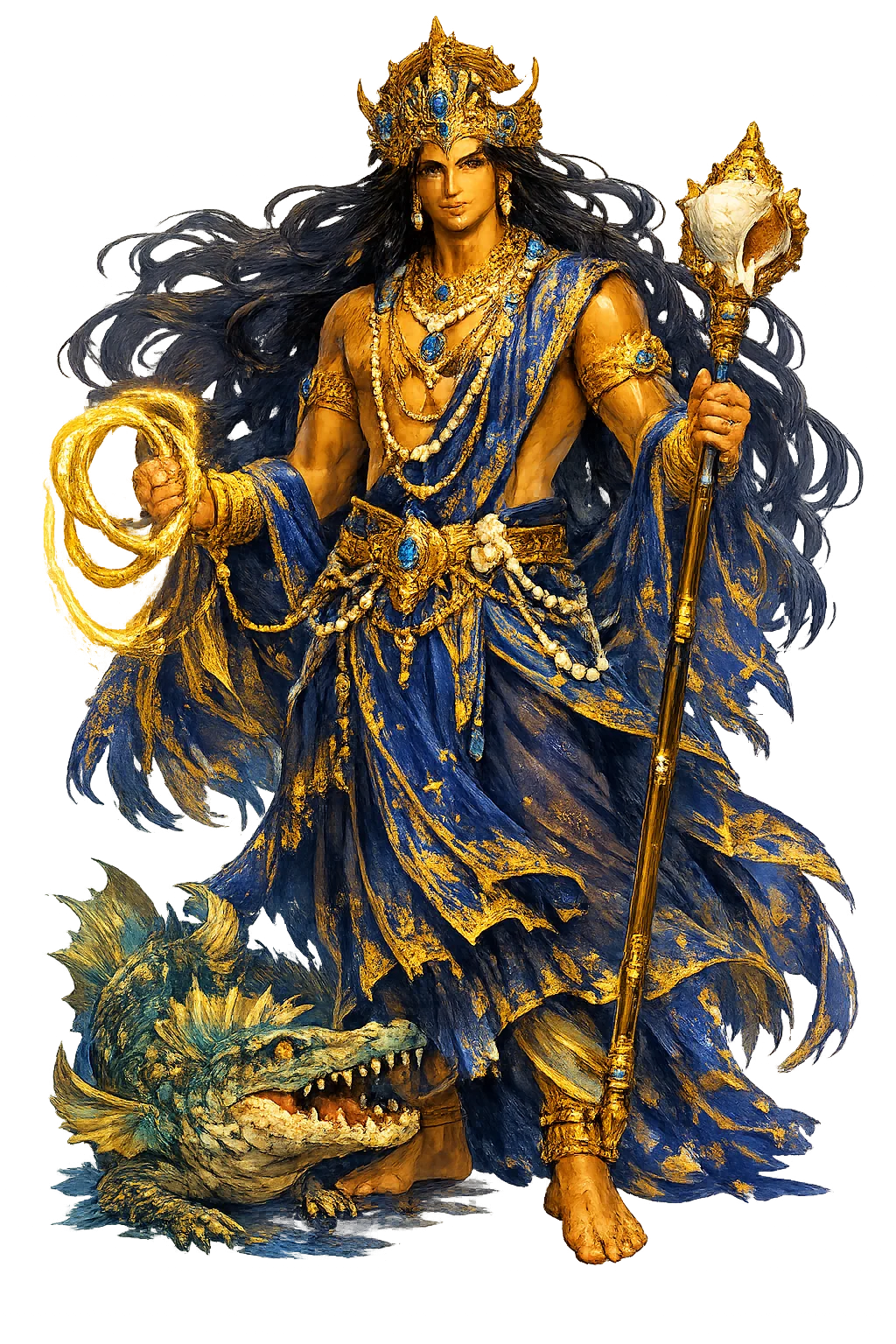
Stories of Varuṇa
Varuṇa's mythology is the anatomy of cosmic accountability: an all-seeing judge whose noose is disease and whose waters are law. He has no battles and few adventures — his drama is the drama of the oath, the confession, and the king who learns that vows to the lord of ṛta cannot be postponed. The Ṛgveda's Varuṇa hymns are the oldest religious poems of conscience in any Indo-European language.
Ṛgveda 7.86 preserves the oldest confession in world literature. The seer Vasiṣṭha — called Varuṇa's own poet — cries out: 'O lord Varuṇa, I have gone against your ordinances again and again; do not deliver your devotee over to death!' (RV 7.86.5–6). He cannot even name his sin: 'What is my chief transgression, Varuṇa, that you would destroy your friend who sings your praise? Tell me, unassailable one, so I may quickly come to you with homage!' The hymn imagines guilt as a knot in the sunless sea, and Varuṇa as the one who ties and unties. Sickness and dread are the felt tightening of the noose; honesty loosens it. The myth means that cosmic law is not blind fate but a relationship that truthfulness can repair — the earliest known poem of conscience before an all-seeing judge.
In the Aitareya Brāhmaṇa (7.13–18), the childless King Hariścandra vows to Varuṇa that he will surrender his firstborn in exchange for a son. When the boy Rohita is born, the king stalls for years, offering substitutes — until Varuṇa's disease seizes his body, the royal flesh itself tightening like a noose. Rohita, wandering in exile, at last buys the middle son of a poor brahmin, Śunaḥśepa, as the offering. Bound to the sacrificial post of King Ajigarta, the boy sings hymn after hymn to the gods and is cut down from the stake at the very last moment, saved by his words; he becomes Varuṇa's priest and royal chaplain, while Hariścandra pays his debt. The myth means that a vow to the lord of ṛta cannot be outrun by wealth or delay — but eloquent truth spoken at the threshold can redeem even the condemned.
Varuṇa dwells in the waters — rivers, seas, rain, and the cosmic ocean — and through them sustains ṛta, the order by which sun and moon move and the seasons return (Ṛgveda 7.49; 7.87). The waters are called 'Varuṇa's wives' (AV 4.16? TS 2.1.11); heaven and earth themselves are said to rest upon his ordinances, and the sacrifice — the ritual act that keeps the cosmos lubricated — is performed under his gaze. In the oldest layer he is a sky-sovereign; only later does he shrink into the sea-god of classical Hinduism. The Ṛgvedic poets already sense the distance between his majesty and his domain: 'I ask you, Varuṇa, about the falling away from the path... I go about sinning, and unobserved I do wrong' (RV 7.86.3–4, trans. Jamison–Brereton). The myth means that order is not imposed from above but flows — truth is liquid, moving, and inescapable.
The Mitra-Varuṇa hymns give Varuṇa his most chilling attribute: an intelligence service of the cosmos. 'The spies of Mitra and Varuṇa move about as if on errands... they see the hidden and the manifest' (RV 7.61–66, passim). His thousand eyes are the stars; he knows the path of birds in the sky and of ships at sea, the flight of the wind — and the secret thoughts of every man. Yet this total surveillance serves not terror but law: the same god who watches is the one whose ordinance keeps the world from splitting apart. The Brahmanas ritualize the idea — the king at his consecration becomes the visible agent of the same watchfulness. The myth means that omniscience, in the Vedic imagination, is the precondition of justice rather than its instrument of fear: a god can only judge what he truly sees, and Varuṇa sees everything.
Ṛgveda 4.42 stages a remarkable contest of self-praise: the seer Vāmadeva gives the verses alternately to Indra and to Varuṇa, and each god claims the greater power. Indra boasts of his thunderbolt and his victories over the dragon and the human foes; Varuṇa answers with the deeper trump — 'I am king Varuṇa... my greatness spreads as far as heaven and earth.' The hymn dramatizes the two faces of sovereignty: force and law, the war-leader and the judge, lightning and noose. In the battle hymn of the ten kings (RV 7.83) both are invoked together before the fight, because might without ṛta is mere violence and ṛta without might cannot defend itself. The myth means that legitimate power in the Vedic world is always double — and its bearers argue about which half is greater.
Varuṇa is the Vedic sovereign of ṛta, the cosmic order that binds gods and mortals alike. He is the lord of all waters — rivers, seas, rain, and the underworld streams — and the guardian of truth who sends a thousand spies to watch the world. To swear falsely before Varuṇa is to invite disease, disaster, and the loosening of the bonds that hold existence together.
As guardian of ṛta, Varuṇa keeps sun, moon, seasons, and sacrifice moving in their proper courses.
Rivers, rain, oceans, and the hidden springs all flow by his authority; drought is his noose tightened.
He binds oath-breakers with the pāśa noose and loosens it for those who confess and speak truth.
His thousand eyes are the stars; he sees the path of ships, the flight of birds, and the secrets of hearts.
From the original script to the living URL
वरुण
The name in its original Sanskrit form. Varuṇa (वरुण) is attested in the source tradition — “The All-Enveloping Sky — the Vedic Āditya of the waters and of ṛta, paired with Mitra”. Its nasal retroflexes carry the full phonetic and orthographic weight of the source tradition.
varuna
Reduced to plain varuna, the name loses everything that made it specific: nasal retroflexes. What remains is an ASCII string that machines can parse but that no longer speaks with its original voice.
Varuṇa
The Unicode restoration recovers what ASCII flattened. Varuṇa restores nasal retroflexes, returning the name to its original written dignity. The domain encodes to Punycode, but the browser displays the truth.
Varuṇa.com → xn--varua-6l1b.com
The non-ASCII characters in Varuṇa are encoded while the ASCII remains visible. To the DNS, it is Punycode. To humanity, it is Varuṇa.
Owned, ideal, and ASCII forms of Varuṇa
Varuṇa
Restores वरुण. The live temple domain — varuṇa.com.
varuna
Flattens वरुण. The plain ASCII fallback — what DNS and legacy systems see.
How Varuṇa was spoken
How Varuṇa travels from ancient script to the modern URL
Sanskrit Varuṇa; from the root vṛ- “to cover, encompass"; the Vedic guardian of cosmic order and the waters.
Cosmic Order, Oceans, Law
The IAST form Varuṇa uses registrable Latin diacritics; the Devanagari form is not supported in .com.
The lore you have read is the living myth. Extended Lore opens the scholarly vault beneath it: the cult and its material remains, a history of the image, the name after antiquity, a meditation on what the name still means, and the full scholarly apparatus — etymology, orthography, sources.
Enter Extended Lore