PuniCodex

Extended Lore

वरुण Varuṇa

Etymology · Orthography · Cult · Iconography · Reception · Sources

Tier 1 Varuṇa.com
Varuṇa — Cosmic Order, Oceans, Law
01

Quick Facts

Essential information about Varuṇa, Cosmic Order, Oceans, Law

Original Scriptवरुण
Unicode RestorationVaruṇa
Reconstructed Pronunciation/ˈʋɐ.ru.ɳɐ/
PantheonSanskrit
DomainCosmic Order, Oceans, Law
MeaningThe All-Enveloping Sky — the Vedic Āditya of the waters and of ṛta, paired with Mitra
ClassificationTier 1
Primary DomainVaruṇa.com
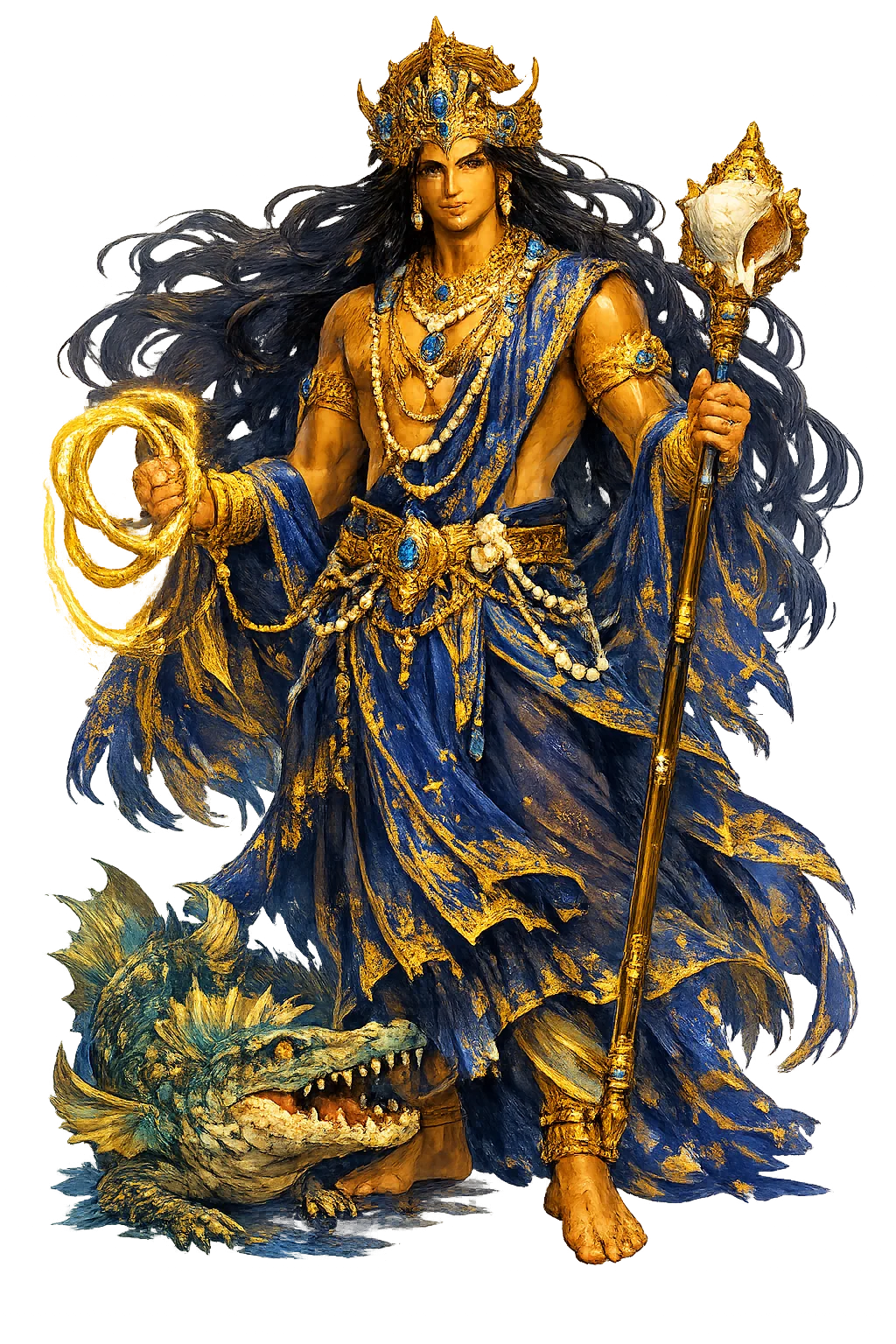
Sacred SymbolsNoose (pāśa), The waters, The makara, The thousand eyes
02

Etymology & Word Family

From original script to Unicode restoration

Proto-indo-european *u̯er- to cover, bind, enclose
Original Script वरुण Varuṇa — "The All-Enveloping Sky — the Vedic Āditya of the waters and of ṛta, paired with Mitra"
Unicode Restoration Varuṇa Restored stress, length, and script
Modern ASCII varuna Plain-ASCII fallback

Usually derived from Sanskrit vṛ- 'to cover, encompass', with a proposed Proto-Indo-European root *u̯er- 'to cover, bind'; the exact formation and prehistory remain disputed.

03

Unicode Character Breakdown

Character-by-character philological analysis

CharacterUnicodeNameBlockPhonetic Role
VU+0056Latin Capital Letter VBasic LatinSame
aU+0061Latin Small Letter ABasic LatinSame
rU+0072Latin Small Letter RBasic LatinSame
uU+0075Latin Small Letter UBasic LatinSame
ṇU+1E47Latin Small Letter N with Dot BelowUnknownN with dot below
aU+0061Latin Small Letter ABasic LatinSame

The Tier 1 classification reflects how much of the original phonology this restoration preserves — stress and vowel length for Greek names, distinctive letters and diacritics for every other tradition.

04

Cult & Worship

How the sacred was kept — rites, sanctuaries, remains

The Cult

Varuṇa's cult was essentially Vedic. Hymns 7.86–89 of the Ṛgveda address him as lord of ṛta and as witness to oaths, and the royal consecration rite bound kings to his moral gaze. As one half of the paired Mitra-Varuṇa, he received soma offerings alongside the solar Mitra. With the rise of theistic Hinduism his independent worship declined: he became one of the lokapāla guardians of the west and a sea-king rather than a supreme sovereign. No major temple was ever dedicated to him alone, and his ancient cult is now remembered chiefly through Vedic recitation and through the scholarly reconstruction of Indo-Iranian religion.

In the Earth

The Indo-Iranian antiquity of Varuṇa is anchored by the Mitanni treaty tablets from Boğazköy (Hattusa, Turkey, c. 1380 BCE), where 'U-ru-wa-na' appears among the divine witnesses in Hittite cuneiform. In India he has no early cult images — the Vedic gods were worshipped at fire, not in statues — and his iconographic career begins with the Maurya-Sunga railing medallions at Bharhut and Sanchi, where a water-guardian with a noose may represent him. From the Gupta period onward he joins the dikpāla guardians: the Deogarh and Khajuraho temple programs place him, makara-mounted, in the west. Coastal shrines, stepwells, and tīrtha lists across Gujarat and Maharashtra preserve his older identity with waters.

05

Iconography

How Varuṇa was imaged across the ages

The Image

The Vedic gods were worshipped at fire, not in statues, so Varuṇa has no early cult image. His iconographic career begins with Maurya-Sunga railing medallions at Bharhut and Sanchi, where he appears as a regal figure riding a crocodile or sea-monster. Later Hindu art shows him as a white-complexioned lokapāla holding a noose and a conch, attended by the river goddess Gaṅgā. These images are late and derivative, reflecting his absorption into the classical pantheon rather than an independent visual tradition rooted in the Vedic age.

06

Reception & Transformation

The name after its own age — transmission, translation, survival

Afterlives

Varuṇa fascinated nineteenth-century comparative mythologists, who linked him with Greek Ouranos and reconstructed a Proto-Indo-European sky-sovereign. That equation is now treated more cautiously, but it ensured Varuṇa a lasting place in Indo-Iranian studies. Within Hinduism he was demoted from cosmic king to western guardian and ocean lord, while in Buddhism and Jainism his name attached to attendant deities and directional protectors. Modern scholarship has concentrated on his ethical role as overseer of ṛta and on the Mitanni treaty tablets from Boğazköy, which prove his antiquity across Bronze Age West Asia.

Identifications Across Traditions

Varuṇa's antiquity is proven not in India but in Anatolia: the treaties between the Hittite emperor Šuppiluliuma I and the Mitanni king Šattiwaza (Boğazköy archives, c. 1380 BCE) invoke 'Mi-it-ra' and 'U-ru-wa-na' beside Indra and the Nasatyas — Vedic gods sworn in Hittite cuneiform, generations before the Ṛgveda was fixed in writing. Within Iran his name does not survive as an independent god; his covenant and water functions pass to Miθra (Yašt 10) and to Apąm Napāt, 'grandson of the waters.' In later Hinduism he narrows into the sea-god and the western dikpāla, while Yama inherits his judicial darkness and Mitra fades entirely. Buddhist and Jain texts remember him as a deva-king of the western ocean, and Southeast Asian cosmology keeps him among the guardians of the quarters.

Modern Legacy

Varuṇa's name survives wherever India remembers water and conscience together. Classical drama has kings swear by him as naturally as Greeks swore by Zeus; modern Indian languages use varun as a poetic word for rain and the monsoon. His thousand-eyed vigil became the standard metaphor for conscience — the watcher within — and his noose seeded later images of cosmic bondage and release in Śaiva and Vedantic literature. Coastal and riverine communities of Gujarat and Maharashtra kept his association with waters in local guardian cults long after his pan-Indian cult waned. The hydronym itself endures: from the Mitanni treaty to modern Bollywood's address of the sea, Varuṇa remains the name India gives to the water that judges.

07

The Meditation

What Varuṇa means — beyond the dictionary

Varuṇa is the oldest surviving portrait of the watching conscience — not the thunderbolt of Zeus nor the grace of Christ, but the steady, patient knowledge that nothing done in darkness is done alone. His Ṛgvedic sinner does not bargain or sacrifice his way out; he asks to be told his own crime. That request — 'tell me my transgression' — is arguably the birth moment of introspection in recorded literature: the discovery that the judge may be external while the court is internal.

In a century of surveillance, Varuṇa is uncomfortably modern. But his mythology draws a line our technologies forget: watching is just only in the service of repair. His noose loosens for the confessor. The thousand eyes exist so that truth can be told and the bond re-tied — law as relationship, not as trap. To remember Varuṇa is to remember that accountability without mercy is merely cruelty with better optics.

08

Frequently Asked Questions

Common questions about Varuṇa, Cosmic Order, Oceans, Law, and Unicode restoration

01How do you pronounce Varuṇa?

In reconstructed pronunciation, Varuṇa is /ˈʋɐ.ru.ɳɐ/ — approximately 'VUH-roo-nah' — start with a soft 'v', keep the middle syllable light, and end with a tongue-tip-curled 'n' like an American 'r' pressed against the roof of the mouth.

02What does Varuṇa mean?

Varuṇa means The All-Enveloping Sky — the Vedic Āditya of the waters and of ṛta, paired with Mitra in the sanskrit tradition.

03What are the symbols of Varuṇa?

Varuṇa is associated with Noose (pāśa) (The cosmic bond that ties wrongdoers to their crimes and releases the penitent — in the confession hymns, the loosening of Varuṇa's bonds is the felt sign of forgiveness (Ṛgveda 7.86).), The waters (All freshwater and salt water are his domain; the regular fall of rain and the cycle of rivers are ṛta made visible (Ṛgveda 7.49; Taittirīya Saṃhitā 2.1.11).), The makara (The crocodilian vehicle of later iconography, linking him to rivers, seas, and the monsoon — a Vedic sky-judge gradually docked in the ocean.), The thousand eyes (His spies, moving among men 'as if on errands' — the stars are their visible form; nothing done in darkness escapes them (Ṛgveda 7.61–66).).

04Why restore Varuṇa in Unicode?

Plain ASCII varuna strips the stress, length, and script that make the name specific. Unicode restoration returns the name to its original written dignity.

05What is the most important myth about Varuṇa?

“The Sinner's Cry to the Great God” — the Confession story that anchors the mythology of Varuṇa, told in full on the lore page.

09

Scholarly Sources

The philological foundations of this restoration

Every claim on this page is grounded in established scholarship. The orthographic restorations follow disciplinary convention. The etymological chain follows the best available reference works. This is not invention — it is resurrection through scholarship.

◈

Lexicography & Philology

  • MW
  • KEWA
◎

Primary Texts

  • Ṛgveda Saṃhitā 7.86–89 (Varuṇa hymns; the confession)
  • Ṛgveda Saṃhitā 4.42 (Indra–Varuṇa dialogue)
  • Ṛgveda Saṃhitā 7.61–66 (Mitra-Varuṇa hymns; the spies)
  • Jamison & Brereton, The Rigveda: The Earliest Religious Poetry of India
◉

Archaeology & Art History

  • Material evidence — iconography, inscriptions, and temple archaeology — for Varuṇa and related cults.
✦

Religious Studies

  • Aitareya Brāhmaṇa 7.13–18 (Śunaḥśepa and the royal vow)
  • Boğazköy treaties of Šuppiluliuma I and Šattiwaza (KBo I 1; KBo I 3), c. 1380 BCE
  • Monier-Williams, Sanskrit-English Dictionary; Mayrhofer, EWAia s.v. varuṇa-
Return

The Surface Awaits

You have traced the name from its earliest attestation to its Unicode restoration. Now return to the myth. The story is where the name lives.

Back to Lore
Varuṇa mascot