
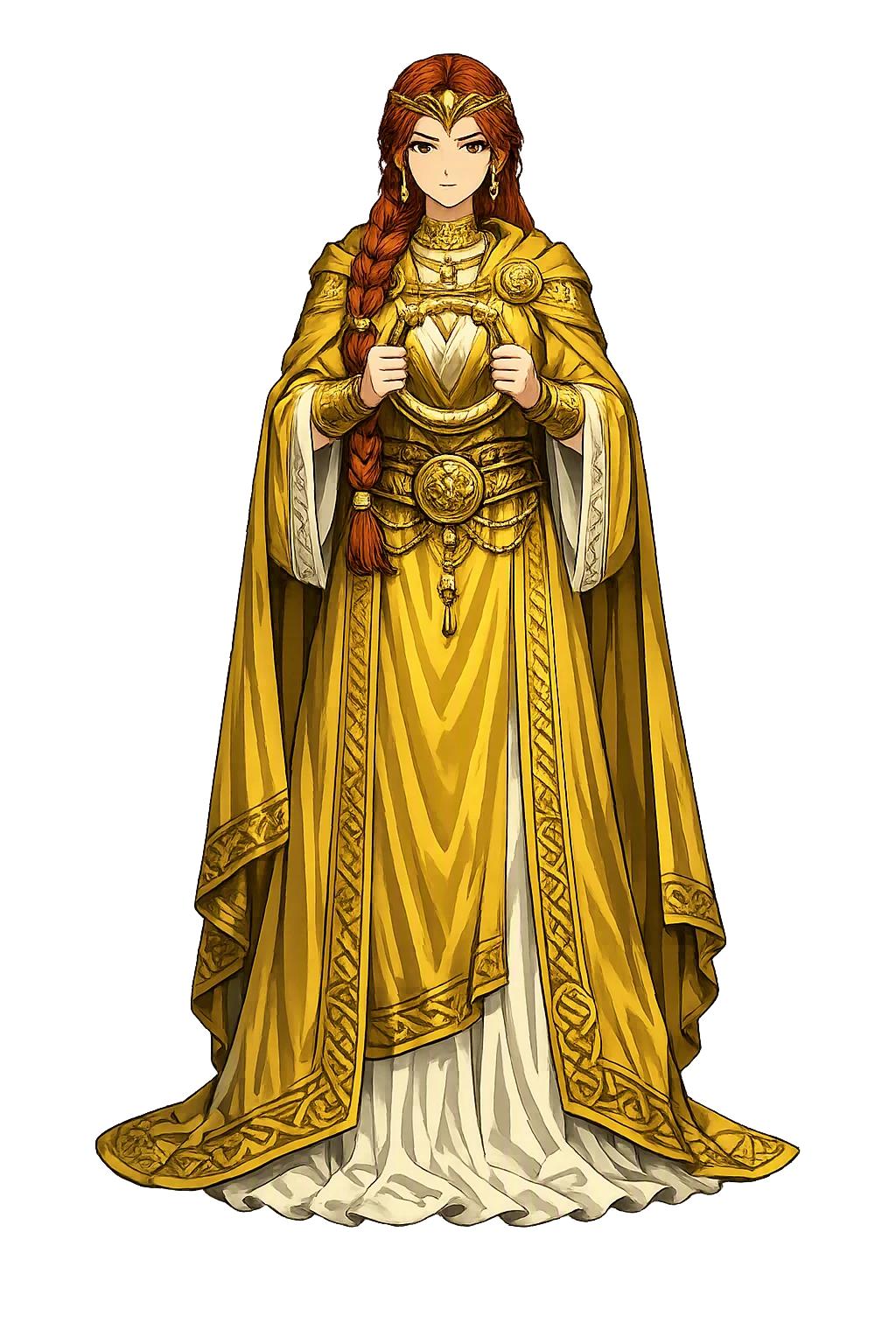
Pronouncing Vár: a guide for the curious
Saying Vár aloud is harder than reading it on a screen, and more rewarding. The restored spelling is a compressed pronunciation guide: every accent and macron is an instruction. This post unpacks those instructions — the reconstructed sound, the phoneme-by-phoneme record, the kindred forms in neighboring languages — and then zooms out to the full record around the name: its Younger Futhark writing, its mythology, its cult, and its modern life as a Unicode domain. Whether you arrive as a linguist, a reader of myth, or a domainer, you will leave able to say the name the way the evidence suggests it was said — and able to type it the way it was written.
At a Glance
- Restored name: Vár
- ASCII form: var
- Meaning: "Agreement, vow"
- Domain of influence: Oaths, Marriage Agreements
- Pantheon: Norse
- Restoration: Preserves stress
- Reconstructed form: ᚢᛅᛦ (Younger Futhark)
- Live domain: vár.com
Overview
Vár (var) — Agreement, Vow · Goddess of Oaths and Marriage Pacts — belongs to the Norse tradition, where she is catalogued under the domain "Oaths, Marriage Agreements". The name means "Agreement, vow".
Vár is one of the ásynjur, the female powers of the Norse pantheon, and is named in the Prose Edda as the goddess who hears the vows and agreements made between men and women, especially marriage contracts. Snorri explains her name as deriving from a word meaning 'vow' or 'pledge', and he adds that she punishes those who break their oaths. Her domain is therefore the sacred bond of speech — the promise that, once uttered, becomes a legal and moral reality.
PuniCodex restores the name as Vár and serves its temple at vár.com. The restoration preserves the acute accent on the a that the ASCII form loses, and exactly one historically valid Unicode restoration exists. The plain ASCII form var survives as a modern convenience imposed by the early domain-name system; the restoration, not the fallback, is the form the project defends as philologically complete.
The Name
The name is attested in Old Norse as Vár. Etymologically it means "Agreement, vow". The word vár is related to the concept of a pledge or contract, especially the marriage vow; it is also associated with spring (vár), and some scholars have debated whether the goddess's name is connected to the season of renewal. Snorri's etymology focuses on vows and agreements, making her the divine witness to human contracts.
The ASCII form var survives only because the early domain-name system could not carry diacritics; it is a technological compromise, not an ancient spelling. The Unicode restoration Vár recovers the acute accent of the original directly in the address bar. The original carries stress, and exactly one historically valid Unicode restoration exists.
The letter-by-letter transformation runs:
- v → V — Same, capitalized
- a → á — A with acute: stressed a
- r → r — Same
The project holds the domain vár.com as the canonical home of this name.
Etymology & Roots
The recorded derivation reads: Old Norse Vár, goddess who hears oaths and contracts; her name means "agreement, vow".
The root gloss is "agreement, vow."
The reconstruction is classed as attested.
The Original Script
The name is preserved in medieval Icelandic manuscripts in the Latin alphabet as Vár — Old Norse (North Germanic), attested 13th–14th c. CE in the codices of Snorri's Edda, recording material centuries older. Before the Latin bookhand, Old Norse names were carved in the Younger Futhark; no runic attestation of this name survives.
The scholarly rendering proceeds step by step:
- The normalized Old Norse spelling uses á (a with acute) for the long stressed vowel.
- In the Younger Futhark the name would have been carved approximately ᚢᛅᛦ, with the ᚢ-rune covering the v sound.
- The Unicode form Vár is a scholarly normalization that distinguishes the stressed long vowel from the plain ASCII form.
Pronunciation
The reconstructed pronunciation of the name is /vaːr/ — Old Norse Reconstruction.
Phoneme by phoneme:
- V- — Voiced labiodental fricative [v]
- -á- — Long open back [aː] with acute stress
- -r — Alveolar trill or tap [r]
For the modern speaker, the closest approximation is: 'VAHR' — one syllable, with a long, stressed 'ah'.
Kindred and historical forms of the name:
- Old Norse — Vár, the goddess of vows and marriage agreements
- Modern Icelandic — Vár, unchanged and still used as a given name
Vár preserves both features because the Norse form preserves the acute stress that ASCII loses. The restoration keeps that accent visible in the domain name.
Mythology
Vár's mythology is concentrated in a few sentences of Snorri's Prose Edda, but those sentences define a crucial domain: the sanctity of the spoken pledge.
In the Prose Edda
In Gylfaginning 35 and in the þulur, Snorri lists Vár among the ásynjur and explains her name: 'She hears the vows and agreements that men and women make with each other; therefore the holy vows are called várar'. He adds that she punishes those who break their vows. The passage makes her the divine enforcer of contract, a function essential to a society in which legal agreements were often oral and witnessed by the community.
Marriage and Law
In Old Norse society, marriage was a contractual arrangement between families, and the vows spoken at the wedding were binding on both parties and their kin. Vár's presence at such moments guaranteed that the pledge was heard by a power who could punish its breach. She thus bridges the domestic and the legal, the sacred and the social.
Relation to Vǫr
Vár is often discussed alongside Vǫr, the goddess of hidden knowledge and oaths. The two names are sometimes confused in modern sources, but their functions differ: Vǫr knows secrets, while Vár witnesses vows, especially those of marriage. Together they form a pair of judicial goddesses guarding speech and truth.
Goddess of Betrothal (Gylfaginning 35)
Snorri's entire dossier of Vár is a single sentence in Gylfaginning 35: 'The ninth is Vár. She hears the oaths and the private agreements that men and women make with each other. Therefore these agreements are called várar, and she punishes those who break them.' That is all — and it is enough. In one clause Snorri makes her the divine witness to the most consequential contract in a Norse life, the marriage vow; in the next he makes her its enforcer, the goddess who punishes. The etymology does real work, for the derivation runs both ways: because the word for a class of oaths, várar, was explained through her name, every solemn vow sworn in the plural invoked her. The mythology of the North is often terse, but nowhere else is a goddess's whole being compressed so exactly into what she guards — a promise spoken between two people, and heard by a third.
Oaths Called Várar (Legal vocabulary)
Old Norse legal language kept Vár alive after her myth faded. A vow could be sworn 'til Várar' — into Vár's keeping — and the sagas preserve the solemn mechanics of betrothal: the joined hands of bride and groom before witnesses, and the mundr, the bride-gift that made the match a contract rather than an abduction, counted before the assembly. Icelandic law — the betrothal clauses preserved in Grágás — treats the spoken agreement as binding in itself: once the vows were said before witnesses, the marriage existed, whatever the feast or the bedding later confirmed. Into this law Vár's name was written as the invisible witness. Cleasby–Vigfusson's dictionary records vár, 'a vow, betrothal,' and Zoëga confirms the sense; the goddess had become, in the most literal way, a grammatical fact of honor. When every binding promise in the language carried her name, she needed no temple: the law itself was her shrine.
Among the Goddesses of Order (Ásynjur lists)
Vár stands in the catalogues of divine order: the þulur, the mnemonic name-lists preserved with Snorri's Edda, count her among the Ásynjur, and Gylfaginning numbers her ninth among the goddesses 'who deserve to be named' for their powers. Her neighbors are instructive — Vǫr, the wise one who knows all things that come to pass; Sága, who sits drinking with Odin at Søkkvabekkr; Snotra, mistress of courtesy. These are the goddesses of the measured life: knowledge, memory, courtesy, and Vár's own province, the kept word. Simek and Lindow both note that this stratum of the pantheon reflects the values of the Icelandic Commonwealth — a society that had no king but did have law, where a man's word before witnesses was his whole security. Vár is the goddess such a society would have invented if it had not inherited her: the divine guarantor that speech binds, standing quietly ninth in the list, holding everything together.
Symbols & Iconography
The iconography associated with Vár centers on the sacred bond and the spoken word:
- The joined hands — the handshake or clasp that seals a vow
- The ring — the circular pledge of marriage, without beginning or end
- The drinking horn — the shared cup of the wedding feast, drunk in honor of the gods
- The contract or rune-stave — the written or carved record of agreement
- The spring flower — a secondary emblem derived from the homonymy with 'spring'
- The ring or handshake — The outward sign of the vow she witnesses
- The written or spoken contract — The words that bind, recorded in memory and law
- The hearth — The household founded upon the marriage agreement
Archaeology & Evidence
No cult site, votive deposit, or named image of Vár is known. Her attestation is entirely literary, confined to Snorri's Prose Edda. The relevant manuscripts are the principal codices of Snorri's Edda — the Codex Regius (GKS 2367 4to, early 14th c.), the Codex Wormianus, and the Uppsala Edda. The visual record is indirect: any image of a wedding scene or of a goddess receiving vows might evoke Vár, but no ancient image is labeled with her name.
Realm & Domain
Vár belongs to the Norse tradition as the goddess of vows, marriage agreements, and the spoken bond. Her domain is the moment when words become obligations and when two people or communities are joined by pledge.
Marriage Vows
She hears the vows exchanged between bride and groom and holds the contract sacred.
Oaths and Agreements
All formal pledges, especially those between men and women, fall under her gaze.
Punishment of Perjury
Snorri says that she punishes those who break their vows, making her a judicial as well as a nuptial figure.
Spring and Renewal
The homonymy of her name with the word for spring has led some scholars to associate her with seasonal renewal, though Snorri emphasizes the vow instead.
Witness of Vows
She is the goddess who hears and remembers every pledge made between lovers and kin.
Husbands' Oaths
Snorri says that women call upon Vár in matters of betrothal and the oaths between husbands and wives.
Sacred Bond
She guards the agreement that turns two households into one, the spoken contract at the heart of marriage.
Across Cultures
Vár has no direct foreign counterpart, but the goddess who guards marriage vows has parallels in the Greek Hera Teleia, the Roman Juno, and the Germanic figure of Freyja as patroness of weddings. Within the Norse tradition she is closest to Vǫr, the goddess of oaths and hidden knowledge, and to Frigg, the highest goddess associated with marriage and household.
Kindred figures in the PuniCodex cross-tradition index include Vǫr and Frigg, linked through oaths, marriage, and the sacred word.
Cultural Legacy
Vár is remembered in modern Heathen and Ásatrú wedding rituals as the goddess who hears and guards vows. Her name is sometimes invoked when couples make their pledges, and she remains a figure for the idea that marriage is not merely a private feeling but a public and sacred contract. The name Vár is also a modern Icelandic given name, carrying the old sense of spring as well as the divine vow. In scholarship she is studied as one of the minor ásynjur whose functions illuminate the legal and religious status of marriage in Norse society.
The Scholarly Record
The account of Vár given in this edition rests on the witnesses and reference works listed below. The Prose Edda supplies the only extended narrative; the dictionaries and handbooks secure the form and meaning of the name.
- Snorri Sturluson, Prose Edda, Gylfaginning 35 / Skáldskaparmál, trans. Anthony Faulkes, Everyman / Viking Society for Northern Research, 1220. Full text
- Cleasby, Richard, and Guðbrandur Vigfússon, An Icelandic-English Dictionary, 2nd ed. (Oxford: Clarendon Press, 1957), s.v. Vár.
- Zoëga, Geir T., A Concise Dictionary of Old Icelandic (Oxford: Clarendon Press, 1910).
- Simek, Rudolf, Dictionary of Northern Mythology, trans. Angela Hall (Cambridge: D. S. Brewer, 1993), s.v. Vár.
- Lindow, John, Norse Mythology: A Guide to the Gods, Heroes, Rituals, and Beliefs (Oxford University Press, 2001), s.v. Vár.
- Gordon, E. V., An Introduction to Old Norse, 2nd ed. rev. A. R. Taylor (Oxford: Clarendon Press, 1957).
A Meditation
Vár is the witness to every promise. She does not speak the vow; she hears it, and in her hearing it becomes real. In an age when contracts are often reduced to fine print and promises to performance metrics, she reminds us that the spoken word was once sacred enough to require a goddess. The restoration of her name in Unicode is a small act of recognition for the old conviction that a vow, once made, binds both speaker and world.
The Unicode Restoration
Vár preserves stress. The ASCII fallback var still resolves everywhere, but it is the restored form that carries the name's full information. Across the 3 characters of the name, the restoration adjusts 1: 1 mark of stress (á). That is the whole thesis of this temple: the marks are the message.
Character by Character
The journey from var to Vár, one character at a time:
- v → V — Same, capitalized
- a → á — Acute on a
- r → r — Same
The Domain Name
The restored name is live as a working domain: vár.com, which the DNS carries in punycode form as xn--vr-mia.com — an ASCII-compatible encoding that lets a non-ASCII name travel the global network without breaking older infrastructure. The visitor sees Vár; the machines see the encoding. That duality is the engineering compromise on which the entire restoration rests, and it is why a name written the way its own tradition wrote it in Younger Futhark can now be typed into any browser on earth.
The Norse Pantheon
Vár is one of 101 entries the PuniCodex lexicon catalogues under the Norse pantheon. The Pantheon page gathers the tradition's major figures in one place, and the Lexicon lets you filter all 983 restorations by tradition or script — the fastest way to see where this name sits among its kin.
Frequently Asked Questions
What does Vár mean? The traditional gloss is "Agreement, vow."
Which tradition does Vár belong to? Vár is catalogued in the Norse pantheon of the PuniCodex lexicon.
What does Vár preserve that ASCII cannot show? The form itself answers: Vár preserves stress — and the marks in the restored spelling are exactly that evidence.
Is Vár a working domain? Yes — vár.com resolves today and routes to this temple.
What is the punycode for vár.com? The DNS encoding is xn--vr-mia.com; browsers perform the translation automatically, so visitors only ever see the restored name.
Can I use Vár in a normal browser? Yes. The DNS resolves the punycode form automatically, and the type tool on this site converts var to Vár for copying and pasting.
Where does the scholarly information come from? The entry is built from lexica, inscriptional evidence, and reviewed scholarly sources listed in the Scholarly Edition. Every claim is traceable to a canonical source.
Why This Restoration Matters
Pronunciation turns out to be the heart of the matter. The marks in Vár are instructions for the voice, and a web that strips them is a web that mispronounces the past at scale. The restoration hands the instructions back: say it as the evidence suggests, type it as the tradition wrote it, and let the punycode machinery do the quiet translation in between. That is all the PuniCodex project asks of the infrastructure — and everything it asks of you, the reader, is to use the whole name.
Explore Further
This post is one doorway into the temple. The home page carries the full character breakdown and the ambient canvas; the lore page tells the myths in long form; the Scholarly Edition preserves the sources, pronunciation data, and revision history; and the patron wall supports the restoration directly. For the wider map, browse the Lexicon, explore the Pantheon, or return to the PuniCodex blog.
Related Names
Sources
The full scholarly apparatus — every citation, revision, and review — lives in the Scholarly Edition. Key references for this post:
- Snorri Sturluson, Prose Edda, Gylfaginning 35 / Skáldskaparmál, trans. Anthony Faulkes, Everyman / Viking Society for Northern Research, 1220.
- Cleasby, Richard, and Guðbrandur Vigfússon, An Icelandic-English Dictionary, 2nd ed. (Oxford: Clarendon Press, 1957), s.v. Vár.
- Lindow, John, Norse Mythology: A Guide to the Gods, Heroes, Rituals, and Beliefs (Oxford University Press, 2001), s.v. Vár.
- Snorri Sturluson, Prose Edda, Gylfaginning 35 / Skáldskaparmál, trans. Faulkes.
- Cleasby & Vigfússon, An Icelandic-English Dictionary, 2nd ed., s.v. Vár.
- Lexicon authorities for this entry: Prose Edda, Cleasby-Vigfusson.