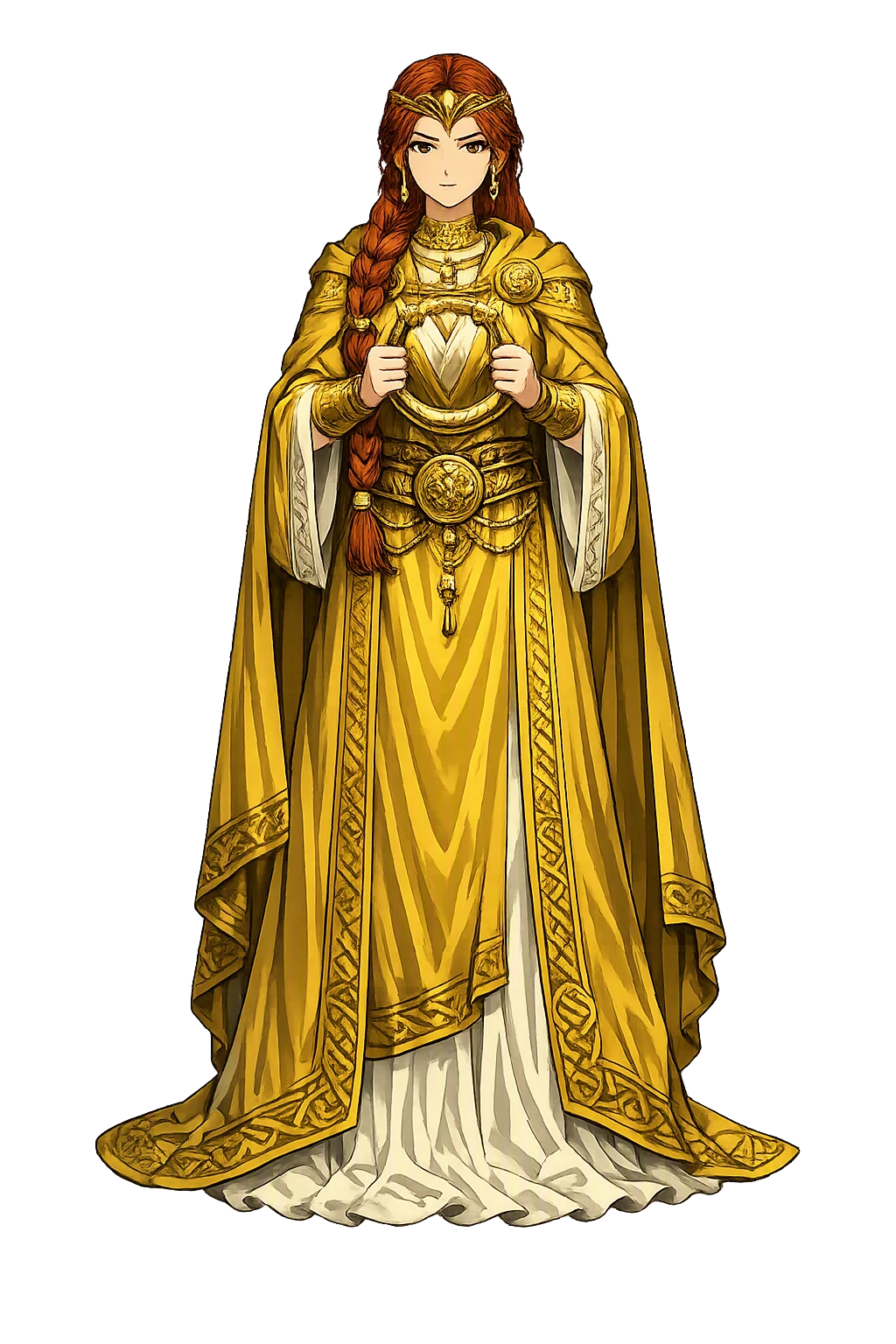
Stories of Vár
Vár's mythology is concentrated in a single paragraph of Snorri, but her importance is social: she is the divine sanction behind marriage. Around that one sentence grew a legal vocabulary, a ritual habit, and — in modern Heathenry — a revived cult.
Snorri's entire dossier of Vár is a single sentence in Gylfaginning 35: 'The ninth is Vár. She hears the oaths and the private agreements that men and women make with each other. Therefore these agreements are called várar, and she punishes those who break them.' That is all — and it is enough. In one clause Snorri makes her the divine witness to the most consequential contract in a Norse life, the marriage vow; in the next he makes her its enforcer, the goddess who punishes. The etymology does real work, for the derivation runs both ways: because the word for a class of oaths, várar, was explained through her name, every solemn vow sworn in the plural invoked her. The mythology of the North is often terse, but nowhere else is a goddess's whole being compressed so exactly into what she guards — a promise spoken between two people, and heard by a third.
Old Norse legal language kept Vár alive after her myth faded. A vow could be sworn 'til Várar' — into Vár's keeping — and the sagas preserve the solemn mechanics of betrothal: the joined hands of bride and groom before witnesses, and the mundr, the bride-gift that made the match a contract rather than an abduction, counted before the assembly. Icelandic law — the betrothal clauses preserved in Grágás — treats the spoken agreement as binding in itself: once the vows were said before witnesses, the marriage existed, whatever the feast or the bedding later confirmed. Into this law Vár's name was written as the invisible witness. Cleasby–Vigfusson's dictionary records vár, 'a vow, betrothal,' and Zoëga confirms the sense; the goddess had become, in the most literal way, a grammatical fact of honor. When every binding promise in the language carried her name, she needed no temple: the law itself was her shrine.
Vár stands in the catalogues of divine order: the þulur, the mnemonic name-lists preserved with Snorri's Edda, count her among the Ásynjur, and Gylfaginning numbers her ninth among the goddesses 'who deserve to be named' for their powers. Her neighbors are instructive — Vǫr, the wise one who knows all things that come to pass; Sága, who sits drinking with Odin at Søkkvabekkr; Snotra, mistress of courtesy. These are the goddesses of the measured life: knowledge, memory, courtesy, and Vár's own province, the kept word. Simek and Lindow both note that this stratum of the pantheon reflects the values of the Icelandic Commonwealth — a society that had no king but did have law, where a man's word before witnesses was his whole security. Vár is the goddess such a society would have invented if it had not inherited her: the divine guarantor that speech binds, standing quietly ninth in the list, holding everything together.
No Eddic poem tells a story of Vár, so modern Ásatrú and Heathen communities have returned her to the place she never truly left: the wedding. Contemporary Heathen marriage rites invoke her by name as witness while the couple speaks its vows and joins hands, sometimes over an oath-ring or a hammer, consciously restoring the ancient structure in which a third party — goddess, kindred, law — stood behind every promise. The sources for the old rite are indirect, and honest scholarship says so: the sagas describe vows exchanged and hands joined at the betrothal feast, and the law codes count the witnesses, but the ancient invocations themselves are lost. Yet the function is perfectly clear, because it never stopped being true. A vow needs a hearer, and the North chose a goddess. When modern couples speak their promises in the sight of Vár, they are pronouncing the oldest sentence in her cult — the one Snorri recorded.
Goddess of Betrothals and Marriage Agreements
Vár is the goddess who hears the vows that bind. Her name is the Old Norse word for "pledge" or "betrothal," and she is invoked whenever men and women make marriage agreements. In Snorri's catalogue she is one of the Ásynjur, the divine witness to contracts of the heart and the household.
She is the goddess who hears and remembers every pledge made between lovers and kin.
Marriages were made in her name; to break a vow sworn to Vár was to invite her judgment.
Snorri says that women call upon Vár in matters of betrothal and the oaths between husbands and wives.
She guards the agreement that turns two households into one, the spoken contract at the heart of marriage.
From the original script to the living URL
ᚢᛅᚱ
The name in its original Norse form. Vár (ᚢᛅᚱ) is attested in the source tradition — “Agreement, vow”. Its acute stress marks carry the full phonetic and orthographic weight of the source tradition.
var
Reduced to plain var, the name loses everything that made it specific: acute stress marks. What remains is an ASCII string that machines can parse but that no longer speaks with its original voice.
Vár
The Unicode restoration recovers what ASCII flattened. Vár restores acute stress marks, returning the name to its original written dignity. The domain encodes to Punycode, but the browser displays the truth.
Vár.com → xn--vr-mia.com
The non-ASCII characters in Vár are encoded while the ASCII remains visible. To the DNS, it is Punycode. To humanity, it is Vár.
Owned, ideal, and ASCII forms of Vár
Vár
Restores ᚢᛅᚱ. The live temple domain — vár.com.
var
Flattens ᚢᛅᚱ. The plain ASCII fallback — what DNS and legacy systems see.
How Vár was spoken
How Vár travels from ancient script to the modern URL
The lore you have read is the living myth. Extended Lore opens the scholarly vault beneath it: the cult and its material remains, a history of the image, the name after antiquity, a meditation on what the name still means, and the full scholarly apparatus — etymology, orthography, sources.
Enter Extended Lore