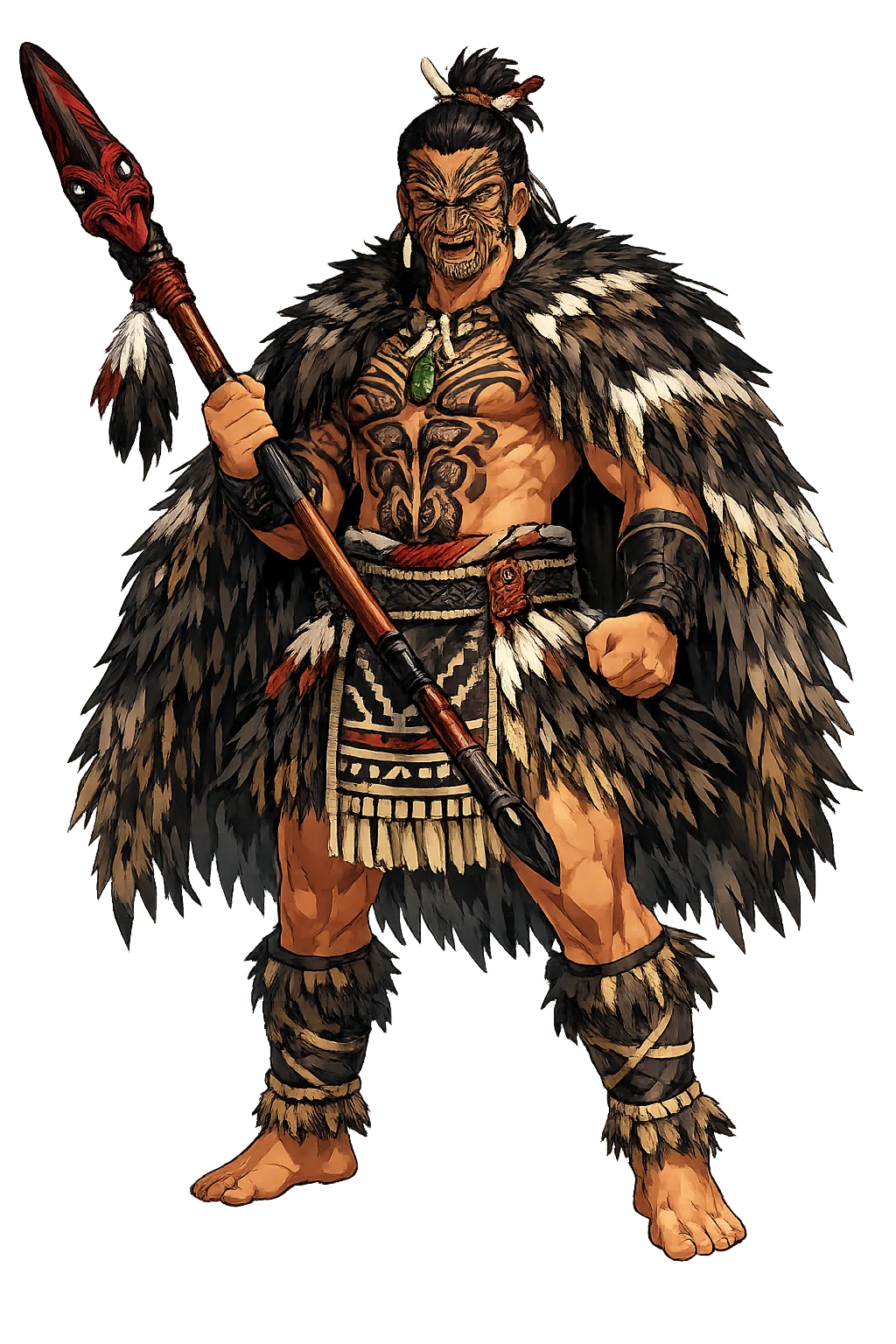
Stories of Tūmatauenga
Tūmatauenga's cycle is the Polynesian account of how humanity got its arts: not by gift but by conquest — the war-god subduing his elemental brothers and distributing the spoils to his mortal children.
In the beginning the Sky Father Ranginui and the Earth Mother Papatūānuku lay locked together in an embrace, and their children lived crushed in darkness between them. Among the sons was Tūmatauenga, fiercest of them all. When the brothers debated what to do, it was Tū who urged the final solution — kill the parents and have done. The others recoiled at the thought of slaying their own father and mother, and the gentler counsel of Tāne prevailed: the parents would be forced apart, not slain (Grey, Polynesian Mythology, the legend of the children of Rangi and Papa). Rongo, Tangaroa, Haumia, and Tū himself tried to push the parents and failed; then Tāne set his head on the earth, his feet against the sky, and tore the parents open. Light came into the world — and Tāwhirimātea, who had loved the darkness, went to war over it. The myth is exact about its genealogy of war: strife is not an intruder into creation but a sibling of the light itself, born the moment separation was chosen.
Tāwhirimātea, god of winds and storms, had opposed the separation of his parents, and now he took war to his brothers in revenge, riding the weapon-winds of his storm-army. Tangaroa fled to the sea; Tāne withdrew into the forests; Rongo and Haumia thrust themselves into the earth — but Tūmatauenga alone stood fast on the open plain, unbowed under the tempest (Grey, Polynesian Mythology). When the storm at last spent itself, the standing one turned on his fleeing brothers and made their domains his own: he wove nets and took Tangaroa's fish, set snares for Tāne's birds, and dug into the earth for Rongo's kūmara and Haumia's fern-root. His name is the doctrine: tū means 'to stand'. War, in the Māori telling, is first of all a posture — the refusal to move when everything else runs — and only secondly a weapon; the whole later tradition of the haka, the pūkana, and the pa is that posture made communal.
By subduing his brothers, Tūmatauenga made their realms noa — common, usable — and so gave humankind its technologies: the net and hook for the sea, the snare for the forest, the digging-stick for the garden. The karakia of planting, fishing, fowling, and war all carry his name, for every tapu those arts break was broken first by him; Best and Tregear record his invocation where food is made safe to eat. The cycle thus makes the fiercest god the culture-bringer: not Tāne the gentle separator but Tū the stander, who gathered what the storm scattered and portioned it out. The distribution is the myth's second doctrine. What war wins must be handed on; the conqueror who keeps everything for himself defeats the purpose of standing, and the tribe that forgets how to feed itself has lost the spoils twice.
The tradition gives the war-god a family larger than any brotherhood: humankind itself. Tregear records the phrase he tamaiti nā Tū — 'a child of Tū' — as a way of naming a human being (The Maori-Polynesian Comparative Dictionary, s.v. Tu), and the southern branches of the family tell the same descent as genealogy: in Tahiti, Tū is not only the war-god but the first ancestor, the root of the human line (Henry, Ancient Tahiti). The Māori cycles draw the moral plainly. The brothers who fled or hid left their domains to be taken; the one who stood gave humans his own nature — fierceness, endurance, and the habit of war. To be human, in this theology, is to have inherited the furious face; the arts of peace, Rongo's garden and Tangaroa's sea, are the domains of humankind's gentler uncles, conquered and kept only because their fierce brother stands guard over them.
War, the Angry Face, and the Taming of the Brothers
Tūmatauenga is the Māori god of war and of humanity's fierce inheritance: the one son of the Sky Father who stood firm when the storm-god attacked, and who then subdued his own brothers — taking their fishes, their birds, and their crops — to feed the people he had made. War, in his story, is the price of standing.
The flat greenstone club of the chief — the weapon that is also a badge of rank and a gift of state.
His name: the war-face (pūkana) that the haka still performs with widened eyes and out-thrust tongue.
He snared his brother Tangaroa's fish: the arts of fishing, won by war and given to man.
The fortified hill-settlement — his architecture, crowning New Zealand's ridgelines by the thousand.
From the original script to the living URL
Tūmatauenga
The name survives only in scholarly transliteration. Tūmatauenga is the standard Polynesian romanisation, documented in academic sources — “'The man of furious face' (tū + mata + ēngā), god of war and of humankind”. Its macron-length vowels preserve distinctions lost in plain ASCII.
No indigenous writing system is securely attested for individual polynesian names. The form shown is a modern scholarly transliteration.
tumatauenga
Reduced to plain tumatauenga, the name loses everything that made it specific: macron-length vowels. What remains is an ASCII string that machines can parse but that no longer speaks with its original voice.
Tūmatauenga
The Unicode restoration recovers what ASCII flattened. Tūmatauenga restores macron-length vowels, returning the name to its original written dignity. The domain encodes to Punycode, but the browser displays the truth.
Tūmatauenga.com → xn--tmatauenga-5dc.com
The non-ASCII characters in Tūmatauenga are encoded while the ASCII remains visible. To the DNS, it is Punycode. To humanity, it is Tūmatauenga.
Owned, ideal, and ASCII forms of Tūmatauenga
Tūmatauenga
The live temple domain — tūmatauenga.com.
tumatauenga
The plain ASCII fallback — what DNS and legacy systems see.
How Tūmatauenga was spoken
How Tūmatauenga is preserved in writing
No indigenous writing system is securely attested for individual polynesian names. The form shown is a modern scholarly transliteration.
Contribute scholarly provenance →The lore you have read is the living myth. Extended Lore opens the scholarly vault beneath it: the cult and its material remains, a history of the image, the name after antiquity, a meditation on what the name still means, and the full scholarly apparatus — etymology, orthography, sources.
Enter Extended Lore