PuniCodex

Extended Lore

Tūmatauenga

Etymology · Orthography · Cult · Iconography · Reception · Sources

Tier 1 Tūmatauenga.com
Tūmatauenga — War, Humanity, Strength
01

Quick Facts

Essential information about Tūmatauenga, War, Humanity, Strength

Scholarly TransliterationTūmatauenga
Unicode RestorationTūmatauenga
Reconstructed Pronunciation/tuː.ma.taʊ.ˈe.ŋa/
PantheonPolynesian
DomainWar, Humanity, Strength
Meaning'The man of furious face' (tū + mata + ēngā), god of war and of humankind
ClassificationTier 1
Primary DomainTūmatauenga.com
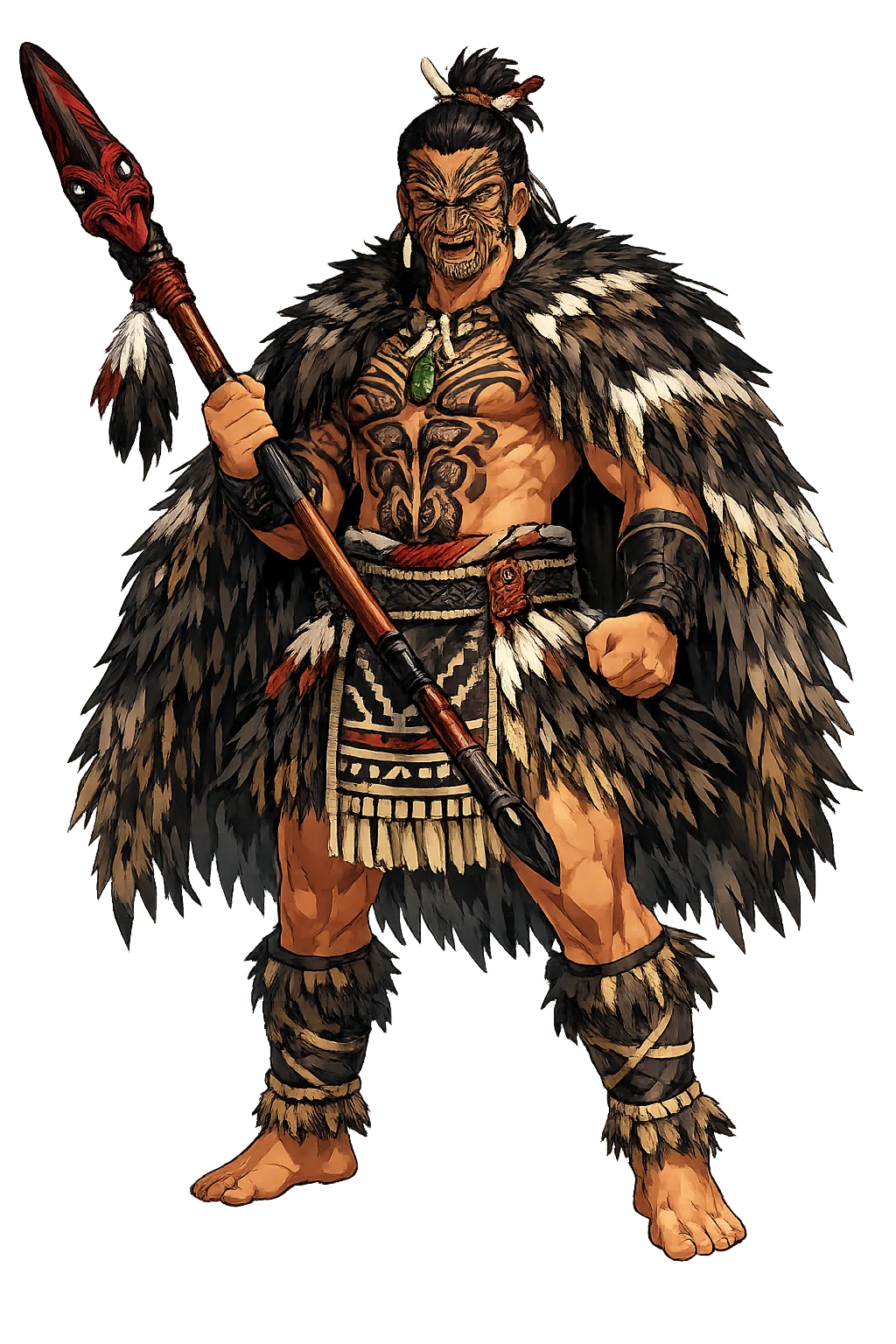
Sacred SymbolsThe taiaha, The haka, The pūkana, The feather cloak
02

Etymology & Word Family

From original script to Unicode restoration

Scholarly Transliteration Tūmatauenga Tūmatauenga — "'The man of furious face' (tū + mata + ēngā), god of war and of humankind"
Unicode Restoration Tūmatauenga Restored stress, length, and script
Modern ASCII tumatauenga Plain-ASCII fallback

The name Tūmatauenga carries the orthographic signature of the polynesian tradition. Unicode restoration recovers what ASCII flattens.

03

Unicode Character Breakdown

Character-by-character philological analysis

CharacterUnicodeNameBlockPhonetic Role
TU+0054Latin Capital Letter TBasic LatinSame letter
ūU+016BLatin Small Letter U with MacronLatin Extended-AMacron marks the long vowel
mU+006DLatin Small Letter MBasic LatinSame letter
aU+0061Latin Small Letter ABasic LatinSame letter
tU+0074Latin Small Letter TBasic LatinSame letter
aU+0061Latin Small Letter ABasic LatinSame letter
uU+0075Latin Small Letter UBasic LatinSame letter
eU+0065Latin Small Letter EBasic LatinSame letter
nU+006ELatin Small Letter NBasic LatinSame letter
gU+0067Latin Small Letter GBasic LatinSame letter
aU+0061Latin Small Letter ABasic LatinSame letter

The Tier 1 classification reflects how much of the original phonology this restoration preserves — stress and vowel length for Greek names, distinctive letters and diacritics for every other tradition.

04

Cult & Worship

How the sacred was kept — rites, sanctuaries, remains

The Cult

No separate priesthood served Tūmatauenga in the way a temple cult would demand; his ritual presence was diffused through karakia spoken over war parties and through the taiaha and greenstone mere that carried his authority. The fortified pa on New Zealand ridgelines were themselves his sanctuaries, their terraced earthworks the architecture of his domain. Warriors invoked him before battle, and the planting karakia that followed conflict acknowledged that the same force which took life must also restore food. In the modern era the New Zealand Army bears the name Ngāti Tūmatauenga, turning an ancient war deity into the custodian of state violence and remembrance.

In the Earth

New Zealand's ridgelines keep his monuments: thousands of pa — terraced, ditched, and palisaded hill-forts — from the classic period, with sites like Maungakiekie (One Tree Hill) among the largest earthworks of the Pacific. The greenstone mere and the carved taiaha of the museum collections (Te Papa's among them) are his regalia; the Auckland War Memorial Museum — itself a cenotaph to the fallen — houses the war-canoes and the martial taonga of his people. The kūmara storage-pits beside every pa tie his war-and-garden cycle into the ground itself.

05

Iconography

How Tūmatauenga was imaged across the ages

The Image

Tūmatauenga was never fixed in a single anthropomorphic cult statue; his image resided in weapons and posture. The greenstone mere and carved taiaha preserved in museums such as Te Papa are his surviving regalia, their surfaces polished by handling and combat. Wooden tiki and hei forms, with fierce grimacing mouths, conveyed the same furious countenance implied by his name. Prow and sternpost carvings on war canoes, and the elaborately carved gateways of pa, made his presence visible without depicting him bodily. Where a human figure appears, it is the warrior-leader himself, armed and tattooed, standing in for the god.

06

Reception & Transformation

The name after its own age — transmission, translation, survival

Afterlives

Tūmatauenga entered the written record only with colonial ethnography: George Grey's Polynesian Mythology (1855) and Edward Tregear's comparative dictionary fixed the Māori narrative in print for European audiences, though the whakataukī and war karakia had kept him alive in oral transmission for centuries. The myth of the children of Rangi and Papa became a touchstone of Māori identity during the nineteenth-century land wars and the later cultural renaissance, when the separation of heaven and earth was read as a charter for Māori autonomy. His adoption as the Army's tribal name in the 1990s reframed the deity as a symbol of controlled force and national service, a striking modern afterlife for a figure born from celestial violence. The name survives, too, in school curricula and on public monuments, where he stands for both martial pride and the cost of war.

Identifications Across Traditions

He is one face of a Polynesian-wide god: Hawaiian Kū — the great war-god of the heiau temples — Tahitian Tū, first ancestor as well as war-god, and the Cook Islands' war deities share his name and his office, the deepest layer of pan-Polynesian religion. In New Zealand his worship ran through the war-parties and their tohunga; the nineteenth-century Māori military genius — the gunfighter pa of the New Zealand Wars — applied his standing to musket and trench, and the New Zealand Army today bears his name as its own: Ngāti Tūmatauenga, 'the tribe of the war-god.' The identification is unique in the modern world: no other ancient deity is the officially patron ancestor of a modern state's armed forces.

Modern Legacy

The haka — performed by the All Blacks before every match and by the army at every farewell — is his face in modern life: the widened eyes and out-thrust tongue are the literal mata of his name. Ngāti Tūmatauenga, the army's Māori designation, makes him the only ancient god officially patron of a modern state's armed forces. His cycle — the standing against the storm, the conquest that feeds the people — remains the charter myth of Māori resilience, quoted in land-march speeches and waiata alike.

07

The Meditation

What Tūmatauenga means — beyond the dictionary

Tūmatauenga is the god of standing your ground — and of what standing costs. He alone faced the storm, and so he alone could feed the people; but the myth hides nothing: his fierceness proposed killing the parents, and his victories are his brothers' defeats. He asks the hardest question of every defender: what are you standing against — and what, when you have won, will your strength feed?

08

Frequently Asked Questions

Common questions about Tūmatauenga, War, Humanity, Strength, and Unicode restoration

01How do you pronounce Tūmatauenga?

In reconstructed pronunciation, Tūmatauenga is /tuː.ma.taʊ.ˈe.ŋa/ — approximately TOO-mah-tow-ENG-ah, long ū on the first syllable.

02What does Tūmatauenga mean?

Tūmatauenga means 'The man of furious face' (tū + mata + ēngā), god of war and of humankind in the polynesian tradition.

03What are the symbols of Tūmatauenga?

Tūmatauenga is associated with The taiaha (The long staff-weapon of chiefly combat — spear and club in one lineage), The haka (The war-dance: the body made into the angry face of the god, rehearsed before every contest of the tribe), The pūkana (The widened eyes and out-thrust tongue of the war-face — the literal mata of his name, worn by every performer), The feather cloak (The kahu huruhuru of the war-chief — honour worn on the shoulders, ransom and glory in one garment).

04Why restore Tūmatauenga in Unicode?

Plain ASCII tumatauenga strips the stress, length, and script that make the name specific. Unicode restoration returns the name to its original written dignity.

05What is the most important myth about Tūmatauenga?

“The Sons of Ranginui and Papatūānuku” — the The Separation story that anchors the mythology of Tūmatauenga, told in full on the lore page.

09

Scholarly Sources

The philological foundations of this restoration

Every claim on this page is grounded in established scholarship. The orthographic restorations follow disciplinary convention. The etymological chain follows the best available reference works. This is not invention — it is resurrection through scholarship.

◈

Lexicography & Philology

  • Grey, Polynesian Mythology
  • Best
  • Tregear
◎

Primary Texts

  • Primary sources in the polynesian tradition for Tūmatauenga.
◉

Archaeology & Art History

  • Material evidence — iconography, inscriptions, and temple archaeology — for Tūmatauenga and related cults.
✦

Religious Studies

  • Grey, Polynesian Mythology (1855), the legend of the children of Rangi and Papa
  • Tregear, The Maori-Polynesian Comparative Dictionary (1891), s.v. Tu-mata-uenga
  • Best, Māori Religion and Mythology
  • Orbell, A Concise Encyclopedia of Māori Myth and Legend (1998)
  • Beckwith, Hawaiian Mythology (1940), s.v. Kū
Return

The Surface Awaits

You have traced the name from its earliest attestation to its Unicode restoration. Now return to the myth. The story is where the name lives.

Back to Lore
Tūmatauenga mascot