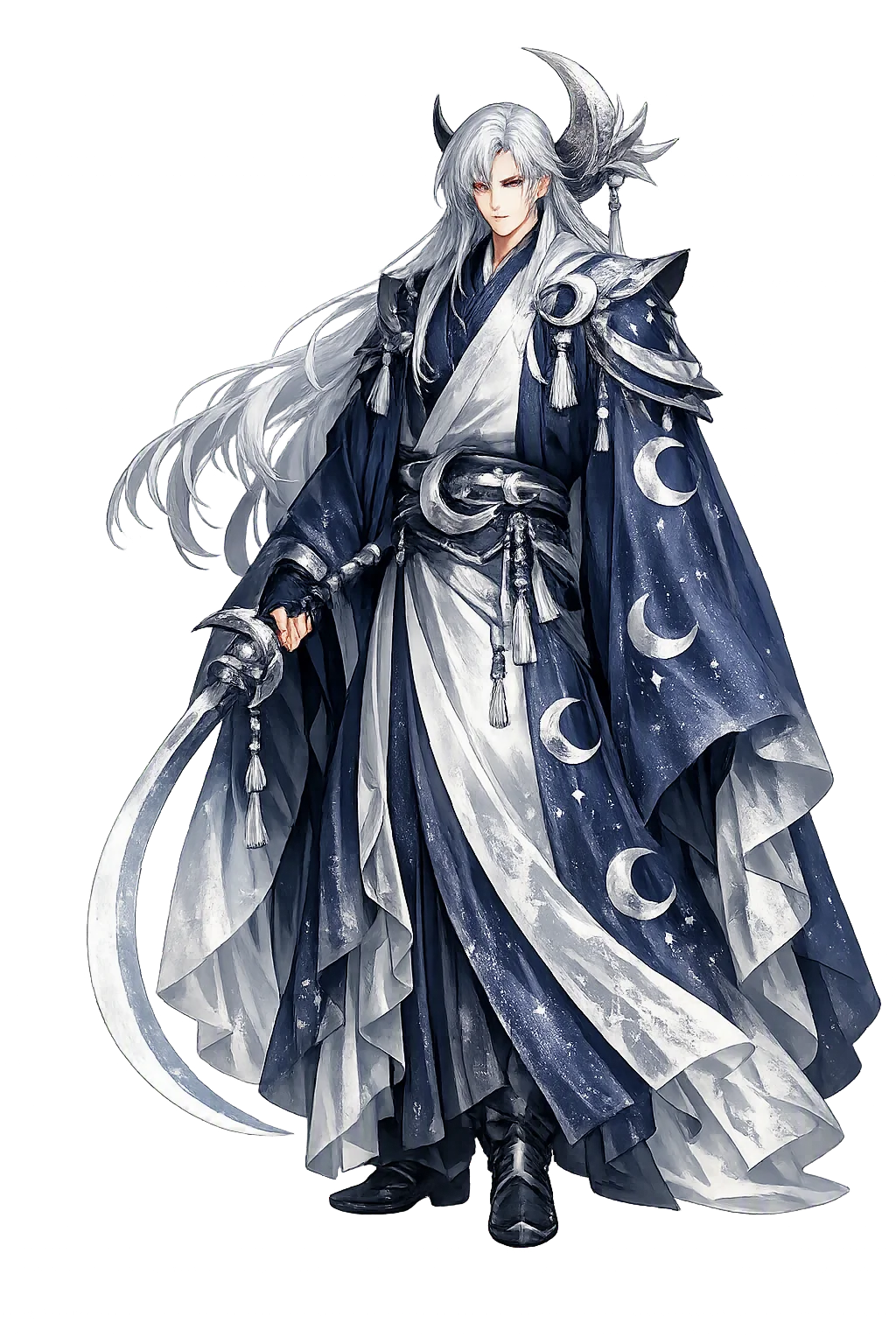
Stories of Tsukuyomi
Tsukuyomi's mythology is the shortest dossier of the three celestial siblings, and the chronicles themselves treat him as an afterthought. What survives is one birth, one killing, and one eternal estrangement — enough to divide the sky.
After his escape from Yomi, Izanagi washed away the pollution of the underworld, and the three great sovereign deities came from his face: Amaterasu from the left eye, Tsukuyomi from the right eye, and Susanoo from the nose (Kojiki 1). Izanagi appointed Amaterasu to rule the day and Tsukuyomi the night, dividing the luminous and dark halves of the world between the siblings. Where Amaterasu received her father's necklace and the highest heaven, Tsukuyomi received no emblem — a first hint of how thin his dossier would remain. His name joins tsuku, the moon, with yomi, read as 'night' or as 'counting,' the deity who numbers the months. The myth establishes the moon as the sun's twin: born in the same instant of purification, ruling the complementary half of the sky.
Amaterasu heard of a wondrous goddess of food, Uke-mochi, and sent Tsukuyomi to look upon her. Uke-mochi turned toward the land and from her mouth and body produced a banquet — boiled rice, millet, and every grain (Kojiki 1). Tsukuyomi was revolted: a meal that issued from a body was pollution itself, and he drew his blade and killed her. Amaterasu's anger was immediate and eternal — she declared him an evil god she would never again face, and from that moment the sun and moon kept separate courses. From Uke-mochi's slain body the useful world sprang: silkworms from her head, rice from her eyes, millet from her ears, beans from her nose, wheat and soy from her lower body (Nihon Shoki 1). The myth weighs purity against fecundity: the moon's fastidious blade cuts the night off from the very source of food.
The Kojiki gives no further adventures of Tsukuyomi — his entire narrative after the killing is one sentence of divine estrangement. Amaterasu, as sovereign of the day, pronounced the sentence; the moon god departed, and the chronicle lets him go without a shrine, a child, or another deed. Later readers noticed the astronomy already inside the story: the moon that strikes down the goddess of food is the moon that rules the night in which nothing grows; the sun that refuses to see him is the sun under whose gaze the five grains ripened from Uke-mochi's body. The separation is thus both an eternal feud and a daily rotation — estrangement written across the sky as the alternation of day and night, the celestial siblings meeting only at the thresholds of dawn and dusk, and never face to face.
The compilers of the Nihon Shoki reproduce several variant accounts of the celestial birth, and their disagreements are themselves informative: the recensions differ in the occasion of the washing and in small details of order, and one tradition lets Tsukuyomi's name be read as 'moon-counter,' the deity who numbers the months; the Kojiki grants him the grand style Tsukuyomi-no-mikoto, 'His Augustness Moon-Night,' and then never uses it again. No variant gives him a further myth. The scholarly conclusion is sober: unlike his siblings, Tsukuyomi attracted no cycle of tales — perhaps, as some have argued, because the moon's waxing and waning were read through other divinities in the popular cults. His faintness in the record is the most distinctive thing about him: the god of the night keeps to the edges of the text, exactly as the moon keeps to the edges of the day.
Lunar Order, Separation, and Celestial Sibling
Tsukuyomi is the moon kami of Japanese myth, born from Izanagi's right eye when the creator washed away the pollution of Yomi. He rules the night and the counting of months, and his entire narrative turns on a single act of violence that separated him forever from the sun.
Ruler of the night sky and the lunar calendar that numbers the months.
Born with her from Izanagi's purification — the night's twin of the day.
He governs the realm opposite the sun, where nothing ripens.
His killing of Uke-mochi divided him from Amaterasu into day and night.
From the original script to the living URL
月読
The name in its original Japanese form. Tsukuyomi (月読) is attested in the source tradition — “Moon reader”. Its original diacritics and script distinctions carry the full phonetic and orthographic weight of the source tradition.
tsukuyomi
The plain tsukuyomi form is identical to the Unicode restoration. Because this name is already written in Latin letters, no diacritics, stress, or script information were lost — only capitalization differs.
Tsukuyomi
The Unicode restoration does not need to recover lost marks for Tsukuyomi. Its value is canonical spelling and consistent cataloguing, not the reconstruction of erased orthography. The domain is readable as-is to both DNS and humanity.
Tsukuyomi.com
This restoration is written entirely in ASCII letters — no Punycode encoding stands between Tsukuyomi and the DNS. The domain reads identically to machines and to human eyes.
Owned, ideal, and ASCII forms of Tsukuyomi
Tsukuyomi
Restores 月読. The full Unicode restoration. tsukuyomi.com is not in the PuniCodex collection — it is watched for release; if it drops, this temple upgrades to an owned flagship.
How Tsukuyomi was spoken
How Tsukuyomi is preserved in writing
A bespoke provenance study for Tsukuyomi is being prepared by the PUNICODEX scholarly team.
Contribute scholarly provenance →The lore you have read is the living myth. Extended Lore opens the scholarly vault beneath it: the cult and its material remains, a history of the image, the name after antiquity, a meditation on what the name still means, and the full scholarly apparatus — etymology, orthography, sources.
Enter Extended Lore