
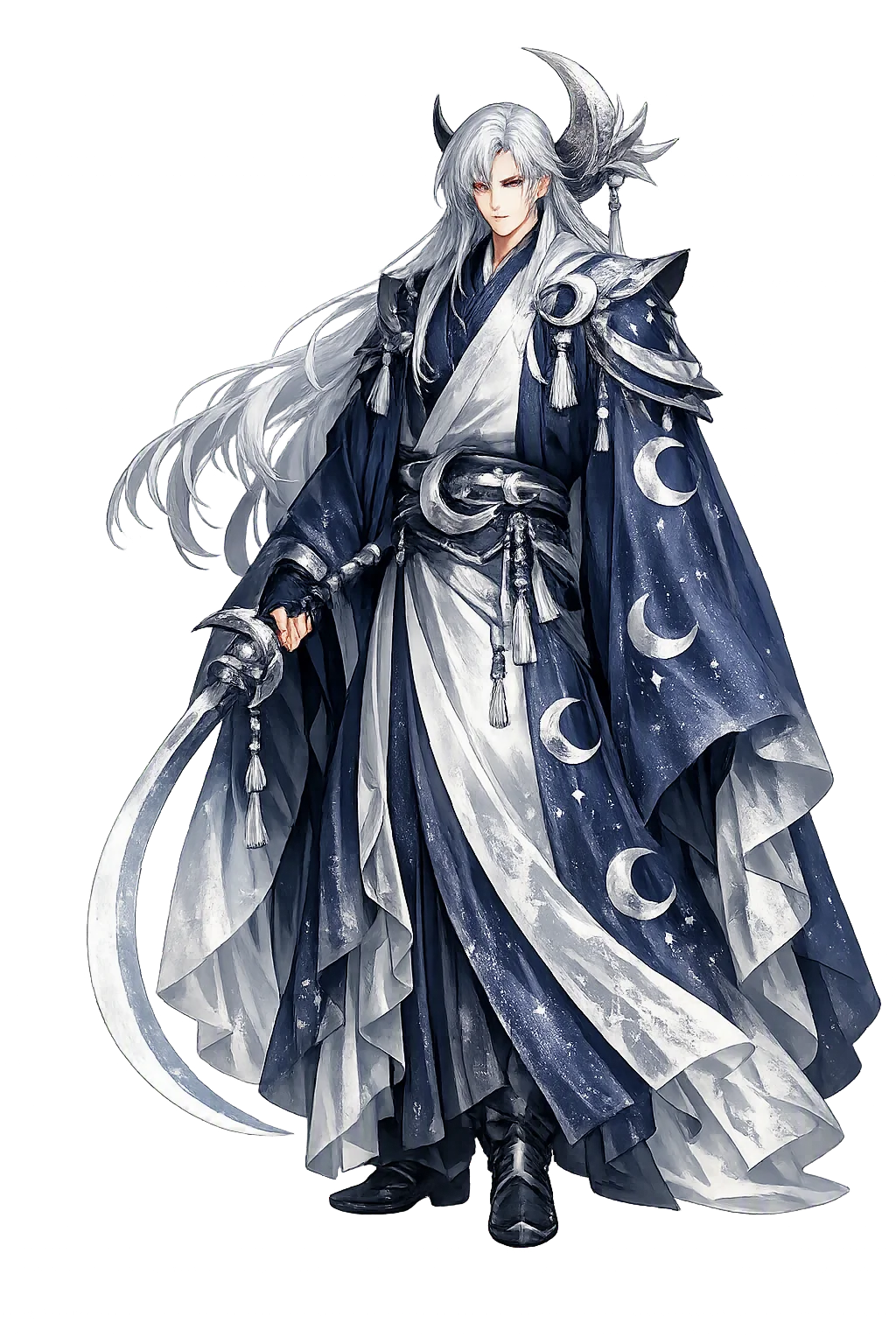
Tsukuyomi: the stories first, then the spelling
You cannot weigh an accent without knowing what it carries. Here is what Tsukuyomi has been carrying.
The Stories That Carry the Name
From the Right Eye of Izanagi. After his escape from Yomi, Izanagi washed away the pollution of the underworld, and the three great sovereign deities came from his face: Amaterasu from the left eye, Tsukuyomi from the right eye, and Susanoo from the nose (Kojiki 1). Izanagi appointed Amaterasu to rule the day and Tsukuyomi the night, dividing the luminous and dark halves of the world between the siblings. Where Amaterasu received her father's necklace and the highest heaven, Tsukuyomi received no emblem — a first hint of how thin his dossier would remain.
The Feast of Uke-mochi. Amaterasu heard of a wondrous goddess of food, Uke-mochi, and sent Tsukuyomi to look upon her. Uke-mochi turned toward the land and from her mouth and body produced a banquet — boiled rice, millet, and every grain (Kojiki 1). Tsukuyomi was revolted: a meal that issued from a body was pollution itself, and he drew his blade and killed her.
Why Sun and Moon Never Meet. The Kojiki gives no further adventures of Tsukuyomi — his entire narrative after the killing is one sentence of divine estrangement. Amaterasu, as sovereign of the day, pronounced the sentence; the moon god departed, and the chronicle lets him go without a shrine, a child, or another deed. Later readers noticed the astronomy already inside the story: the moon that strikes down the goddess of food is the moon that rules the night in which nothing grows; the sun that refuses to see him is the sun under whose gaze the five grains ripened from Uke-mochi's body.
And Here Is What the Spelling Preserves
Against those stories, the attestation: 月読, as Kojiki 1 (birth, Uke-mochi episode) and Nihon Shoki 1 (variant birth accounts, the five grains) record. The name means "Moon reader".
At a Glance
- Restored name: Tsukuyomi
- ASCII form: tsukuyomi
- Meaning: "Moon reader"
- Domain of influence: Moon God, Shintō
- Pantheon: Japanese
- Classification: Tier 2
- Original script: 月読
- Series: The Restoration Files, No. 499 of 548
The Name Travels
Tsukuyomi was drawn early into the Buddhist astronomy that mapped the pantheon onto the heavens: in esoteric mandalas the lunar deity appears among the devas as a moon-disc (gachirin), and medieval Shinto-Buddhist thought quietly read the moon kami as Dainichi's reflected light — the moon as borrowed radiance, a natural metaphor for compassion that mirrors its source. In honji-suijaku terms he attracted no major buddha of his own, and his cult shrank as Amaterasu's and Susanoo's grew.
The Address It Earned
The temple of Tsukuyomi stands at /tsukuyomi/ — lore, scholars, patterns — because a name carrying this much story deserves more than a parking page. Tier-2 here means one preserved truth — not less important, just singular. The temple shows it and names it.
The Sources Are Open
The myths above are retold from the temple's record; the primary voices are in the Sacred Texts: Kojiki and Nihon Shoki. Nothing in this file outranks them.
The File Continues
Read the founding dispatch for the name's full story, the Resonance File for the archetype at work — or the whole archive in one sitting.
Continue the series — previous file: Troíā (read it here) · next file: Tūmatauenga (read it here).
The Restoration Files are written from the same canonical record as the temples themselves: the lexicon, the lore catalog, the pattern atlas, and the cited scholarly sources. If a file ever disagrees with its temple, the temple is right — tell us, and the file will be corrected.