Stories of Trengtreng
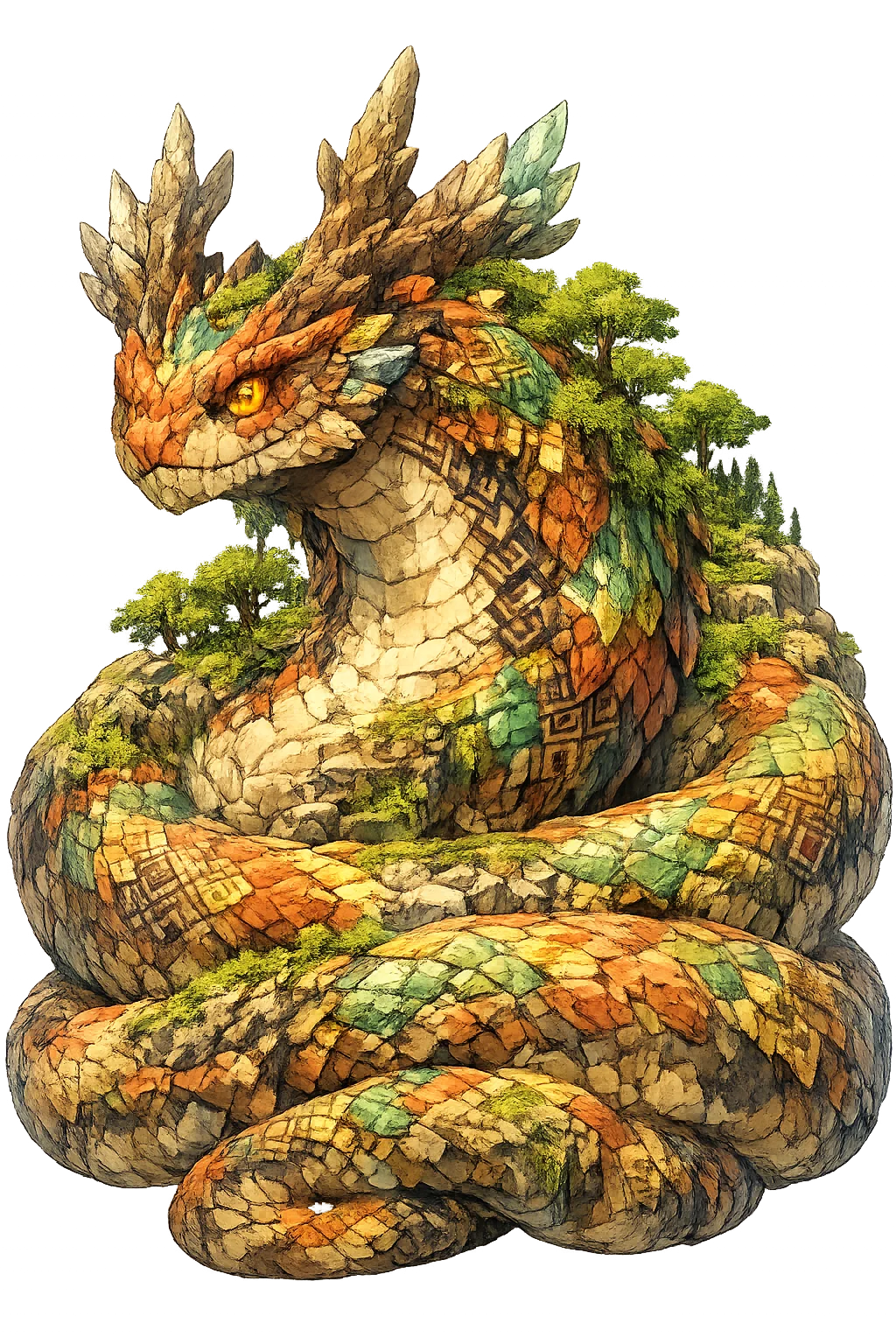
Trengtreng is a sacred volcanic peak in Mapuche cosmology, one of the primordial heights raised during the great flood. Together with its counterpart Kai-Kai, it embodies the volcanic forces that shaped the southern Andes and the sacred geography that still anchors Mapuche identity.
Mapuche tradition tells of a primordial deluge driven by Caicai Vilu, the water-serpent, enemy of the earth-serpent Trentren and of humankind. As Caicai made the sea rise to drown the world, Trentren raised the hills in answer, each power straining against the other until the mountains out-topped the waters; the peaks of Trengtreng and Kai-Kai became refuges above the flood, while above the serpents stood Pillán, lord of volcano and storm. Those who reached the heights survived and became the ancestors of the Mapuche. The thunder spirit Pillán stood above the serpents, lord of volcano and storm, lending the earth-serpent his fire. The fullest colonial record of the duel is Alonso de Ovalle’s Histórica Relación (1646), drawing on Mapuche informants of the Arauco frontier. The myth means the Andes themselves are a rescue — the cordillera is not scenery but the shape of survival, raised on purpose against the sea.
Pillán, the Mapuche thunder-and-volcano spirit, is the power whose name crackles in storms and whose fire runs down the cordillera. The voice of the volcano is his voice, its eruption his weapon; the chroniclers describe the thunder spirits waging war from the heights with fire and storm. Trengtreng belongs to his storm-world twice over — as one of the peaks raised in the flood-duel, and as a name that rattles like the thunder it imitates — which is why colonial sources sometimes blur the mountain, the thunder-sound, and the god into a single figure. Later Andean Catholicism read the same volcanoes as signs of divine anger, while Mapuche communities kept Pillán in oral tradition and ritual. The myth means a mountain can be at once geology and presence: the peak is where the sky’s violence touches the earth’s.
In the flood narrative the survivors who climbed Trengtreng, Kai-Kai, and the other sacred heights became the ancestors of the later communities — so the mountain functions as an origin place, the point where a living people connects to a mythic past of catastrophe and renewal. The tradition keeps its geography exact and inhabited: the volcanoes of the southern cordillera are named, known, and visited, and oral genealogy runs through them rather than around them. Pilgrimage, storytelling, and the everyday toponymy of Araucanía — where mountain names are spoken in Mapudungun, not Spanish — keep the peak active in Mapuche identity long after the flood has receded. The myth means ancestry here is not abstract: it is a specific slope you can climb, a horizon you can point to from the valley floor.
Today Trengtreng remains a landmark of the southern Andean landscape and a point of reference in Mapuche oral geography. The flood myth survives in several colonial witnesses — Alonso de Ovalle’s Histórica Relación del Reino de Chile (1646), Pedro Mariño de Lobera’s Crónica del reino de Chile, and Alonso de Góngora Marmolejo’s Historia de Chile (1575) — the earliest written records of a far older oral tradition. Modern Mapuche writers, musicians, and territorial movements invoke the flood mountains as symbols of resilience and sacred land, and the name endures in local toponymy, and the volcano chain itself — Llaima, Villarrica, Lonquimay — still performs the myth with smoke and tremor. The myth means the tradition proved more durable than the empire that wrote it down: the chroniclers’ pages closed, and the mountains kept the story.
Volcanic refuge raised above the flood
Trengtreng is one of the primordial volcanic peaks of Mapuche cosmology — a sacred height raised by the earth-serpent Trentren above the flood-waters of Caicai Vilu. Its thunder-name crackles like the storms that roll across the southern Andes: with its counterpart Kai-Kai it embodies the living power of the volcano and the sacred geography that anchors Mapuche identity.
The reduplicated name is onomatopoeic for rolling thunder; the spirit's voice is heard in storms and volcanic eruptions.
Trengtreng is one of the volcanic peaks raised by Pillan to save the people from the primordial deluge.
As a thunder-and-war power, the spirit lends Mapuche fighters the striking force of the storm and the macana club.
Those who climbed the sacred peaks during the flood became the ancestors of later Mapuche communities.
From the original script to the living URL
Trengtreng
The name survives in scholarly transliteration. Trengtreng is the standard Mapuche romanisation, documented in academic sources — “Mapuche thunder and war god”. Because the spelling uses only Latin letters, the form is the same in both ASCII and Unicode.
No indigenous writing system is securely attested for individual mapuche names. The form shown is a modern scholarly transliteration.
trengtreng
The plain trengtreng form is identical to the Unicode restoration. Because this name is already written in Latin letters, no diacritics, stress, or script information were lost — only capitalization differs.
Trengtreng
The Unicode restoration does not need to recover lost marks for Trengtreng. Its value is canonical spelling and consistent cataloguing, not the reconstruction of erased orthography. The domain is readable as-is to both DNS and humanity.
Trengtreng.com
This restoration is written entirely in ASCII letters — no Punycode encoding stands between Trengtreng and the DNS. The domain reads identically to machines and to human eyes.
Owned, ideal, and ASCII forms of Trengtreng
Trengtreng
The live temple domain — trengtreng.com.
How Trengtreng was spoken
How Trengtreng is preserved in writing
No indigenous writing system is securely attested for individual mapuche names. The form shown is a modern scholarly transliteration.
Contribute scholarly provenance →The lore you have read is the living myth. Extended Lore opens the scholarly vault beneath it: the cult and its material remains, a history of the image, the name after antiquity, a meditation on what the name still means, and the full scholarly apparatus — etymology, orthography, sources.
Enter Extended Lore