The Living Myth
Cosmology, Heaven and Earth, Order · The Heaven-and-Earth Order
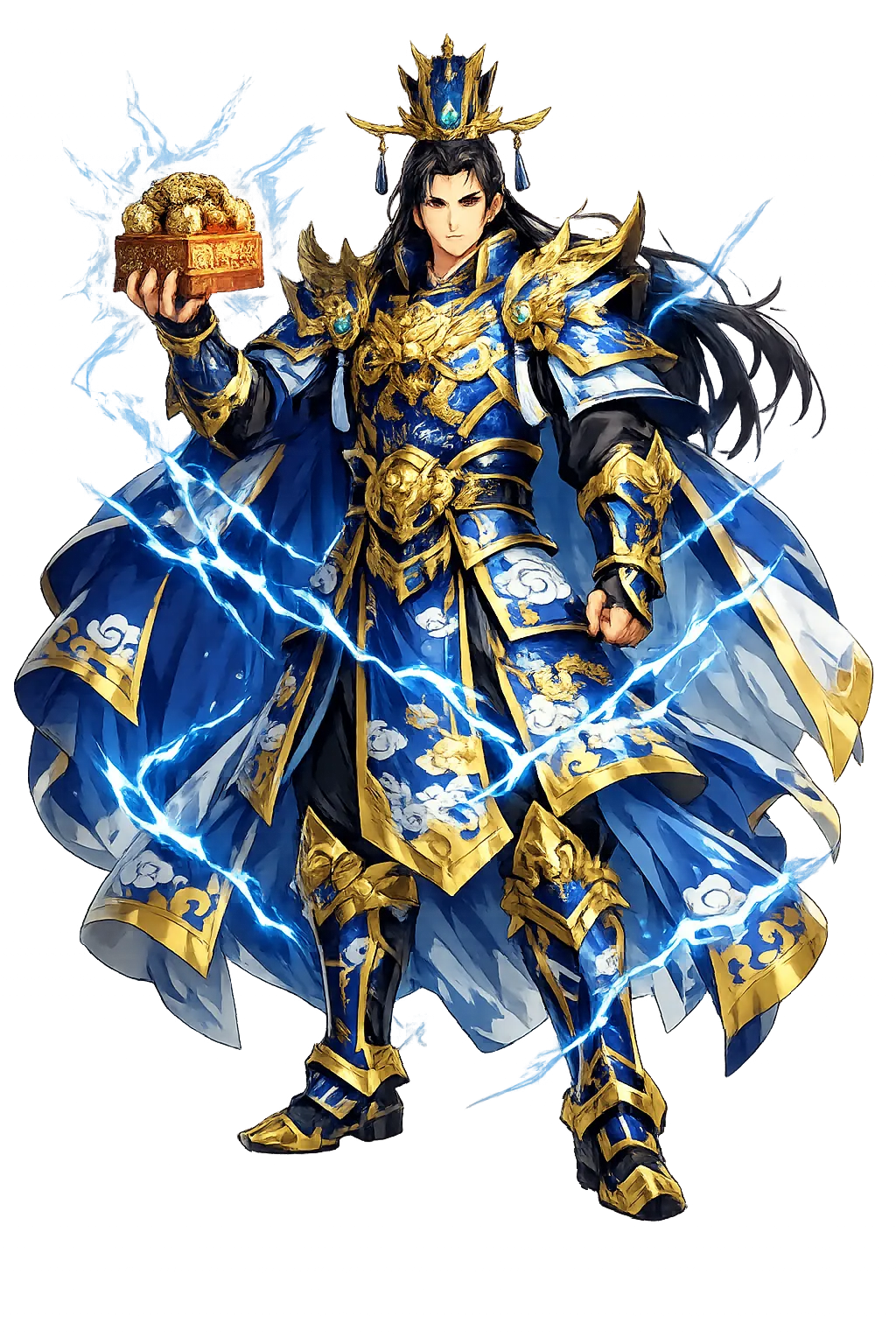
Stories of Tiāndì
Tiāndì is not a mythic protagonist but the setting within which Chinese myths unfold. Its stories are cosmogonic, ritual, and reparative: how the pair was separated, how the emperor keeps it speaking to the state, and how it was once broken — and mended.
The earliest full telling of Pangu's story survives in fragments of Xu Zheng's Sanwu liji (三五曆記, Records of the Three and Five, Three Kingdoms period, 3rd century CE), quoted in later encyclopedias, with a parallel in his Wuyun linian ji. In the beginning, heaven and earth were one chaos, like an egg, and inside it Pangu slept and grew for eighteen thousand years. When he woke, he took up a broadaxe, pushed the light heaven upward and pressed the heavy earth downward — and each day the sky rose ten feet, the earth thickened ten feet, and Pangu grew ten feet taller between them. When at last he died, his body became the landscape: his breath the wind and clouds, his voice the thunder, his left eye the sun and his right eye the moon, his limbs the five sacred mountains, his blood the rivers, his flesh the soil, his hair the stars and the plants, his teeth and marrow the metals and jade, his sweat the rain. The cosmos of Tiāndì is not a creator's throne but a giant's body — the world continuous with flesh, heaven and earth the two halves of a single sacrifice.
Shang dynasty oracle bones already record sacrifice to Dì, the high lord who governed harvest and victory; the Zhou recast him as Tiān, Heaven, whose Mandate (Tiānmìng) passed to rulers who governed rightly and withdrew from those who did not — the doctrine thundered in the Great Declaration chapters of the Shujing. The Liji and later ritual codices organized the response: the emperor, Son of Heaven (Tiānzǐ), sacrificed to Heaven at the winter solstice and to Earth at the summer solstice, in round and square enclosures at the southern and northern suburbs. The Ming Yongle emperor rebuilt this liturgy in stone between 1406 and 1420: the Temple of Heaven's Circular Mound, where the sovereign stood at the center of an open sky speaking upward, remains the most eloquent ritual building on earth. The rite is the technology of legitimacy — heaven does not vote, but it is heard annually, and a dynasty that skipped the sacrifice had already begun to fall.
The Dàodéjīng (ch. 42) gives the dyad its metaphysical place: 'The Dao gives birth to One; One gives birth to Two; Two gives birth to Three; Three gives birth to the ten thousand things.' In the standard reading the Two is Tiāndì — the first differentiation, from which all phenomena arise as the interplay of yin and yang. The Yìjīng's Great Commentary (Xìcí) fills in the character of the pair: 'Qian and Kun are the gate of change... Qian knows through the easy, Kun accomplishes through the simple' — heaven active and creative, earth receptive and completing, 'the father and mother of all things.' The Commentary of Zheng Xuan and the whole commentarial tradition drew the moral: the sage aligns with heaven's activity and earth's receptivity, and so the rites, the calendar, and the family are all miniature Tiāndì. The myth's precision is the point: the world does not begin with a thing but with a relation, and everything since has been that relation thickening.
Not every myth keeps Tiāndì whole. The Huáinánzǐ (ch. 6, Lánmíng) remembers the catastrophe: 'In ancient times the four pillars collapsed and the nine provinces split open. Heaven could not cover everything, earth could not bear everything. Fires blazed without going out, waters flooded without receding, fierce beasts devoured the people.' The goddess Nǚwā — sometimes credited in the Fēngsú Tōngyì with molding the first humans from yellow clay — came to repair what had broken. She smelted five-colored stones to patch the blue sky; cut the legs from a giant sea-turtle and set them up as the four pillars; killed the black dragon that was devouring Jizhou; and piled up the ash of reeds to dam the flood waters. Heaven was made whole again, and the ten thousand things lived peacefully on the earth. It is the rarest kind of creation myth — not a making but a mending. Tiāndì is not guaranteed; it is maintained, by a goddess with a furnace, and the tradition has never stopped drawing the lesson: cosmic order is a repair job, permanently in progress.
Cosmology, Natural Order, and Imperial Ritual
Tiāndì is the Chinese cosmos in two characters. Tiān is Heaven: not a place above the clouds but the supreme moral and natural order, the source of seasons, rain, and legitimacy. Dì is Earth: the receptive ground that bears all things. Together they name the whole within which human life finds its proper place — and whose rupture, the myths insist, can be mended.
Heaven is active and round; Earth is receptive and square. Together they generate the ten thousand things.
The emperor ruled by the Mandate of Heaven, sacrificing at the winter solstice on the Circular Mound of Heaven.
The calendar, the seasons, and the harvest depend on the harmony of heaven above and earth below.
Right action aligns with the way of heaven; disaster signals its disruption — and repair is possible.
From the original script to the living URL
天地
The name in its original Chinese form. Tiāndì (天地) is attested in the source tradition — “Heaven and Earth; the natural order of the cosmos”. Its macron-length vowels carry the full phonetic and orthographic weight of the source tradition.
tiandi
Reduced to plain tiandi, the name loses everything that made it specific: macron-length vowels. What remains is an ASCII string that machines can parse but that no longer speaks with its original voice.
Tiāndì
The Unicode restoration recovers what ASCII flattened. Tiāndì restores macron-length vowels, returning the name to its original written dignity. The domain encodes to Punycode, but the browser displays the truth.
Tiāndì.com → xn--tind-tpa7j.com
The non-ASCII characters in Tiāndì are encoded while the ASCII remains visible. To the DNS, it is Punycode. To humanity, it is Tiāndì.
Owned, ideal, and ASCII forms of Tiāndì
Tiāndì
Restores 天地. The live temple domain — tiāndì.com.
tiandi
Flattens 天地. The plain ASCII fallback — what DNS and legacy systems see.
How Tiāndì was spoken
How Tiāndì is preserved in writing
A bespoke provenance study for Tiāndì is being prepared by the PUNICODEX scholarly team.
Contribute scholarly provenance →The lore you have read is the living myth. Extended Lore opens the scholarly vault beneath it: the cult and its material remains, a history of the image, the name after antiquity, a meditation on what the name still means, and the full scholarly apparatus — etymology, orthography, sources.
Enter Extended Lore