PuniCodex

Extended Lore

天地 Tiāndì

Etymology · Orthography · Cult · Iconography · Reception · Sources

Tier 1 Tiāndì.com
Tiāndì — Cosmology, Heaven and Earth, Order
01

Quick Facts

Essential information about Tiāndì, Cosmology, Heaven and Earth, Order

Original Script天地
Unicode RestorationTiāndì
Reconstructed Pronunciation/tʰjɛn˥˥ ti˥˩/
PantheonChinese
DomainCosmology, Heaven and Earth, Order
MeaningHeaven and Earth; the natural order of the cosmos
ClassificationTier 1
Primary DomainTiāndì.com
Sacred SymbolsRound heaven and square earth, Jade disc (bì), Yellow earth, North Star, The five-colored stones
02

Etymology & Word Family

From original script to Unicode restoration

Proto-sino-tibetan *l̥ˤin heaven, sky
Original Script 天地 Tiāndì — "Heaven and Earth; the natural order of the cosmos"
Unicode Restoration Tiāndì Restored stress, length, and script
Modern ASCII tiandi Plain-ASCII fallback

Tiān 天 (heaven/sky) + dì 地 (earth/ground). The compound expresses the dyad that frames Chinese cosmology.

03

Unicode Character Breakdown

Character-by-character philological analysis

CharacterUnicodeNameBlockPhonetic Role
TU+0054Latin Capital Letter TBasic LatinSame, capitalized
iU+0069Latin Small Letter IBasic LatinSame
āU+0101Latin Small Letter A with MacronLatin Extended-AMacron: first tone
nU+006ELatin Small Letter NBasic LatinSame
dU+0064Latin Small Letter DBasic LatinSame
ìU+00ECLatin Small Letter I with GraveLatin-1 SupplementGrave: fourth tone

The Tier 1 classification reflects how much of the original phonology this restoration preserves — stress and vowel length for Greek names, distinctive letters and diacritics for every other tradition.

04

Cult & Worship

How the sacred was kept — rites, sanctuaries, remains

The Cult

Tiāndì was worshipped from the apex of the state, never from the household. The emperor — Tiānzǐ, Son of Heaven — alone performed the great suburban sacrifices codified in the Lǐjì: to Heaven at the winter solstice on the round, blue-glazed Circular Mound, to Earth at the summer solstice on the square Altar of Soil and Grain. The rite was material but never iconic — jade bī discs, silk, and grain offered to powers that received no cult statue. The lineage runs deep: Shāng oracle bones, a thousand years earlier, already record sacrifice to Dì as lord of harvest and victory, and every dynastic founder re-validated the Mandate by sacrificing to Heaven. Popular religion split the dyad into the Jade Emperor above and the village earth-god below, but the imperial rite — performed from Shāng bones to the very end, when Yuán Shìkǎi staged the last solstice sacrifice on the Circular Mound in 1914 as scenery for his monarchy — was the state's monopoly and China's oldest continuous liturgy.

In the Earth

The cult of Heaven and Earth is materialized in China's imperial ritual landscape, above all the Temple of Heaven (Tiāntán) and the Altar of Earth (Dìtán) in Beijing, rebuilt under Yongle (1406–1420) on Ming cosmological principles — round for heaven, square for earth, blue glaze for the sky, yellow for the soil. Oracle-bone inscriptions from the Shang dynasty record sacrifices to Dì, the high lord of harvest and victory, and Zhou bronze inscriptions consolidate the dyad of Tiāndì as the foundation of political legitimacy. Han stone reliefs and Mawangdui silk paintings map the cosmography the rites addressed — heaven round above, earth square below, the human world set precisely between.

05

Iconography

How Tiāndì was imaged across the ages

The Image

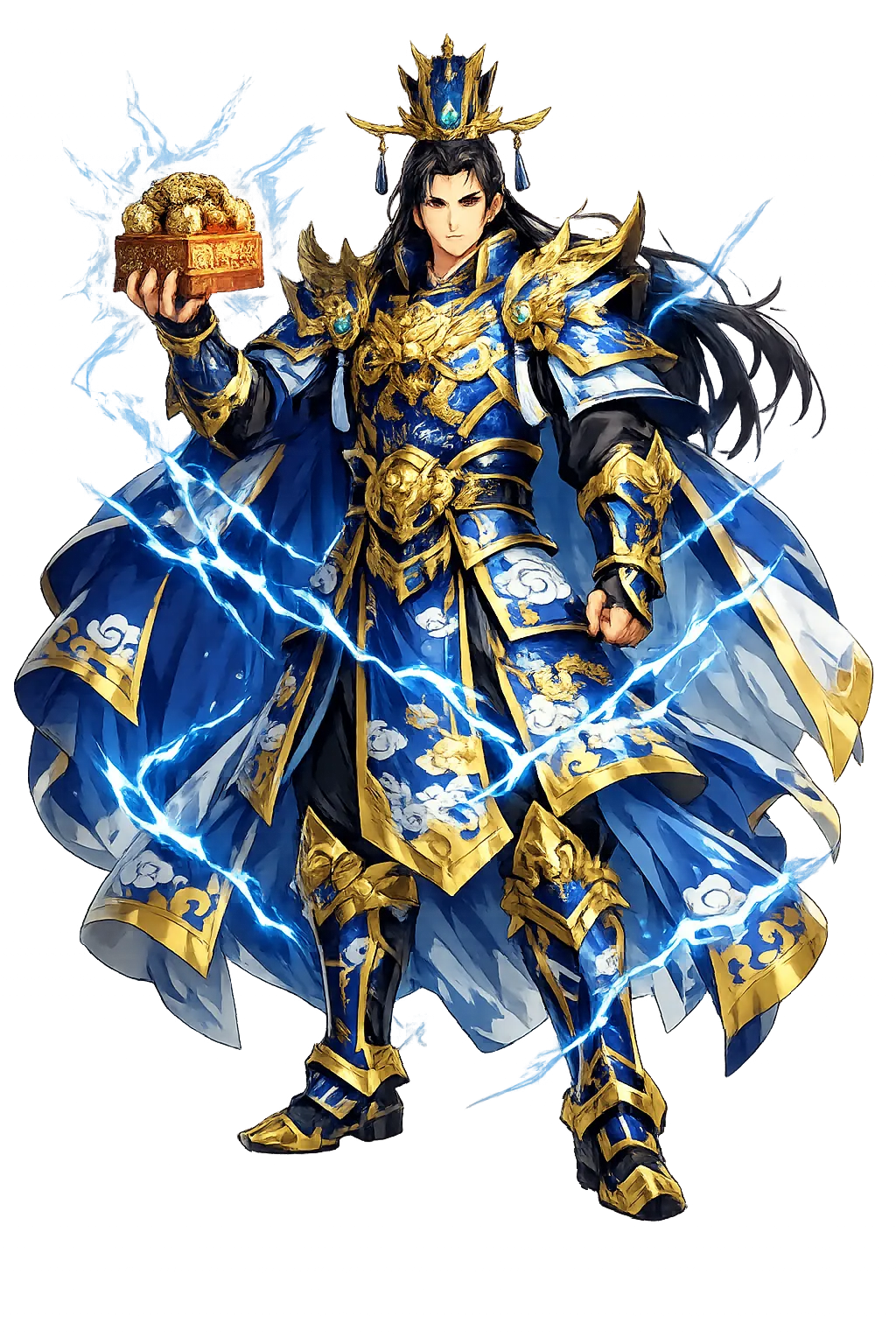
Heaven and Earth were deliberately never given faces. The state cult offered to tablet and throne, not statue — the tiered marble dais in Tiāntán's Hall of Prayer held spirit-tablets where other religions set a god. Architecture did the imaging instead: round enclosures and blue glaze for heaven, square terraces and yellow glaze for earth, the cosmos drawn in plan. The oldest visual language is cosmographic — Hàn tomb banners and stone reliefs setting the round sky above the square fields — and jade bī discs, round as the sky and pierced like its axis, are the material residue of an image-that-is-not. Only late popular religion dared personify Heaven at all, as the Jade Emperor, a robed court bureaucrat. Canonical Tiāndì remains, by design, a shape and not a body.

06

Reception & Transformation

The name after its own age — transmission, translation, survival

Afterlives

The Confucian ritual canon carried Tiāndì for two millennia: the Lǐjì fixed the liturgy, and dynast after dynast restaged it to certify a new Mandate. The Jesuits turned the dyad into a theological problem — Matteo Ricci argued Tiān was China's ancient monotheism — and Leibniz read the Yìjīng's hexagrams as a parallel binary cosmology. The nineteenth century brought the evidence and the argument: oracle bones, recognized in 1899, vindicated the Shāng sacrifices to Dì, while the Gǔshǐ biàn, the Doubting Antiquity school, questioned whether the sage-kings were history at all. After 1911 the rite ended and the scholarship began — the Beijing altars became monuments, then a UNESCO listing, and the Mandate of Heaven passed into political vocabulary as the ancient warrant for judging rulers by results. The two characters never changed shape; the argument about what they mean remains China's longest conversation.

Identifications Across Traditions

Tiāndì absorbed and was absorbed by every Chinese religious current. Confucian state ritual made the worship of Heaven the monopoly of the emperor and Earth the charge of the court. Popular religion localized the pair as the Jade Emperor above and Tǔdìgōng, the earth god of each village, below. Daoism reinterpreted Tiān as the celestial Dao and dì as the material field it orders, while Buddhism, entering China, had to map its Indic heavens and hells onto a Tiāndì-shaped cosmology — the Buddha himself was politely seated beneath heaven in temple iconography. Modern nationalism claimed Tiān as a proto-monotheistic deity for China's antiquity, and contemporary environmental thought reads Tiāndì as an early ecological holism: heaven, earth, and humanity as one body (tiān rén hé yī). The two characters have carried every Chinese worldview without once changing their shape.

Modern Legacy

Tiāndì remains the backbone of Chinese cosmological language. The phrase tiān xià — 'all under heaven' — still names the world in diplomacy and idiom. The Temple of Heaven in Beijing is a UNESCO World Heritage site and one of the most visited monuments in China; its round-and-square geometry is taught to every schoolchild as the shape of the cosmos. The Mandate of Heaven survives in political rhetoric as the ancient warrant for judging rulers by their results, and the ideal of harmony among heaven, earth, and humanity shapes everything from traditional medicine to urban feng shui. Even in secular China, 'heaven' and 'earth' are not physical terms; they carry the weight of moral and cultural order. The two characters are among the most compound-words in the language — tiāndì appears in hundreds of set phrases, the lexicon's proof that a cosmology can become grammar.

07

The Meditation

What Tiāndì means — beyond the dictionary

Tiāndì is the oldest Chinese statement of relationship. Before there are gods, humans, or rituals, there is the pair: the active above and the receptive below. Everything else — morality, agriculture, architecture, family — is an elaboration of this pairing, and the Nǚwā myth adds the crucial footnote: the relationship can break, and when it does, it must be mended, not mourned.

To think Tiāndì is to think positionally. Where do I stand between heaven and earth? Am I aligned with the seasons? Does my conduct echo the order above or disturb it? The question is not whether one believes in a personal god but whether one participates in the pattern that makes life possible. Tiāndì does not demand worship; it demands alignment. The rain falls, the earth yields, and the human task is to fit oneself into that generosity without breaking it — and to keep the five-colored stones ready.

08

Frequently Asked Questions

Common questions about Tiāndì, Cosmology, Heaven and Earth, Order, and Unicode restoration

01How do you pronounce Tiāndì?

In reconstructed pronunciation, Tiāndì is /tʰjɛn˥˥ ti˥˩/ — approximately TYEHN-DEE — 'tian' high and level, like a held note; 'di' sharp and falling, like a command.

02What does Tiāndì mean?

Tiāndì means Heaven and Earth; the natural order of the cosmos in the chinese tradition.

03What are the symbols of Tiāndì?

Tiāndì is associated with Round heaven and square earth (The circular altar and square terrace of Beijing's Temple of Heaven encode the cosmic dyad in architecture), Jade disc (bì) (The ritual jade offered to heaven, round like the sky and green like life), Yellow earth (The soil of the central plain, offered at the Altar of Earth — the nation's foundation), North Star (The pivot of heaven around which all stars turn; the emperor's celestial model), The five-colored stones (The minerals Nǚwā smelted to patch the broken sky — heaven's wounds are mended, not replaced).

04Why restore Tiāndì in Unicode?

Plain ASCII tiandi strips the stress, length, and script that make the name specific. Unicode restoration returns the name to its original written dignity.

05What is the most important myth about Tiāndì?

“Pangu Separates Heaven and Earth” — the Xu Zheng, Sanwu liji story that anchors the mythology of Tiāndì, told in full on the lore page.

09

Scholarly Sources

The philological foundations of this restoration

Every claim on this page is grounded in established scholarship. The orthographic restorations follow disciplinary convention. The etymological chain follows the best available reference works. This is not invention — it is resurrection through scholarship.

◈

Lexicography & Philology

◎

Primary Texts

  • Primary sources in the chinese tradition for Tiāndì.
◉

Archaeology & Art History

  • Material evidence — iconography, inscriptions, and temple archaeology — for Tiāndì and related cults.
✦

Religious Studies

  • Yijing, Xici zhuan (Great Commentary)
  • Laozi, Daodejing ch. 42
  • Shujing (Book of Documents), Great Declaration chapters
  • Liji (Book of Rites), suburban sacrifice chapters
  • Huainanzi, ch. 6 (Lanming) and ch. 1 (Nüwā passages); Xu Zheng, Sanwu liji (fragments)
  • Birrell, Chinese Mythology: An Introduction (1993)
Return

The Surface Awaits

You have traced the name from its earliest attestation to its Unicode restoration. Now return to the myth. The story is where the name lives.

Back to Lore
Tiāndì mascot