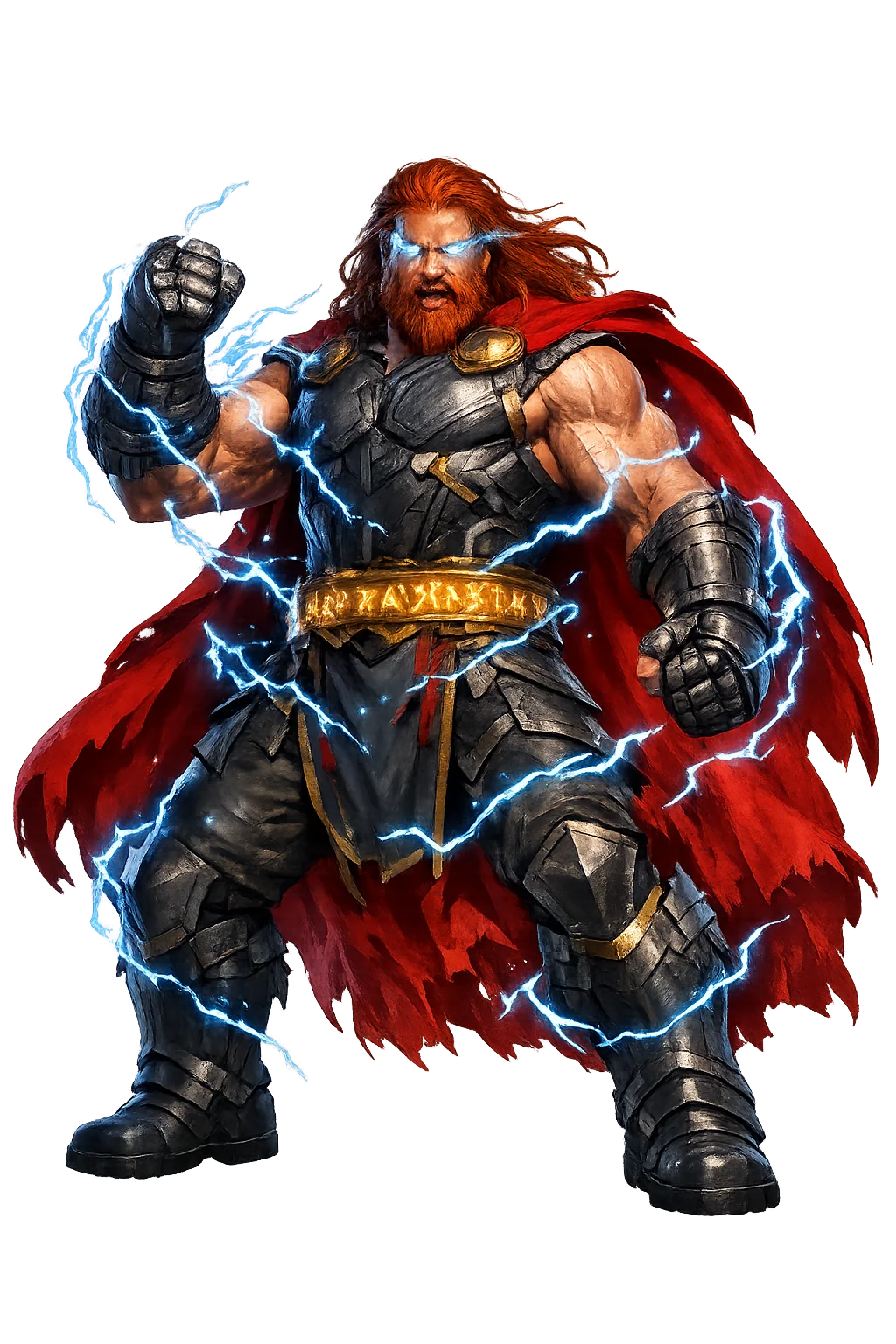
Stories of Þórr
Þórr is the Æsir's enforcer: Mjölnir in hand, he keeps the giants beyond the fence of the world and rides out in a cart drawn by the goats Tanngnjóstr and Tanngrisnir, whose rumble is thunder. The Eddas cast him as the defender of order — sometimes comic, never trivial.
When Þórr woke to find Mjölnir gone, his first thought was for the giants: with the hammer lost, their old terror was lost too. The thief proved to be Þrymr, who would return it only for Freyja as bride. The goddess, enraged, refused; Heimdallr proposed the stratagem. They dressed Þórr in bridal linen and keys, hung the necklace Brísingamen on him, veiled his beard, and sent him east with Loki as his handmaid. At the wedding Þrymr grew suspicious at the bride's appetite — a whole ox, eight salmon, three casks of mead — but Loki explained that Freyja had fasted eight nights in longing. Then Þrymr ordered the hammer laid in the bride's lap to hallow her, and the moment Mjölnir touched his knee Þórr laughed aloud: he killed Þrymr and every giant in the hall (Poetic Edda, Þrymskviða). The poem is the Eddas' greatest comedy, but its premise is dead serious: without Mjölnir the gods cannot defend the world. And its comedy has a moral — Þórr's strength is so secure it can survive a wedding dress; order endures because power is willing to play the fool.
At Ægir's feast the gods needed a cauldron big enough to brew for them all, and only the giant Hymir owned one a mile deep. Þórr went with Týr to fetch it, slew Hymir's herd of oxen for dinner — the giant raged — and at dawn bullied him into a fishing trip, demanding the giant's best bait: the head of the fine ox Himinhrjóðr. Far out, Þórr rowed beyond the giant's comfort, hooked Jörmungandr, the world-serpent, and hauled the venom-dripping, world-encircling monster up over the gunwale; Hymir, grey with fear, cut the line. In Snorri's version the serpent glares up and Þórr strikes its head with Mjölnir as it sinks, and Hymir remarks that they will not fish together again (Hymiskviða; Gylfaginning 48). The myth makes Þórr the one god who tests the world's seams: he alone dares to drag the creature that holds Miðgarðr together out of its own sea — and every time it slips back, Ragnarǫk comes one fight closer.
Trapped by the giant Geirröðr, Loki ransomed himself by swearing to bring Þórr to the giant's hall unarmed. Þórr set out without Mjölnir, without Megingjörð, without Járngreipr — stripped of everything that made him Þórr. The giantess Gríðr, mother of Víðarr, found him on the road and lent him her own belt of strength, her iron gloves, and her staff Gríðarvǫlr, warning him of the trap: a chair of lava, two rivers, a glowing iron in the forge. Þórr waded the rising Vimur, jammed the staff in the riverbed, and swept on. In the hall Geirröðr hurled the glowing missile at him; Þórr caught it in the borrowed glove and threw it back through the giant, through the pillar behind him, through the wall and into the ground — so that every jötunn in the hall died where he stood (Snorri, Skáldskaparmál 17; the skald Eilífr Goðrúnarson's Þórsdrápa). The tale teaches that Þórr's true weapon is not the hammer but the return of violence to its sender: whatever is thrown at him comes back.
At Ægir's banquet Loki, uninvited, went from god to god with insults honed to wound — accusing Óðinn of oath-breaking, Týr of cuckoldry, Frigg and Freyja of unchastity. The gods endured him in silence: a guest beneath the roof could not be struck. Then Þórr came in from the east, from his journey, and the talk changed. 'Hold your tongue, Loki,' he said, 'or Mjölnir will shut it.' Loki mocked him too — but only once, and from the doorway: he had spoken before all the Æsir, he says, yet 'for you alone will I go out, since you threaten with the hammer.' He left, was seized in the Franangr falls, and bound in the guts of his own son (Poetic Edda, Lokasenna). The poem's architecture is its meaning: every god can be talked around, bought or shamed — except the thunderer. Words lose to the hammer; order keeps its enforcer, and Loki's first moment of prudence is his first acknowledgment of Þórr's.
The seeress of the Völuspá foretold the end: the hound Garmr bays before Gnipahellir, the sky splits, and Jörmungandr rises from the poisoned sea to spill venom over sky and earth. Þórr meets his old fishing-quarry one last time and destroys it — but as the serpent dies it pours venom over him, and Þórr walks nine steps and falls (Völuspá 55–56; Snorri, Gylfaginning 51). The strongest of the gods is killed by the very thing he conquered. Yet the Völuspá does not end there: the earth rises green again from the sea, Baldr returns, and Þórr's sons Móði and Magni inherit Mjölnir 'when the gods return' — and Magni boasts his father would be praised. The myth gives Germanic heroism its formula: not survival, but having saved the world first — strength in the service of order, spent to the last drop, and the hammer passed on.
The domain of Þórr
Þórr is the thunder and the protection it promises: guardian of Ásgarðr and of every farmstead beneath it, wielder of Mjölnir, the hammer that levels giants and hallows weddings alike. Where Óðinn traffics in runes and deceit, Þórr answers with straight force — the god of farmers, sailors and householders, whose oath is the storm's.
The short-handled hammer forged by the dwarfs Brokkr and Sindri — it never misses, always returns, and consecrates brides, births and pyres as readily as it shatters giants (Snorri, Skáldskaparmál 35).
Disguised as Freyja in bridal linen, Þórr let the giant Þrymr lay Mjölnir in his lap to hallow the bride — then killed every jötunn in the hall (Poetic Edda, Þrymskviða).
With an ox-head for bait he hooked Jörmungandr, the world-serpent, and dragged it boiling to the surface — Hymir cut the line in terror (Hymiskviða; Gylfaginning 48).
His oak stands where lightning strikes; sailors blessed their ships and farmers their fields in his name, and his day — Þórsdagr — is Thursday.
From the original script to the living URL
ᚦᚢᚱ
The name in its original Norse form. Þórr (ᚦᚢᚱ) is attested in the source tradition — “Thunder (from *þunraz)”. Its acute stress marks carry the full phonetic and orthographic weight of the source tradition.
thor
Reduced to plain thor, the name loses everything that made it specific: acute stress marks. What remains is an ASCII string that machines can parse but that no longer speaks with its original voice.
Þórr
The Unicode restoration recovers what ASCII flattened. Þórr restores acute stress marks, returning the name to its original written dignity. The domain encodes to Punycode, but the browser displays the truth.
Þórr.com → xn--rr-4ja7b.com
The non-ASCII characters in Þórr are encoded while the ASCII remains visible. To the DNS, it is Punycode. To humanity, it is Þórr.
Owned, ideal, and ASCII forms of Þórr
Þórr
Restores ᚦᚢᚱ. The live temple domain — þórr.com.
thor
Flattens ᚦᚢᚱ. The plain ASCII fallback — what DNS and legacy systems see.
How Þórr was spoken
How Þórr travels from ancient script to the modern URL
From Proto-Germanic *Þunraz, 'thunder'. Cognates: Old English Þunor, Old High German Donar, Continental Germanic *Thunaraz.
God of thunder, lightning, storms, oak trees, and the protection of mankind.
The Unicode restoration Þórr uses Thorn (Þ) and acute-accented o, both registrable in .com. The runic form is not used as the primary domain because runic TLD support and keyboard input are impractical.
The lore you have read is the living myth. Extended Lore opens the scholarly vault beneath it: the cult and its material remains, a history of the image, the name after antiquity, a meditation on what the name still means, and the full scholarly apparatus — etymology, orthography, sources.
Enter Extended Lore