PuniCodex

Extended Lore

ᚦᚢᚱ Þórr

Etymology · Orthography · Cultural Legacy · Reception · Primary Sources

Tier 1 Þórr.com
Þórr — Thunder, Storms, Oak
01

Quick Facts

Essential information about Þórr, Thunder, Storms, Oak

Original Scriptᚦᚢᚱ
Unicode RestorationÞórr
Reconstructed Pronunciation/ˈθɔːrː/
PantheonNorse
DomainThunder, Storms, Oak
MeaningThunder (from *þunraz)
ClassificationTier 1
Primary DomainÞórr.com
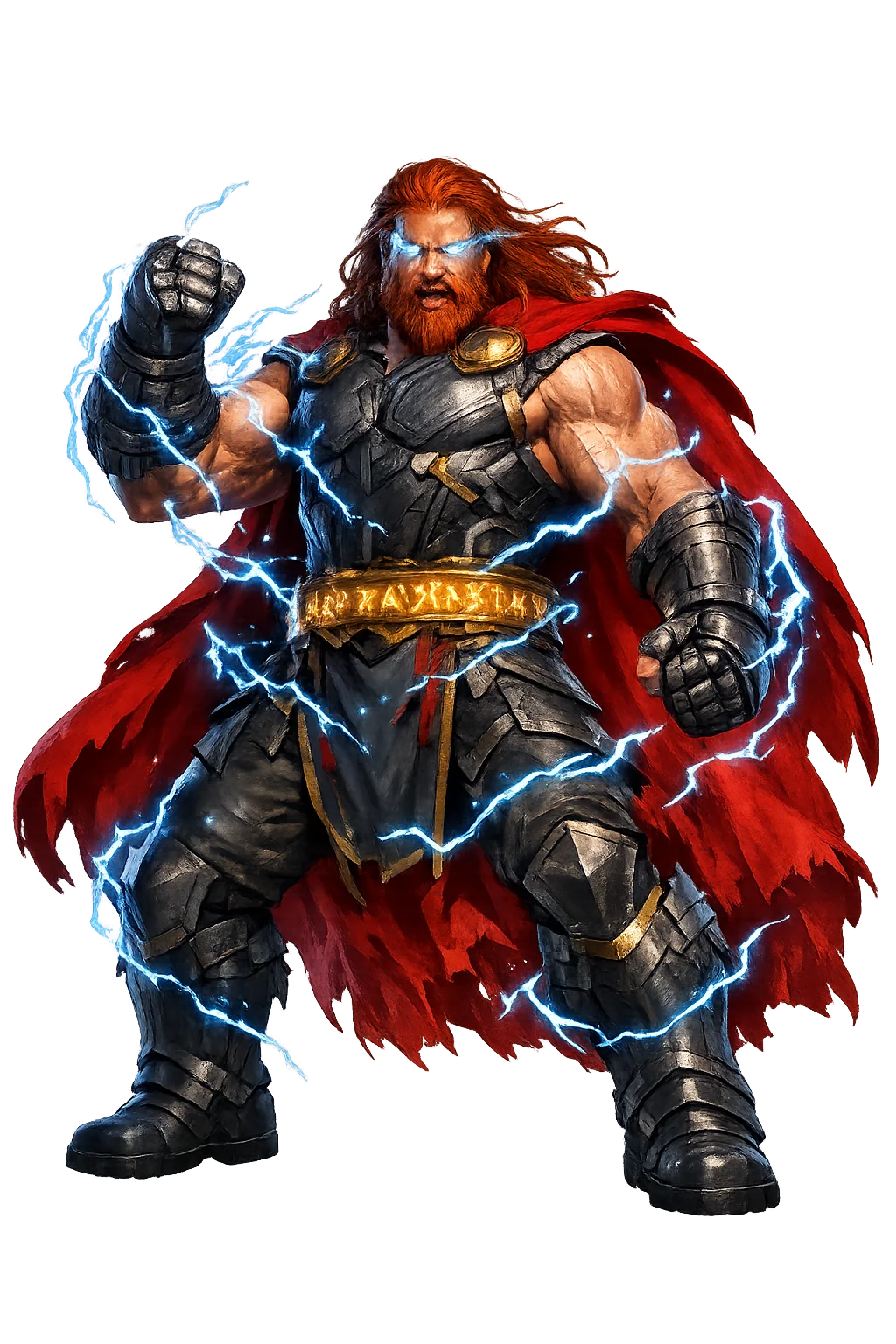
Sacred SymbolsMjöllnir, Járngreipr (iron gloves), Megingjörð (strength belt), Goat-drawn chariot, Oak tree
02

Etymology & Word Family

From original script to Unicode restoration

Proto-indo-european *Þunraz thunder
Original Script ᚦᚢᚱ Þórr — "Thunder (from *þunraz)"
Unicode Restoration Þórr Restored stress, length, and script
Modern ASCII thor Plain-ASCII fallback

PGmc *Þunraz "thunder", from PIE *(s)tenh₂- "to thunder". The thunder god.

03

Unicode Character Breakdown

Character-by-character philological analysis

CharacterUnicodeNameBlockPhonetic Role
ÞU+00DELatin Capital Letter ThornLatin-1 SupplementThorn: voiceless dental fricative
N/ADropped characterNorse orthographyDropped: merged with t into thorn
óU+00F3Latin Small Letter O with AcuteLatin-1 SupplementAcute on o
rrU+0072Character U+0072Basic LatinGeminate: double r in Old Norse

The Tier 1 classification reflects how much of the original phonology this restoration preserves — stress and vowel length for Greek names, distinctive letters and diacritics for every other tradition.

04

Cultural Significance

From ancient cult to modern memory

Þórr in Later Traditions

Rome read Þórr as her own thunderer, and the weekday names say it: Latin dies Jovis became Old English Þunresdæg, German Donnerstag and English Thursday, mapping the Norse god onto Jupiter by function. Medieval writers drew the same parallel differently: Adam of Bremen describes the great temple at Uppsala where 'Thor, the mightiest', sits enthroned between Wodan and Fricco, master of thunder and lightning, and Saxo Grammaticus rationalizes him as a usurping warrior whose hammer-strokes were long remembered. The Hercules comparison recurred as well, since both bludgeon chaos-monsters. Under Christianization the cult left durable fossils: Mjölnir amulets are found in graves beside crosses, and his name survives in hundreds of Scandinavian place-names and in the English weekday. The nineteenth-century romantic revival — and after it, modern Ásatrú — restored him from folklore to godhood, a journey no other Germanic deity travelled quite so far.

Modern Legacy

Þórr never left daily life: his weekday, Thursday, is spoken weekly by hundreds of millions who never think of him. Hundreds of Scandinavian place-names — Torslanda, Thorsager and their kin — pin his cult to the map, and runestones from the Glavendrup stone ('may Thor hallow these runes') to the Altuna stone's serpent-fishing scene kept his image in stone. In the twentieth century he leapt to comics and film, where the Marvel Thor both popularizes and flattens him; meanwhile modern Ásatrú and heathen communities have re-sacralized Mjölnir as a pendant — a symbol now also contested by movements seeking borrowed Norse prestige. The medieval god of farmers and sailors endures because he was always the people's god: his cult was never an aristocracy's property, and so it could not be buried with one.

In the Earth

The Altuna runestone in Uppland (U 1161) depicts Þórr fishing for the Miðgarðsormr, the most direct pictorial attestation of his myth. Mjölnir pendants are found by the thousand from Birka, Hedeby, and across the Norse diaspora; the Eyrarland bronze statuette from Iceland may represent the thunder-god with his hammer. The Jelling stones and runestones such as the Glavendrup stone invoke his protection.

05

The Meditation

What Þórr means — beyond the dictionary

Þórr is strength that knows its job. He is the strongest of the gods and almost never the cleverest, and the Eddas treat that as a virtue: the world does not need its thunder to scheme. While Óðinn buys wisdom with an eye and a hanging, Þórr travels, fishes, dresses as a bride, loses his temper — and keeps the giants on their side of the fence. His hammer consecrates weddings, births, funerals and fields; Germanic oath-language invoked him, as the Glavendrup stone still testifies. He is, in short, the god of the unglamorous majority — farmers, sailors, householders — whose protection was expected daily, not mystically.

Restoring his name in Old Norse dress — thorn Þ, acute ó, geminate rr — matters precisely because that majority is where the name lived. Þórr is not the thunder of the cosmos; he is the thunder that walks home.

06

Screen & Culture

Where Þórr echoes through film, television, and games — and how

07

Frequently Asked Questions

Common questions about Þórr, Thunder, Storms, Oak, and Unicode restoration

01How do you pronounce Þórr?

In reconstructed pronunciation, Þórr is /ˈθɔːrː/ — approximately 'THORR' — begin with the breathy 'th' of 'thin', hold the 'o' long like 'awe', and trill the final r slightly longer than usual.

02What does Þórr mean?

Þórr means Thunder (from *þunraz) in the norse tradition.

03What are the symbols of Þórr?

Þórr is associated with Mjöllnir (The short-handled hammer that returns to his hand and strikes down giants), Járngreipr (iron gloves) (The gloves that allow Thor to grasp the hammer's searing haft), Megingjörð (strength belt) (The belt that doubles Thor's already formidable strength), Goat-drawn chariot (Tanngrisnir and Tanngnjóstr, the goats who pull his thundering cart), Oak tree (The tree sacred to Thor in Germanic folk practice, struck by lightning).

04Why are there different spellings of Þórr?

Each form is a historically attested restoration rather than a mistake: Thorr is the alt-stress form (Alternate: Thorr (length on o)). PUNICODEX registers the full set so the tradition is preserved under every defensible spelling.

05Why restore Þórr in Unicode?

Plain ASCII thor strips the stress, length, and script that make the name specific. Unicode restoration returns the name to its original written dignity.

06What is the most important myth about Þórr?

“The Recovery of Mjölnir” — Þórr is the Æsir's enforcer: Mjölnir in hand, he keeps the giants beyond the fence of the world and rides out in a cart drawn by the goats Tanngnjóstr and Tanngrisnir, whose rumble is thunder. The Eddas cast him as the defender of order — sometimes comic, never trivial. The full telling lives on the lore page.

08

Scholarly Sources

The philological foundations of this restoration

Every claim on this page is grounded in established scholarship. The orthographic restorations follow disciplinary convention. The etymological chain follows the best available reference works. This is not invention — it is resurrection through scholarship.

Lexicography & Philology

  • Cleasby-Vigfusson
  • Zoëga

Primary Texts

Archaeology & Art History

  • Material evidence — iconography, inscriptions, and temple archaeology — for Þórr and related cults.

Religious Studies

  • Eilífr Goðrúnarson, Þórsdrápa (the Geirröðr narrative in skaldic verse)
  • Adam of Bremen, Gesta Hammaburgensis IV.26–28 (the Uppsala temple)
  • Turville-Petre, Myth and Religion of the North; de Vries, Altgermanische Religionsgeschichte
Return

The Surface Awaits

You have traced the name from its earliest attestation to its Unicode restoration. Now return to the myth. The story is where the name lives.

Back to Lore
Þórr mascot