
How Thēseus got its accent back
The ASCII form theseus is missing something. Thēseus restores the marks the source language used to distinguish this name from a thousand others — and those marks change how the name is read, pronounced, and understood. This post explains, with the full scholarly record behind it, what each restored mark preserves: the Greek evidence, the reconstructed sound, the myths the name carries, and the mechanical logic of what each restored mark preserves. By the end, the marks in Thēseus will look less like ornaments and more like what they are — recovered evidence, pinned back in its proper place.
At a Glance
- Restored name: Thēseus
- ASCII form: theseus
- Meaning: "The Gatherer (from τίθημι)"
- Domain of influence: Heroism, Athens, Labours
- Pantheon: Greek
- Restoration: Preserves vowel length
- Original script: Θησεύς (Greek)
- Live domain: thēseus.com
Overview
Thēseus (theseus) — Heroism, Athens, Labours · The Gatherer (from τίθημι) — belongs to the Greek tradition, where it is catalogued under the domain "Heroism, Athens, Labours". The name means "The Gatherer (from τίθημι)".
Thēseus belongs to the Greek tradition, where it is associated with heroism, athens, labours.
PuniCodex restores the name as Thēseus and serves its temple at theseus.com. The original carries both stress and vowel length, and exactly one historically valid Unicode restoration exists. The plain ASCII form theseus survives as a modern convenience imposed by the early domain-name system; the restoration, not the fallback, is the form the project defends as philologically complete.
The Name
The name is attested in Greek as Θησεύς. Etymologically it means "The Gatherer (from τίθημι)".
The reconstructed proto-form is dʰeh₁- (proto-indo-european, "to put, to place"). Greek Θησεύς, popularly derived from τίθημι 'to set, to place'; the Athenian hero who slew the Minotaur and unified Attica.
The ASCII form theseus survives only because the early domain-name system could not carry diacritics; it is a technological compromise, not an ancient spelling. The Unicode restoration Thēseus recovers the vowel length of the original directly in the address bar. The original carries both stress and vowel length, and exactly one historically valid Unicode restoration exists.
The letter-by-letter transformation runs:
- t → T — Tau
- h → h — Theta
- e → ē — Eta: long epsilon
- s → s — Sigma
- e → e — Short epsilon
- u → u — Upsilon
- s → s — Sigma
The canonical temple for this name is served at theseus.com.
Etymology & Roots
The recorded derivation reads: Greek Θησεύς, popularly derived from τίθημι 'to set, to place'; the Athenian hero who slew the Minotaur and unified Attica.
The reconstructed proto-form is *dʰeh₁- (proto-indo-european), glossed as "to put, to place".
The reconstruction is classed as attested.
The Original Script
The name is written in Greek as Θησεύς. This original script is the form against which the ASCII fallback theseus and the PuniCodex restoration Thēseus are measured: the restoration preserves its vowel quantity of the written form, so that a reader typing the modern address still speaks the ancient name.
Pronunciation
The reconstructed pronunciation of the name is /theseus/ — Greek Reconstruction.
Phoneme by phoneme:
- T — Initial character of the restored form Thēseus.
- hēseus — Remainder of the name, preserving the distinctive marks of the Greek tradition.
For the modern speaker, the closest approximation is: 'THESEUS' — pronounce the restored form with attention to the preserved diacritics and length.
Kindred and historical forms of the name:
- Greek — Thēseus, the restored Unicode form of the name
Thēseus preserves both features because the Greek form preserves distinctive features that ASCII loses: stress, length, or special characters.
Mythology
The stories of Thēseus circulate within the Greek corpus, where the figure embodies heroism, athens, labours.
Primary Attestation (Sources)
Thēseus is attested in the canonical Greek sources as a figure associated with heroism, athens, labours.
Name and Meaning (Etymology)
The name means "The Gatherer (from τίθημι)" and reflects the figure's role in the tradition. Thēseus is the Athenian hero who slew the Minotaur in the Cretan Labyrinth and unified Attica under Athens. With Ariadne's thread he navigated the maze, then abandoned her on Naxos—an act that later tradition both criticized and mythologized. His career bridges the age of monsters and the age of civic law. His later deeds—including the battle with the Centaurs, the Calydonian boar hunt, and the Amazonomachy—made him the paradigmatic civic hero of classical Athens.
Clearing the Road to Athens (The Labours)
Aithra's son, raised at Troezen, lifted his father's sword from beneath the rock and chose the dangerous road to Athens — 'so that he might not be thought to owe his safety to any but himself' (Plutarch, Theseus 5–11). On the way he made the road safe: he killed Periphḗtēs the club-bearer near Epidaurus and took the club; Sínis the pine-bender on the Isthmus, bent to his own device; the Crommyonian sow; Skíron, who kicked travelers from his cliff; Kerkýon the wrestler of Eleusis; and Prokrustēs, 'the stretcher,' whose two beds he made him try in turn (Apollodorus, Epit. 1.1–4; Pausanias 2.1.3–4). Modern scholarship reads the cycle as an initiation map — the ephebe proving himself on the frontier before entering the city, monster by monster. Before Athens could gather its villages, its hero had to gather the road.
The Minotaur and the Thread (The Labyrinth)
When the third tribute of youths and maidens sailed for Crete, Thēseus went among them, promising to kill the Minotaur. Ariádnē, daughter of Mínōs, fell in love with him and — on Daidalos's advice, some say — gave him a thread to fasten at the gate and unwind toward the monster's lair. In the labyrinth's innermost cell he fought the bull-man and beat it, in Apollodorus with his fists, in Plutarch with a sword; then he followed the line back through the dark and sailed away with the princess and the surviving Athenians (Apollodorus, Epit. 1.7–10; Plutarch, Theseus 15–19; Catullus 64 gives Ariádnē's side of what followed). The tribute ended; the labyrinth stood empty; its maker was still a prisoner inside it. The labyrinth yields to intelligence allied to desire — thread, not sword, is the true weapon.
The Sea Named for a Mistake (The Black Sail)
Before departing, Thēseus had promised his father Aegeus to hoist white sails if he lived. On the homeward voyage — exultant, distracted, in some accounts maddened by grief at losing Ariádnē — he forgot, and the black sail stood. Aegeus, watching day after day from the Acropolis, saw the dark canvas and cast himself into the sea 'which from him bears its name' (Apollodorus, Epit. 1.10–11; Plutarch, Theseus 22). The aition is so tidy that ancient critics suspected it — Herodotus and Thucydides knew the sea simply as the Aegean — but the myth prevailed over the philology, as myths do. Thēseus arrived home a king and an orphan in the same hour. Athens's maritime empire rests, in its founding story, on a son's forgetfulness.
Symbols & Iconography
The iconography associated with Thēseus concentrates in a small set of recurring attributes, each a compressed statement about the name:
- Restored Name — The Unicode form Thēseus carries the original marks of the Greek tradition.
- Source Script — Attested in the original script as Θησεύς.
- Domain — Heroism, Athens, Labours
- Etymology — The Gatherer (from τίθημι)
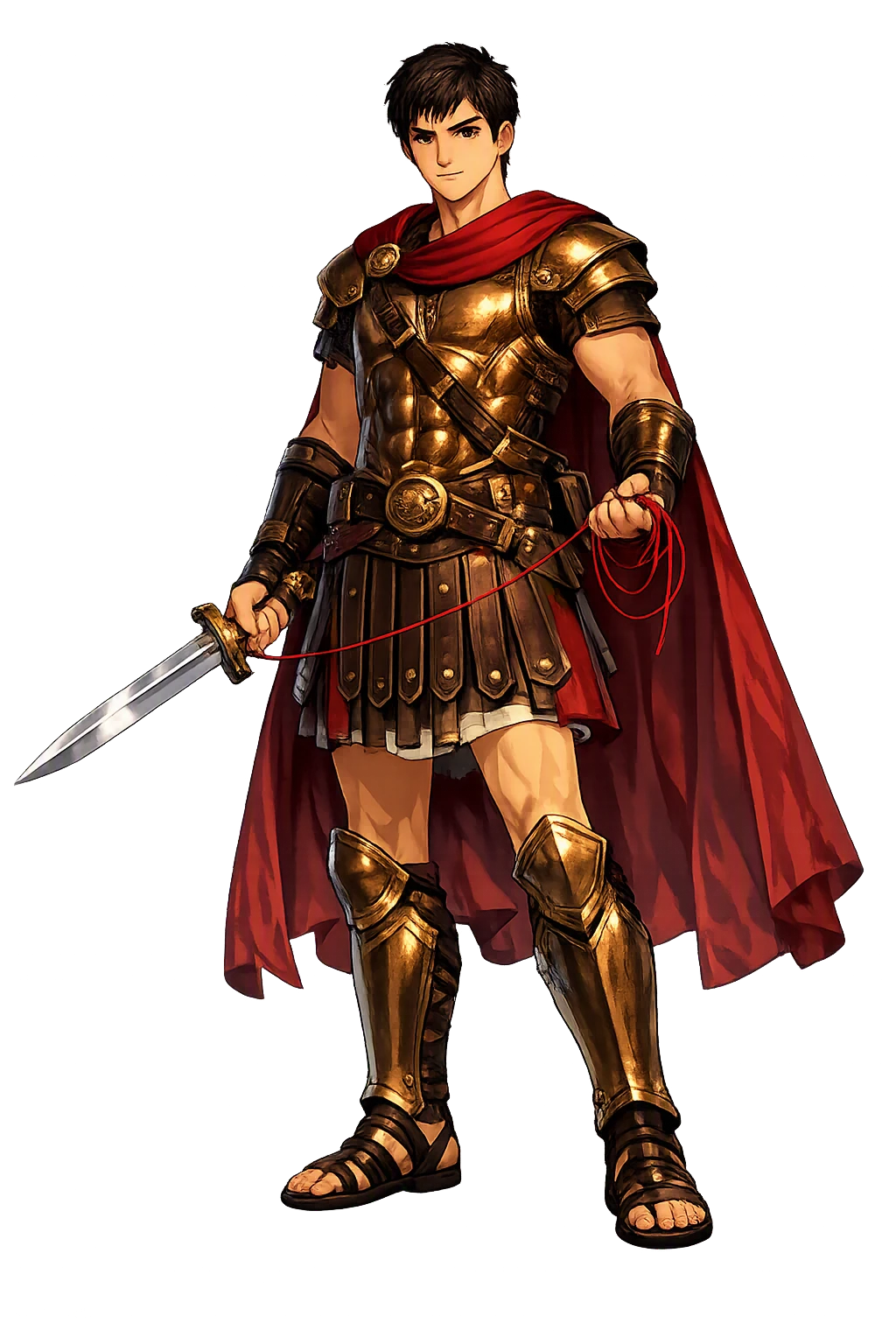
Thēseus is depicted as a beardless young hero, often with a club, a sword, or Ariadne's thread, and in scenes of the Minotaur's defeat. The Athenian ship with black sails, mistaken by Aegeus for a sign of death, is another recurring image.
His iconography deliberately rivals Herakles, asserting Attic pride.
- The Sword and Sandals — Aegeus hid sword and sandals under a great rock at Troezen; lifting them at sixteen, Thēseus claimed his father's inheritance (Plutarch, Theseus 3–6).
- The Iron Club — Taken from Periphḗtēs and carried to Athens: Thēseus chose Heracles' weapon deliberately, styling himself the god's peer (Plutarch, Theseus 7).
- Ariádnē's Thread — The Cretan princess's gift that led him out of the labyrinth; he carried its secret home, and it became the emblem of method.
- The Black Sail — His forgotten signal: the dark sail that told Aegeus his son was dead — the grief that named the Aegean Sea (Plutarch, Theseus 22).
- The Ship of Theseus — His galley kept in Athens' harbor and rebuilt plank by plank as the timbers rotted — antiquity's most durable puzzle about identity (Plutarch, Theseus 23).
Epithets & Cult Titles
Thēseus is Συνοικιστής (Synoikistēs, founder of the synoikismos), Ἡρακλείδης (Hērakleidēs, rival of Herakles), and Ποσειδῶνος παῖς (Poseidōnos pais, son of Poseidon). Athenian oratory calls him ὁ τῆς πόλεως κτίστης (ho tēs poleōs ktistēs, founder of the city).
Each title reflects a different civic identity: unifier, hero, and divine son.
The Homeric Hymns
The Odyssey places Thēseus in the underworld alongside Pirithous, punished for the attempt to abduct Persephone. The Homeric Hymn to Apollo presupposes Attic hero-cult and may reflect the Theseid tradition, though Theseus himself is not hymned.
His labours and synoikismos made him the Attic equivalent of Herakles, a figure too human for an Olympian hymn yet too heroic for ordinary mortality.
Oracle Sites & Sanctuaries
Thēseus consulted Apollo at Delphi before his journey to Crete; the oracle told him to take Aphrodite as his guide, which led him to choose Ariadne. His bones were later brought from Skyros to Athens on Delphic advice, cementing the link between hero and sanctuary.
Delphi thus guided both his departure and his posthumous return.
Archaeology & Evidence
The material record for Thēseus survives in a small number of securely identified remains, catalogued below; the corpus is thin but unambiguous, and each site is tied to the name by ancient testimony.
Thēseus is attested in the textual and iconographic record of the Greek tradition.
Realm & Domain
Thēseus belongs to the Greek tradition, where it is associated with heroism, athens, labours.
Heroism
The central domain of Thēseus in the greek tradition.
The Gatherer (from τίθημι)
The name signifies "The Gatherer (from τίθημι)".
Unicode Restoration
The restoration Thēseus recovers what plain ASCII theseus flattens.
Original Attestation
Attested in the sources as Θησεύς.
The Six Brigands
Periphḗtēs, Sínis, Skíron, Kerkýon, Prokrustēs: the road-monsters of the Saronic and Isthmian roads, slain in sequence on his way to Athens (Plutarch, Theseus 7–11).
The Minotaur
He entered the labyrinth of Knossos with Ariádnē's thread and killed the Bull of Mínōs, ending the tribute of Athenian youths (Apollodorus, Epit. 1.8–10).
The Synoecism
He 'gathered' Attica's independent towns into one common city — the synoikismós that made Athens, celebrated at the Synoikia festival (Thucydides 2.15; Plutarch, Theseus 24).
The King Who Stepped Down
The only Greek hero credited with surrendering monarchy in his own city: he 'handed over the government to the multitude' and ruled as first citizen (Thucydides 2.15; Isocrates, Helen 23–37).
Across Cultures
Thēseus appears within the Greek tradition and has influenced later retellings, artistic depictions, and scholarly study. The Unicode restoration preserves the name's distinctive orthography for contemporary use.
Within the Greek tradition, closely related names in the corpus include Achérōn, Achilleús, Adámas, Aḗr, Aithḗr, and Anánkē.
Cultural Legacy
Thēseus continues to appear in scholarship, art, and popular reception as a significant figure of the Greek tradition. Restoring the name in Unicode returns the original marks that ASCII removes. Theseus became the symbolic founder of Athenian democracy and a recurring figure in classical tragedy, Renaissance painting, and modern retellings of the Minotaur myth.
The Scholarly Record
The account of Thēseus given in this edition rests on the witnesses and reference works listed below. Lexica and etymological dictionaries secure the form and meaning of the name; the literary and religious texts supply the narrative evidence.
- Liddell-Scott-Jones Greek-English Lexicon, 9th ed. with 1996 supplement, 1940. Full text
- Wörterbuch der griechischen Eigennamen, 3rd ed., 1863. Full text
- Etymological Dictionary of Greek, 2 vols., Brill, 2010. Full text
A Meditation
Thēseus embodies heroism, athens, labours in the Greek imagination. The name's restoration is not merely cosmetic: it recovers the stress, length, and script that make the figure recognizable in the source tradition.
The Unicode Restoration
Thēseus preserves vowel length. The ASCII fallback theseus still resolves everywhere, but it is the restored form that carries the name's full information. Across the 7 characters of the name, the restoration adjusts 1: 1 mark of length (ē). That is the whole thesis of this temple: the marks are the message.
Name Variations
The lexicon records 1 additional form of the name:
- Thēseús (ideal) — Acute on the stressed short vowel, matching Greek Θησεύς; preserves stress where the canonical macron-only form records length only.
The temple uses Thēseus as the primary form: it is the spelling that best balances philological accuracy with the practical limits of DNS.
Character by Character
The journey from theseus to Thēseus, one character at a time:
- t → T — Tau
- h → h — Theta
- e → ē — Eta: long epsilon
- s → s — Sigma
- e → e — Short epsilon
- u → u — Upsilon
- s → s — Sigma
The Domain Name
The restored name is live as a working domain: thēseus.com, which the DNS carries in punycode form as xn--thseus-q3a.com — an ASCII-compatible encoding that lets a non-ASCII name travel the global network without breaking older infrastructure. The visitor sees Thēseus; the machines see the encoding. That duality is the engineering compromise on which the entire restoration rests, and it is why a name written the way its own tradition wrote it in Greek can now be typed into any browser on earth.
The Greek Pantheon
Thēseus is one of 269 entries the PuniCodex lexicon catalogues under the Greek pantheon. The Pantheon page gathers the tradition's major figures in one place, and the Lexicon lets you filter all 983 restorations by tradition or script — the fastest way to see where this name sits among its kin.
Frequently Asked Questions
What does Thēseus mean? The traditional gloss is "The Gatherer (from τίθημι)."
Which tradition does Thēseus belong to? Thēseus is catalogued in the Greek pantheon of the PuniCodex lexicon.
What does Thēseus preserve that ASCII cannot show? The form itself answers: Thēseus preserves vowel length — and the marks in the restored spelling are exactly that evidence.
Is Thēseus a working domain? Yes — thēseus.com resolves today and routes to this temple.
What is the punycode for thēseus.com? The DNS encoding is xn--thseus-q3a.com; browsers perform the translation automatically, so visitors only ever see the restored name.
Can I use Thēseus in a normal browser? Yes. The DNS resolves the punycode form automatically, and the type tool on this site converts theseus to Thēseus for copying and pasting.
Where does the scholarly information come from? The entry is built from lexica, inscriptional evidence, and reviewed scholarly sources listed in the Scholarly Edition. Every claim is traceable to a canonical source.
Typing Thēseus
You do not need a special keyboard to use this restoration. The PuniCodex Type Tool converts the ASCII form theseus into Thēseus as you type, and the browser extension offers the same conversion inside any text field. Copy the restored form, paste it into the address bar, and the DNS does the rest.
Sister Temples
Other temples in the Greek pantheon include Asklēpiós, Átlas, and Automédōn — each with its own restoration story, its own scholarly record, and its own place in the lexicon.
Why This Restoration Matters
The marks in Thēseus were never lost; they were only waiting for a carrier that could hold them. Now that the carrier exists, the burden flips: every use of theseus is a choice to leave evidence on the table. The PuniCodex temple keeps the restored form in circulation — as a domain, a dataset entry, and a scholarly argument — so that the choice to use it stays easy. Accent by accent, macron by macron, that is how the original names come back: not with a single grand gesture, but with a spelling that finally works everywhere.
Explore Further
This post is one doorway into the temple. The home page carries the full character breakdown and the ambient canvas; the lore page tells the myths in long form; the Scholarly Edition preserves the sources, pronunciation data, and revision history; and the patron wall supports the restoration directly. For the wider map, browse the Lexicon, explore the Pantheon, or return to the PuniCodex blog.
A Closer Look at the Marks
A restored name is a small map. In Thēseus, the journey from the ASCII fallback theseus to the Unicode form can be read letter by letter, and each letter tells a story. Of the 7 characters, 6 remain unchanged; they anchor the name to its modern shape. The remaining adjustments recover marks the source tradition used to distinguish this name from every other word built from the same letters.
The t stays as it is — Tau.
The h stays as it is — Theta.
The e becomes ē — Eta: long epsilon.
The s stays as it is — Sigma.
The e stays as it is — Short epsilon.
The u stays as it is — Upsilon.
The s stays as it is — Sigma.
Together these changes are not decoration. They are the minimum set of marks needed to keep the name legible in its own tradition. Remove them and you still have a string of letters; you no longer have the name as it was written.
Related Names
Sources
The full scholarly apparatus — every citation, revision, and review — lives in the Scholarly Edition. Key references for this post:
- Liddell-Scott-Jones Greek-English Lexicon, 9th ed. with 1996 supplement, 1940.
- Wörterbuch der griechischen Eigennamen, 3rd ed., 1863.
- Etymological Dictionary of Greek, 2 vols., Brill, 2010.
- Homer, Odyssey 11.631.
- Plutarch, Theseus 1–8.
- Thucydides, History of the Peloponnesian War 2.15.
- Lexicon authorities for this entry: LSJ, Pape-Benseler, Beekes.