Stories of Thánatos
Thánatos appears in Greek myth most often as a function rather than a character — but when he steps onto the stage, the result is unforgettable: the twin who carries heroes home, the official who keeps his appointments, and the one opponent Heracles could throw.
When the Lycian prince Sarpedon — Zeus's own son — fell to Patroclus, the Father of Gods watched from Ida and wept: 'My heart is divided... I am caught between two griefs' (Iliad 16.435–438). He let fate take its course, then sent Apollo to lift the body, wash away the blood, anoint it with ambrosia, and wrap it in garments that ride the wind. Apollo summoned Hýpnos and Thánatos, the twin brothers, and together they lifted the hero in their arms and bore him through the air back to Lycia, where his kinsmen gave him mound and honor. It is Homer's tenderest image of death: not a terror but a carrying — the dark god as the strong son who brings the beloved body home. Even Zeus cannot abolish Thánatos; he can only ask that he be gentle.
In Euripides' Alcestis (1029–1150), Admetus has won from the Fates a reprieve: another may die in his place, and his wife Alcestis has quietly volunteered. When Heracles, passing through Pherae, learns what has happened, he is ashamed before his host and resolves to act. He lies in wait at Alcestis's tomb and, as Thánatos comes with black-robed retinue to claim her, grapples with the god and throws him. 'Let go of the woman — you go below,' Heracles commands; the god, worsted, yields his prize. It is the only open defeat of Death in Greek myth, and Euripides is careful about its meaning: Thánatos is not beaten by a stronger god but by philia — by a friend's refusal to let hospitality be betrayed by grief. Death is inevitable, the play says, but for one night, love is stronger.
Hesiod makes Thánatos a child of Nyx (Night), born without a father beside his twin Hýpnos (Sleep), Kêr, and the other dark abstractions (Theogony 211–225). In the great underworld catalogue the poet describes the brothers' dwelling (756–766): there, where the bright sun never looks, Hýpnos roams peacefully over the earth and is kindly to mortals, but Thánatos has a heart of iron and a spirit pitiless as bronze; whoever he once seizes he holds fast, and he is hateful even to the deathless gods. The passage is the Greek masterpiece of unsentiment: death is not evil, not a demon to be exorcised, but a necessary power with a necessary hardness — the one office no prayer can rewrite. Hesiod's Thánatos is not cruel; he is faithful.
The Alcestis opens with its strangest scene (29–92): Thánatos arrives at Admetus's palace, drawn sword in hand, to cut the lock of hair that marks a soul for the underworld. Apollo, who owes Admetus his service, bars his way and bargains — take an older sacrifice later, take someone else. The god of death refuses, and their exchange is remarkable for its tone: Thánatos taunts Apollo, reminding him how his oracles and his son's healings have failed to save mortals, and boasts that he will take Alcestis anyway. 'An old man will come and wrestle you for her,' Apollo warns, and leaves. The scene establishes what the rest of the play proves: Thánatos knows the law exactly and yields nothing to pity, rank, or divine favor — only to force. He is, in the oldest sense, an official: incorruptible, unloved, and always on time.
The Gentle End and the Inevitable Close
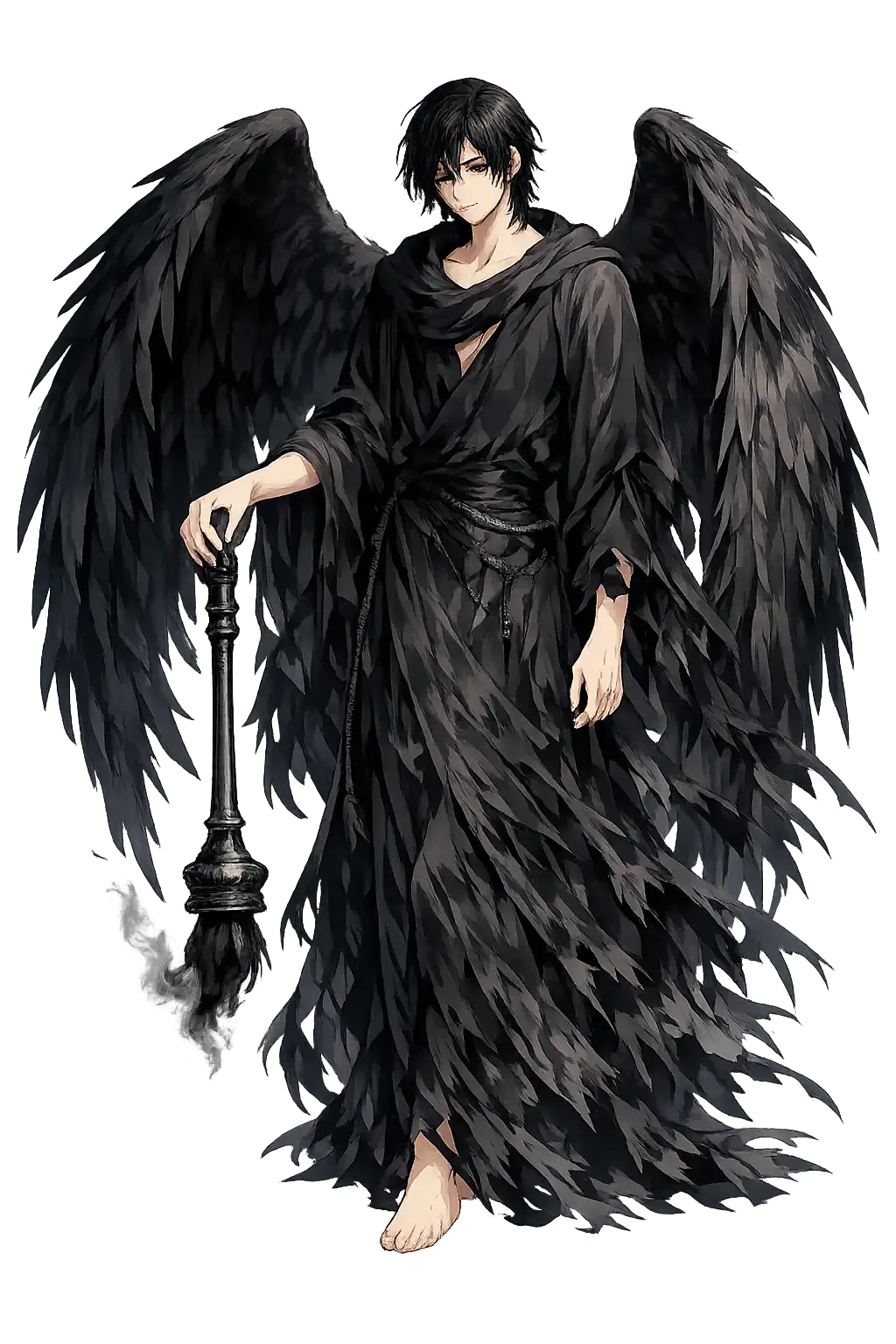
Thánatos is the personification of death in Greek myth: not a terrifying destroyer but the quiet god who closes mortal eyes. He is the twin of Sleep, and the two are often shown together, winged youths lifting the dead from the battlefield with something like tenderness.
He ends life not with violence but with the touch that separates soul from body.
Hýpnos and Thánatos travel as brothers, one bringing rest, the other extinction.
He carries the dead from the field of honour to the house of Hades.
Even heroes cannot bargain with him forever; death is the final common inheritance.
From the original script to the living URL
Θάνατος
The name in its original Greek form. Thánatos (Θάνατος) is attested in the source tradition — “Death”. Its acute accents carry the full phonetic and orthographic weight of the source tradition.
thanatos
Reduced to plain thanatos, the name loses everything that made it specific: acute accents. What remains is an ASCII string that machines can parse but that no longer speaks with its original voice.
Thánatos
The Unicode restoration recovers what ASCII flattened. Thánatos restores acute accents, returning the name to its original written dignity. The domain encodes to Punycode, but the browser displays the truth.
Thánatos.com → xn--thnatos-iwa.com
The non-ASCII characters in Thánatos are encoded while the ASCII remains visible. To the DNS, it is Punycode. To humanity, it is Thánatos.
Owned, ideal, and ASCII forms of Thánatos
Thánatos
Restores Θάνατος. The live temple domain — thánatos.com.
thanatos
Flattens Θάνατος. The plain ASCII fallback — what DNS and legacy systems see.
How Thánatos was spoken
How Thánatos is preserved in writing
A bespoke provenance study for Thánatos is being prepared by the PUNICODEX scholarly team.
Contribute scholarly provenance →The lore you have read is the living myth. Extended Lore opens the scholarly vault beneath it: the cult and its material remains, a history of the image, the name after antiquity, a meditation on what the name still means, and the full scholarly apparatus — etymology, orthography, sources.
Enter Extended Lore