PuniCodex

Extended Lore

Θάνατος Thánatos

Etymology · Orthography · Cult · Iconography · Reception · Sources

Tier 2 Thánatos.com
Thánatos — Death
01

Quick Facts

Essential information about Thánatos, Death

Original ScriptΘάνατος
Unicode RestorationThánatos
Reconstructed Pronunciation/tʰá.na.tos/
PantheonGreek
DomainDeath
MeaningDeath
ClassificationTier 2
Primary DomainThánatos.com
Sacred SymbolsInverted torch, Wings, Wreath, Butterfly or soul
02

Etymology & Word Family

From original script to Unicode restoration

Original Script Θάνατος Thánatos — "Death"
Unicode Restoration Thánatos Restored stress, length, and script
Modern ASCII thanatos Plain-ASCII fallback

The name Thánatos carries the orthographic signature of the greek tradition: Θάνατος. Unicode restoration recovers what ASCII flattens.

03

Unicode Character Breakdown

Character-by-character philological analysis

CharacterUnicodeNameBlockPhonetic Role
TU+0054Latin Capital Letter TBasic LatinT uppercase
hU+0068Latin Small Letter HBasic Latinh same
áU+00E1Latin Small Letter A with AcuteLatin-1 SupplementAcute on a
nU+006ELatin Small Letter NBasic Latinn same
aU+0061Latin Small Letter ABasic Latina same
tU+0074Latin Small Letter TBasic Latint same
oU+006FLatin Small Letter OBasic Latino same
sU+0073Latin Small Letter SBasic Latins same

The Tier 2 classification reflects how much of the original phonology this restoration preserves — stress and vowel length for Greek names, distinctive letters and diacritics for every other tradition.

04

Cult & Worship

How the sacred was kept — rites, sanctuaries, remains

The Cult

Thanatos received no known cult: no temple, altar, festival, or priesthood is attested anywhere in the Greek world. Greek religion honored the dead lavishly — tombs, offerings, public funerals — but Death himself was a personification of poetry, not a power with a sanctuary. Euripides stages him at Alcestis' tomb as a black-robed, sword-bearing official who keeps his appointments: a parody of cult function, not cult. What the sources do give him is genealogy and dread: Hesiod's Theogony makes him a son of Night, twin of Sleep, cruel and of iron heart, dwelling beside the house of Hades — theology in verse, which is where this god lived.

In the Earth

Thánatos received no known cult or temple in the Greek world — his existence is literary and visual. His most famous embodiment is the Euphronios krater (c. 515 BCE, Metropolitan Museum), on which Hýpnos and Thánatos, winged youths in full armor, lift the dead Sarpedon — the very scene of Iliad 16 painted within a generation of the poem's fixation. Attic white-ground lekythoi repeatedly show the pair carrying dead warriors and women, and an anonymous Athenian painter of c. 440 BCE is known to scholarship simply as the Thanatos Painter after such a scene. The Kerameikos cemetery reliefs of fallen soldiers, though unnamed, give the civic frame: a city that buried its war dead with public honor, and imagined the last journey attended.

05

Iconography

How Thánatos was imaged across the ages

The Image

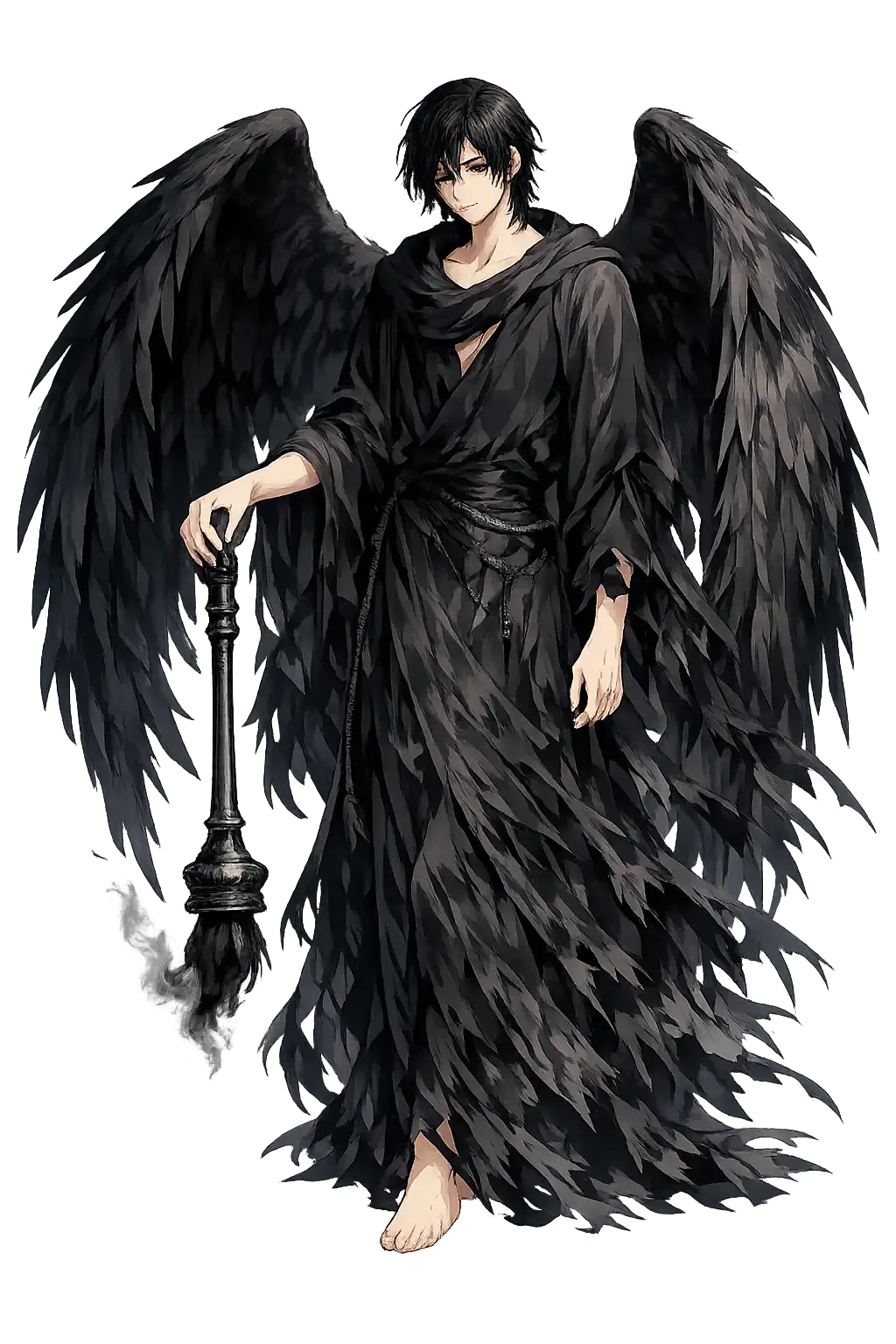
Learn the grammar and Thanatos is unmistakable: a winged youth holding a torch turned flame-downward — life extinguished — almost always paired with his twin Hypnos, the two deliberately near-identical, distinguishable in a given scene only by context. Their one composition is famous: stooping in full armor to lift a fallen body, wingtips trailing, the gentlest image Greek art ever made of its most feared moment. The diagnostic attribute outlived the god. Mors carries the inverted torch on Roman sarcophagus reliefs, and the downward flame passes through Renaissance tombs into the whole later vocabulary of European funerary art, where a torch turned toward the earth still says what Thánatos said.

06

Reception & Transformation

The name after its own age — transmission, translation, survival

Afterlives

Thanatos traveled as a word before he traveled as an image. Homer gave him his unforgettable office — lifting Sarpedon at Zeus's command — and Hesiod gave him his pedigree and his dwelling beside the gates of Hades; lyric and tragedy kept him in circulation. Euripides' Alcestis (438 BCE) is the one great dramatization, and its survival is itself a transmission story: the play rode the Byzantine school-canon of Euripides into the Renaissance, and Aldus Manutius's 1503 Greek edition put it into every European scholar's hands, where the black-robed official at the tomb became the model death-figure of humanist theater. Catullus, Virgil, and Ovid kept the Latin Mors in verse while art soldered the classical winged youth to the Christian angel of death. The nineteenth century closed the arc in paint and science: Waterhouse's Sleep and His Half-Brother Death (1874) gave the twins their most reproduced modern image, while learned Greek minted the name into lasting compounds — euthanasia first, then the twentieth century's thanatology.

Identifications Across Traditions

Roman Mors never achieved the visual or literary richness of Greek Thánatos; Latin poets mostly kept the Greek personification. In later European art the classical winged youth slowly converged with the Grim Reaper and the Christian angel of death — the skeleton with the scythe is not Thánatos, but it inherited his inevitability. The nineteenth century gave him a strange second career: in Freud's Beyond the Pleasure Principle (1920) 'Thanatos' names the death drive, twin and opponent of Eros — Greek myth converted, almost without residue, into modern psychology. The god thus became a name for the destructive forces within the self, and the word thanatology now dignifies the scholarly study of death itself.

Modern Legacy

Thánatos remains one of the most resonant names for death in Western culture. He appears in psychology, philosophy, and literature whenever mortality is discussed not as an event but as a principle — the phrase 'Eros and Thanatos' still structures debates about human motivation. Hospice and grief literature repeatedly returns to the Homeric image of the winged brother lifting the fallen soldier: death not as enemy but as escort. And in the quiet personification of the gentle end — the twin of sleep rather than the horror of the grave — Greek myth preserved a dignity that later, more skeletal personifications often surrendered. His name is still invoked wherever people try to speak of death without hatred.

07

The Meditation

What Thánatos means — beyond the dictionary

Thánatos is the god we do not wish to meet, yet whose presence gives life its shape. Without him, every day would be endlessly postponable; no choice would be final, no love precious because it is brief. The Greeks understood this: death is not the enemy of meaning but its frame.

His twinship with Sleep is the deeper teaching. Every night we practice death; every morning we rehearse resurrection. Thánatos is the brother who, one day, does not let us wake. To name him is to admit that the condition of being alive is being temporary — and that this is not cruelty but definition.

08

Screen & Culture

Where Thánatos echoes through film, television, and games — and how

09

Frequently Asked Questions

Common questions about Thánatos, Death, and Unicode restoration

01How do you pronounce Thánatos?

In reconstructed pronunciation, Thánatos is /tʰá.na.tos/ — approximately 'THAH-nah-tos' — aspirate the first 'th' as in 'top-hat', stress the first syllable, and keep the final 'os' short.

02What does Thánatos mean?

Thánatos means Death in the greek tradition.

03What are the symbols of Thánatos?

Thánatos is associated with Inverted torch (Life extinguished, the flame turned downward.), Wings (The swiftness with which death arrives and departs.), Wreath (The honour due to the dead, especially warriors.), Butterfly or soul (The psȳché, soul, that leaves the body at death.).

04Why restore Thánatos in Unicode?

Plain ASCII thanatos strips the stress, length, and script that make the name specific. Unicode restoration returns the name to its original written dignity.

05What is the most important myth about Thánatos?

“The Body of Sarpedon” — the Iliad story that anchors the mythology of Thánatos, told in full on the lore page.

10

Scholarly Sources

The philological foundations of this restoration

Every claim on this page is grounded in established scholarship. The orthographic restorations follow disciplinary convention. The etymological chain follows the best available reference works. This is not invention — it is resurrection through scholarship.

◈

Lexicography & Philology

  • Liddell, H. G., Scott, R., & Jones, H. S. A Greek-English Lexicon. Oxford: Clarendon Press, 9th ed. 1996.
◎

Primary Texts

  • Hesiod
  • Hesiod, Theogony 211–225, 756–766
  • Homer, Iliad 16.419–683 (the death of Sarpedon)
  • Euripides, Alcestis 29–92, 1029–1150
◉

Archaeology & Art History

  • Material evidence — iconography, inscriptions, and temple archaeology — for Thánatos and related cults.
✦

Religious Studies

  • Hyginus, Fabulae 251
  • Allen, Vox Graeca (on the theta)
  • LIMC, s.v. Thanatos (vase iconography)
Return

The Surface Awaits

You have traced the name from its earliest attestation to its Unicode restoration. Now return to the myth. The story is where the name lives.

Back to Lore
Thánatos mascot