
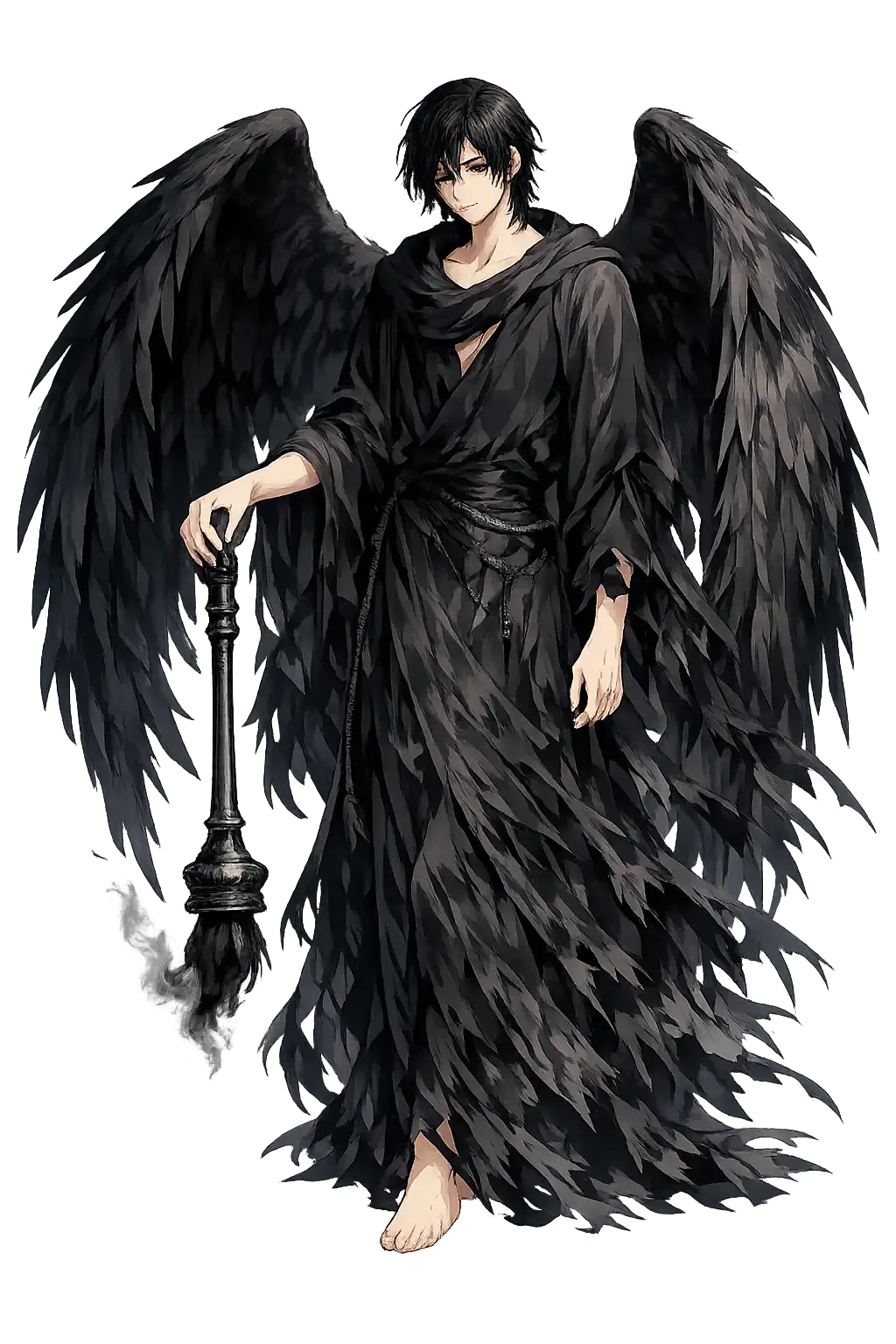
Thánatos: the stories first, then the spelling
The marks in Thánatos make the most sense standing next to the myths they have to carry. So the myths come first.
The Stories That Carry the Name
The Body of Sarpedon. When the Lycian prince Sarpedon — Zeus's own son — fell to Patroclus, the Father of Gods watched from Ida and wept: 'My heart is divided... I am caught between two griefs' (Iliad 16. 435–438).
The Wrestler of the Tomb. In Euripides' Alcestis (1029–1150), Admetus has won from the Fates a reprieve: another may die in his place, and his wife Alcestis has quietly volunteered. When Heracles, passing through Pherae, learns what has happened, he is ashamed before his host and resolves to act. He lies in wait at Alcestis's tomb and, as Thánatos comes with black-robed retinue to claim her, grapples with the god and throws him.
Son of Night. Hesiod makes Thánatos a child of Nyx (Night), born without a father beside his twin Hýpnos (Sleep), Kêr, and the other dark abstractions (Theogony 211–225). In the great underworld catalogue the poet describes the brothers' dwelling (756–766): there, where the bright sun never looks, Hýpnos roams peacefully over the earth and is kindly to mortals, but Thánatos has a heart of iron and a spirit pitiless as bronze; whoever he once seizes he holds fast, and he is hateful even to the deathless gods. The passage is the Greek masterpiece of unsentiment: death is not evil, not a demon to be exorcised, but a necessary power with a necessary hardness — the one office no prayer can rewrite.
And Here Is What the Spelling Preserves
Against those stories, the attestation: Θάνατος, on the evidence Hesiod, Theogony 211–225, 756–766 and Homer, Iliad 16.419–683 (the death of Sarpedon) set down. The name means "Death".
The restoration keeps one feature the ASCII form thanatos cannot show:
- a → á — Acute on a: where the voice peaks.
A storyteller pronouncing the name would restore every one of them by instinct. The file only writes down what the voice already knows.
At a Glance
- Restored name: Thánatos
- ASCII form: thanatos
- Meaning: "Death"
- Domain of influence: Death
- Pantheon: Greek
- Classification: Tier 2
- Original script: Θάνατος
- Series: The Restoration Files, No. 480 of 546
The Name Travels
Roman Mors never achieved the visual or literary richness of Greek Thánatos; Latin poets mostly kept the Greek personification. In later European art the classical winged youth slowly converged with the Grim Reaper and the Christian angel of death — the skeleton with the scythe is not Thánatos, but it inherited his inevitability.
The Address It Earned
The temple of Thánatos stands at /thanatos/ — lore, scholars, patterns — because a name carrying this much story deserves more than a parking page. The restoration keeps one feature the ASCII form drops. One is enough to matter, and the label says so plainly: Tier-2.
The Sources Are Open
The myths above are retold from the temple's record; the primary voices are in the Sacred Texts: Theogony, Homeric Hymns, and Works and Days. Nothing in this file outranks them.
The File Continues
Read the founding dispatch for the name's full story, the Resonance File for the archetype at work — or the whole archive in one sitting.
Continue the series — previous file: Tháleia (read it here) · next file: Theía (read it here).
The Restoration Files are written from the same canonical record as the temples themselves: the lexicon, the lore catalog, the pattern atlas, and the cited scholarly sources. If a file ever disagrees with its temple, the temple is right — tell us, and the file will be corrected.