The Living Myth
Ocean, Sea Creatures, Fishing · God of the sea (from Proto-Polynesian *Taŋaroa)
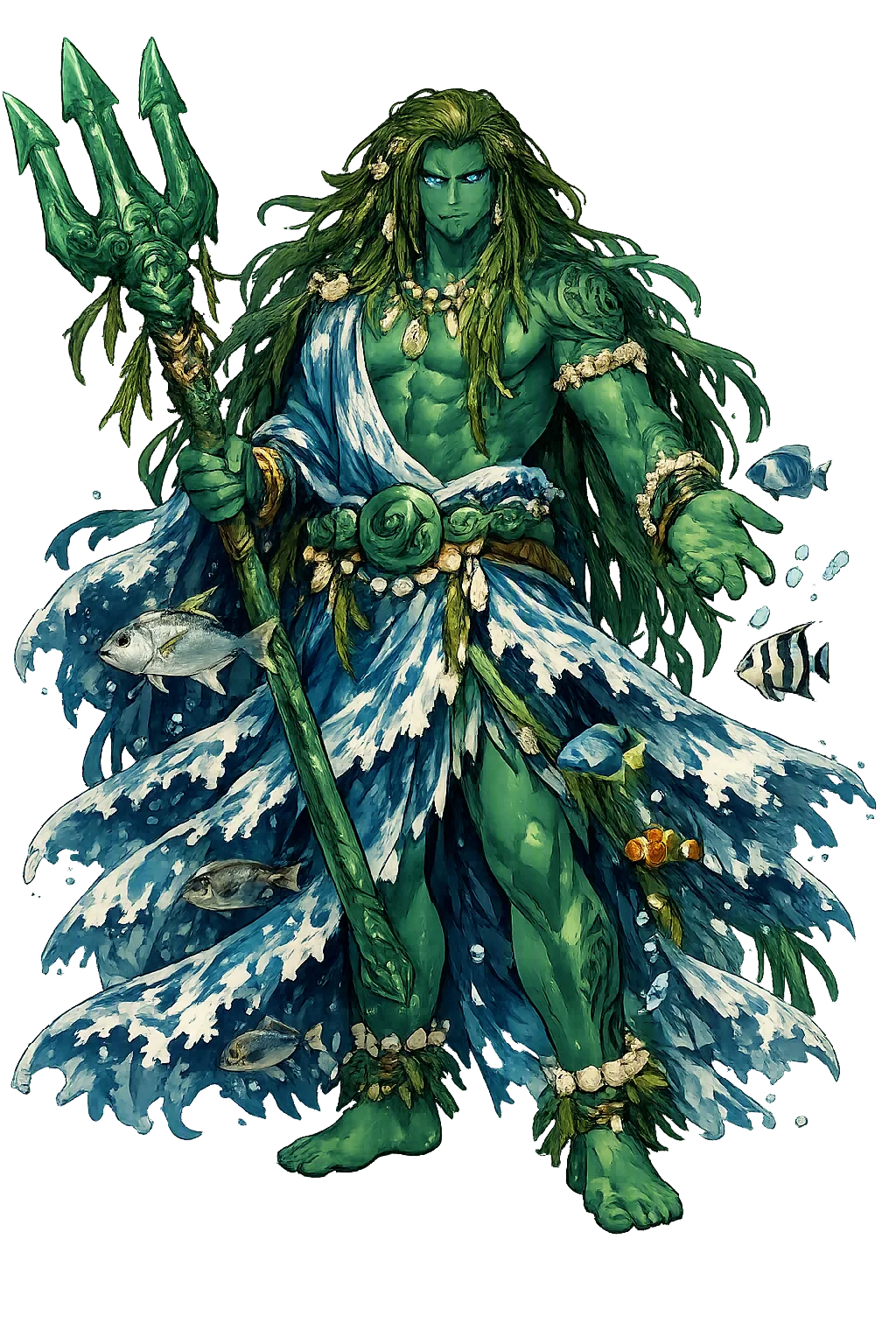
Stories of Tangaroa
Tangaroa's stories are the Māori ocean chapter of the great separation cycle — and then the cycle widens: the same name, in other dialects, becomes the supreme creator of the whole Polynesian triangle. The Māori knew what the comparison would later prove.
Tangaroa was born into the darkness that lay between Ranginui, the Sky, and Papatūānuku, the Earth, whose embrace left no room and no light for their children. With his brothers Tāne, Tāwhirimātea, Tūmatauenga, Rongo, and Haumia-tiketike he grew to manhood in that cramped twilight, and with them he debated how to escape: Tūmatauenga counseled killing the parents outright, Tāne proposed forcing them apart. When Tāne at last pushed Ranginui into the sky and light flooded the world, Tangaroa looked at the dry land his brother had won and chose the other half of creation: he went down into the ocean, and took it for his own. (Grey, Polynesian Mythology, ch. 1; Smith, The Lore of the Whare-wānanga.) The myth reads the coastline as a family wound: the sea is not the land's opposite but its brother, still angry.
Not all the brothers accepted the separation. Tāwhirimātea, the wind, remained with his father in the sky and made war on the others, and Tangaroa's domain was his first battlefield: the sea boiled under the storm. In the rout, Tangaroa's grandchildren — the children of his son Punga — split forever. Ikatere, father of the fish, fled into the deep and cried 'swim, my children'; Tū-te-wehiwehi, father of the reptiles, scrambled ashore into Tāne's forests and cried 'hide, my children.' Hence the hostility the myth sees everywhere along the tideline: fish devour the lizards cast into the sea, and the sea never forgives the land. (Grey, Polynesian Mythology, ch. 1.) What looks like natural enmity is re-read as a family separated under fire — every fish a refugee, every lizard a deserter's child.
In the traditions recorded by Elsdon Best, Tangaroa's wife is Hine-moana, 'ocean woman' — not a separate power but the sea itself, personified as the mother of the fish tribes. Every species is their child, which is why the fisherman addresses the sea as kin, and why the first fish of a catch was laid back into the water: a family does not eat its greeting. The canoes that crossed Hine-moana to reach Aotearoa were themselves spoken of as her children, and the rituals of launching, fishing, and beaching observed her tapu; even the nets and lines were named and placated. (Best, Māori Religion and Mythology; Best, The Māori as He Was.) The theology is ecological before the word existed: the ocean is not a resource but a marriage, and the catch is a relative arriving for dinner.
Travel west and Tangaroa grows greater. In Tahiti the name becomes Ta'aroa, the self-existent creator from whose body the world was hatched (Henry, Ancient Tahiti). In Tonga and Samoa it is Tangaloa, the supreme god whose messenger, the plover Tuli, dove to the sea-bottom and brought up the sand of the first islands (Craig, Dictionary of Polynesian Mythology). In Hawai'i it is Kanaloa, companion of Kāne in the company of gods who made the first man, and lord of the ocean's dark deep (Beckwith, Hawaiian Mythology). The Māori sea-god is thus the eastern branch of the oldest divine name in Polynesia — which is why the nineteenth-century comparatists made him their first case study. One proto-god, four biographies: the triangle itself emerges as a single story told in dialects.
Ocean
Tangaroa is the sea given will: lord of ocean, fish, and all that swims, son of the Sky Father and Earth Mother, and the brother who fled to the deep when his parents were torn apart. Every fish is his child, every canoe his guest, and every storm over the water is family business.
He took the sea for his domain when his parents were separated, vowing in the recitations never to return to the land.
With Hine-moana, the ocean woman, he is ancestor of every finned and swimming creature the nets take.
Tāwhirimātea's war drove him from the coast; his grandchildren scattered to sea and shore, splitting into fish and lizard.
Ta'aroa in Tahiti, Tangaloa in Tonga and Samoa, Kanaloa in Hawai'i — one ocean god under four island names.
From the original script to the living URL
Tangaroa
The name survives in scholarly transliteration. Tangaroa is the standard Polynesian romanisation, documented in academic sources — “God of the sea (from Proto-Polynesian *Taŋaroa)”. Because the spelling uses only Latin letters, the form is the same in both ASCII and Unicode.
No indigenous writing system is securely attested for individual polynesian names. The form shown is a modern scholarly transliteration.
tangaroa
The plain tangaroa form is identical to the Unicode restoration. Because this name is already written in Latin letters, no diacritics, stress, or script information were lost — only capitalization differs.
Tangaroa
The Unicode restoration does not need to recover lost marks for Tangaroa. Its value is canonical spelling and consistent cataloguing, not the reconstruction of erased orthography. The domain is readable as-is to both DNS and humanity.
Tangaroa.com
This restoration is written entirely in ASCII letters — no Punycode encoding stands between Tangaroa and the DNS. The domain reads identically to machines and to human eyes.
Owned, ideal, and ASCII forms of Tangaroa
Tangaroa
The full Unicode restoration. tangaroa.com is not in the PuniCodex collection — it is watched for release; if it drops, this temple upgrades to an owned flagship.
How Tangaroa was spoken
How Tangaroa is preserved in writing
No indigenous writing system is securely attested for individual polynesian names. The form shown is a modern scholarly transliteration.
Contribute scholarly provenance →The lore you have read is the living myth. Extended Lore opens the scholarly vault beneath it: the cult and its material remains, a history of the image, the name after antiquity, a meditation on what the name still means, and the full scholarly apparatus — etymology, orthography, sources.
Enter Extended Lore