PuniCodex

Extended Lore

Tangaroa

Etymology · Orthography · Cult · Iconography · Reception · Sources

Tier 2 Tangaroa
Tangaroa — Ocean, Sea Creatures, Fishing
01

Quick Facts

Essential information about Tangaroa, Ocean, Sea Creatures, Fishing

Scholarly TransliterationTangaroa
Unicode RestorationTangaroa
Reconstructed Pronunciation/ta.ŋa.ˈɾo.a/
PantheonPolynesian
DomainOcean, Sea Creatures, Fishing
MeaningGod of the sea (from Proto-Polynesian *Taŋaroa)
ClassificationTier 2
Primary DomainTangaroa
Sacred SymbolsThe fish-hook (matau), The whale and the shark, The canoe (waka), The tide, The lizard (ngarara)
02

Etymology & Word Family

From original script to Unicode restoration

Proto-polynesian *Ta God of the sea
Scholarly Transliteration Tangaroa Tangaroa — "God of the sea (from Proto-Polynesian *Taŋaroa)"
Unicode Restoration Tangaroa Canonical scholarly spelling — ASCII-identical
Modern ASCII tangaroa Plain-ASCII fallback

God of the sea (from Proto-Polynesian *Taŋaroa)

03

Unicode Character Breakdown

Character-by-character philological analysis

CharacterUnicodeNameBlockPhonetic Role
TU+0054Latin Capital Letter TBasic LatinSame
aU+0061Latin Small Letter ABasic LatinSame
nU+006ELatin Small Letter NBasic LatinSame
gU+0067Latin Small Letter GBasic LatinSame
aU+0061Latin Small Letter ABasic LatinSame
rU+0072Latin Small Letter RBasic LatinSame
oU+006FLatin Small Letter OBasic LatinSame
aU+0061Latin Small Letter ABasic LatinSame

The Tier 2 classification here reflects fidelity to the attested tradition, not recovered diacritics: every character of Tangaroa already survives in ASCII. What the restoration preserves is the canonical spelling itself — the form scholarship standardised.

04

Cult & Worship

How the sacred was kept — rites, sanctuaries, remains

The Cult

Tangaroa's cult was every beach, reef, and fishing ground in Aotearoa — a religion practiced from canoes, not temples. Fishermen addressed him in karakia before launching and before laying nets; the first fish of a catch was returned to the water as a greeting to kin; canoes, nets, and lines were tapu, named, and placated. Best records the sea addressed as Hine-moana, Tangaroa's wife and mother of the fish tribes, so that the whole technology of taking food from the ocean ran on family etiquette. Small shrines and offering places stood at fishing stations and landing sites, but no priesthood and no temple served him — the tapu was kept by the fishermen themselves and by the tohunga who composed the incantations. The rites ran strongest where the myth ran strongest: on the coasts, and in the whale fisheries.

In the Earth

No temple of Tangaroa survives, and Māori religion built none — but his archaeology is the archaeology of the sea. Coastal middens record the fisheries his priests regulated; the bone and shell of his children, stacked in heaps over centuries, are the oldest testimony to the relationship. Fish-hooks (matau) of bone, stone, and shell, many of superb workmanship, turn up wherever Māori camped on a coast; the great shank-hooks for snapper are functional sculpture. Rock shelters in the South Island preserve fish imagery read as ancestral. The canoe itself — the waka of the great voyages, surviving in fragments, adzes, and drilled hull-plugs — is his true monument: a technology of family visits.

05

Iconography

How Tangaroa was imaged across the ages

The Image

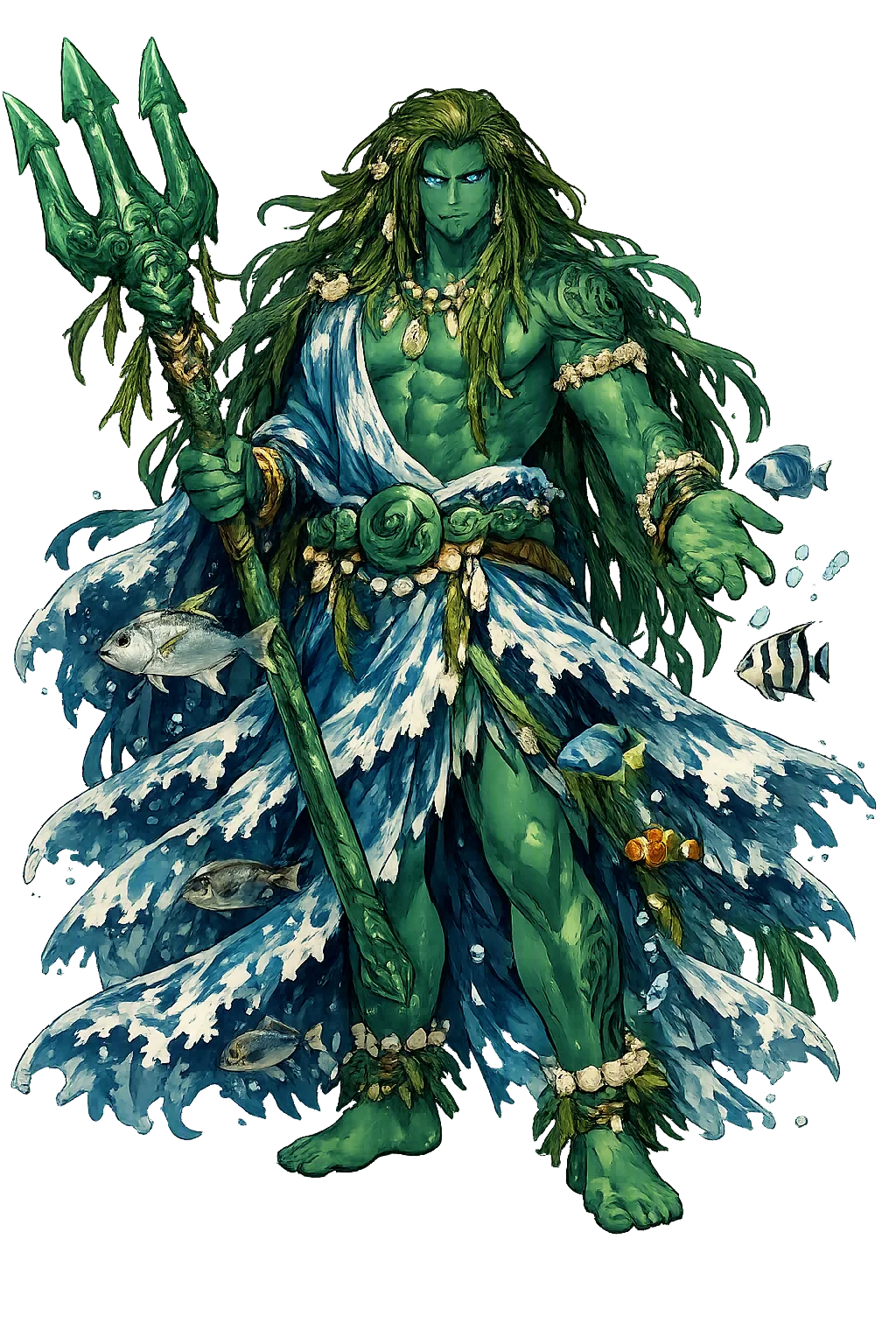
Tangaroa's image is the carved figure of Māori woodcarving: he stands in the meeting-house beams and on the storehouse slabs as an anthropomorphic ancestor, usually marked by the sea creatures that swarm over or within his body — the fish, whales, and reptiles that are his children. No single canonical type ever froze: the regional schools of the whakairo tradition render him with their own spirals and profiles, and he is one ancestor among many rather than a portrait subject. The most eloquent images are objects — the fish-hook, the carved prows that crossed his wife Hine-moana, the stranded whale read as an omen. In the twentieth-century carving renaissance he re-emerged on meeting houses across the country, the sea given a face again.

06

Reception & Transformation

The name after its own age — transmission, translation, survival

Afterlives

Tangaroa's transmission is a triumph of nineteenth-century salvage. The separation cycle survived in oral recitation and a few manuscripts; George Grey, the colony's governor, collected and printed it as Polynesian Mythology in 1855 — the first widely read book of Māori tradition — and his pages made Tangaroa internationally famous, translated and anthologized within a decade. Elsdon Best's monographs of the early twentieth century then fixed the sea-god's genealogy, wife, and rites in scholarly form, while the comparative school — Tregear's dictionary, Fornander's Polynesian Race, later Beckwith — folded him into the pan-Polynesian argument about the god behind *Taŋaroa. Assimilation and urbanization thinned the living rites, but the carving renaissance from the 1960s onward re-imaged him on meeting houses, and the late twentieth century gave him an unexpected second career in public life: the fisheries settlements and the doctrine of kaitiakitanga returned the sea to his descendants as an ancestor, citing the old relationship by name. He entered the modern world not as a museum god but as a quoted authority — the brother who left, still owed.

Identifications Across Traditions

Tangaroa's syncretic career runs in two directions. Westward, in Tonga and Samoa, his name — Tangaloa — remained the supreme creator's, and Samoan Christians long prayed to a God they still sometimes called Tangaloa, a continuity the missionaries alternately welcomed and fought. Eastward, the Māori had already demoted him: from creator of the cosmos to lord of one domain, a brother among brothers, because the separation cycle re-hierarchized the gods around the family drama. In modern Aotearoa the name rides the cultural renaissance: Tangaroa appears in carving, kapa haka, and marine policy as the person of the moana, the sea that feeds and must be fed. The Treaty of Waitangi fisheries settlements of the 1980s and 90s, and the doctrine of kaitiakitanga over the marine estate, gave him a legal afterlife: his name is now cited wherever the sea is spoken of as an ancestor rather than a commodity.

Modern Legacy

Tangaroa remains the most-seen of the Māori gods — in every coastal marae's imagery, in the school-taught separation cycle, and in the everyday word moana for the sea. Fishermen still speak of him half-jokingly and not entirely jokingly; the Māori fisheries claim and its settlement wrote his descendants' relationship with the sea into law. In Hawai'i, where his form is Kanaloa, the modern voyaging canoe Hōkūleʻa sails by the same star-compass the old navigators read — the sea-god's ancient craft, relaunched. Across the Pacific the name survives in hundreds of personal names, in ships, in the naming of research vessels, and in the quiet conviction of island peoples that the ocean is not empty water but occupied country.

07

The Meditation

What Tangaroa means — beyond the dictionary

Tangaroa is the sea as a relative — the most radical idea in the Māori cosmos. A god who is a brother, a domain that is a marriage, a catch that is a visit: the whole grammar of the ocean is familial, and the modern world's grammar of the ocean is exactly the opposite. When Māori negotiators in the 1980s and 90s said the sea is an ancestor, they were not inventing an environmentalism of convenience; they were quoting him. The name Tangaroa carries a complete theory of the deep: that the largest thing on the planet is a person with children, a temper, and a claim on our manners.

There is tragedy folded into the name as well. He is the brother who lost — who left rather than accept the new world, and whose children still flee one another at the water's edge. The tide that has run between brothers for all these generations is the one argument nobody has won: the land says the fish are food, the sea says the fish are family, and every meal from the ocean is a negotiation between the two.

08

Frequently Asked Questions

Common questions about Tangaroa, Ocean, Sea Creatures, Fishing, and Unicode restoration

01How do you pronounce Tangaroa?

In reconstructed pronunciation, Tangaroa is /ta.ŋa.ˈɾo.a/ — approximately 'tah-ngah-ROH-ah' — say ng as in 'singer,' tap the r, and let the last two vowels glide together.

02What does Tangaroa mean?

Tangaroa means God of the sea (from Proto-Polynesian *Taŋaroa) in the polynesian tradition.

03What are the symbols of Tangaroa?

Tangaroa is associated with The fish-hook (matau) (The carved hook with which his descendants take his children from the sea — every catch a petition, every offering a repayment.), The whale and the shark (His largest and most feared children; the whale (tohorā) and the shark (mangō) carry his mana in bulk.), The canoe (waka) (The vessel that crosses his domain; canoes were tapu and addressed as kin, because the sea is a relative who must be asked.), The tide (Tangaroa-whakamau-tai, 'Tangaroa who fixes the tides' — one of his names, and the rhythm by which fishermen read him.), The lizard (ngarara) (His grandchildren who hid ashore: the lizards, fish that chose the land — kin, yet forever on the wrong side of the beach.).

04Why restore Tangaroa in Unicode?

Tangaroa is written entirely in ASCII letters, so its restoration is about canonical fidelity rather than recovered diacritics: the temple fixes the name in its scholarly standard spelling, attested in the source tradition, instead of leaving it to drift.

05What is the most important myth about Tangaroa?

“Born Between the Embrace” — the Genealogy story that anchors the mythology of Tangaroa, told in full on the lore page.

09

Scholarly Sources

The philological foundations of this restoration

Every claim on this page is grounded in established scholarship. The orthographic restorations follow disciplinary convention. The etymological chain follows the best available reference works. This is not invention — it is resurrection through scholarship.

◈

Lexicography & Philology

  • Tregear
◎

Primary Texts

  • Primary sources in the polynesian tradition for Tangaroa.
◉

Archaeology & Art History

  • Material evidence — iconography, inscriptions, and temple archaeology — for Tangaroa and related cults.
✦

Religious Studies

  • Grey, Polynesian Mythology
  • Best, Māori Religion and Mythology
  • Henry, Ancient Tahiti
  • Craig, Dictionary of Polynesian Mythology
  • Beckwith, Hawaiian Mythology
  • Orbell, Concise Encyclopedia of Māori Myth and Legend
Return

The Surface Awaits

You have traced the name from its earliest attestation to its Unicode restoration. Now return to the myth. The story is where the name lives.

Back to Lore
Tangaroa mascot