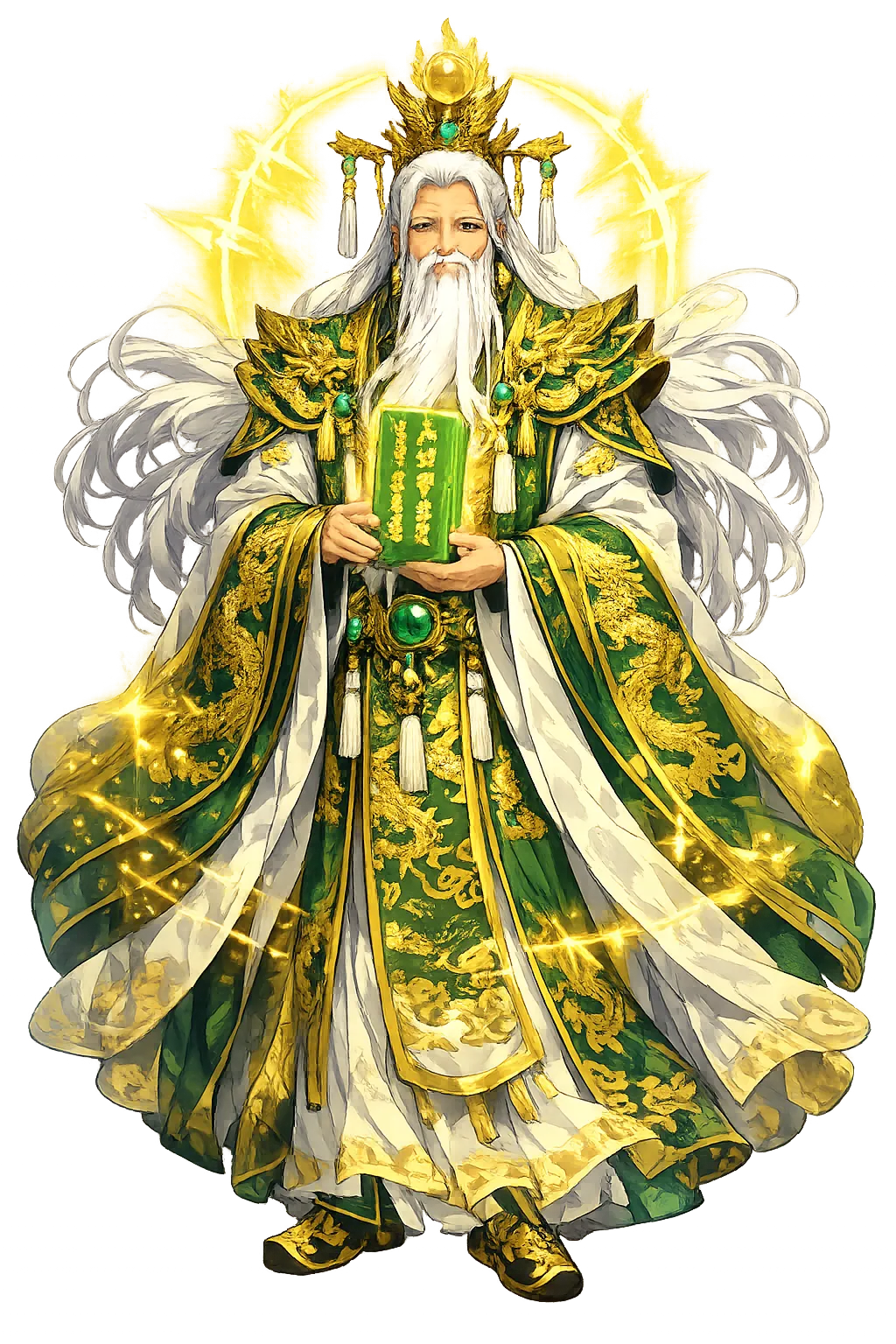
Stories of Tàishàng
Tàishàng's mythology moves between history and cosmology: the shadowy philosopher Laozi becomes the celestial teacher who reveals the Dao to emperors, hermits, and alchemists.
Sima Qian's biography (Shiji, ch. 63) makes Laozi keeper of the royal archives of Zhou, a man so deep that even Confucius sought him out and came away comparing him to a dragon. Weary of the failing dynasty, he rode west on a black ox. At the Hangu Pass the guard Yīn Xī, who had studied the stars and seen a purple vapor rising, recognized the sage and asked for a teaching. Laozi wrote two books of five thousand characters — what became the Dàodéjīng — then passed beyond the pass and out of history. Later Daoism transformed the departure into an ascension: Laozi became Tàishàng Lǎojūn, the supreme immortal, the passage at the pass re-read as the moment the hidden Dao consented, once, to be written down. The myth teaches that the supreme teaching arrives only as a leave-taking — the book exists because the sage refused to stay and explain it.
Medieval Daoist apocrypha claimed that Tàishàng Lǎojūn travelled west after leaving the pass and, finding the barbarians of India unreceptive to his teaching, transformed himself into the Buddha in order to convert them — the doctrine of the Huáhú jīng, the Classic of the Conversion of the Barbarians, which circulated from at least the third century CE. The claim was polemic, not history: it subordinated Buddhism, then flooding into China, by making its founder a mere avatar of Laozi, and it provoked angry Buddhist counter-pamphlets and several imperial suppressions of the text. Tendencies and all, the myth reveals the prestige Tàishàng held in medieval China — great enough that the only way to outrank a foreign saviour was to absorb him, and confident enough to say so in writing.
In formal Daoist theology, developed from the fifth century onward, the Three Pure Ones (Sānqīng) personify the three stages of cosmic emanation and preside over the three highest heavens. YUánshǐ Tiānzūn personifies the Dao in its absolute origin; Língbǎo Tiānzūn the Dao as revealed scripture; Tàishàng Lǎojūn the third — the manifested Dao, the teacher who brings the formless principle into human language. The triad gave every Daoist temple its ceiling and its hierarchy, with Laozi's divinized form enthroned as the compassionate face of the otherwise unfaceable ultimate. He is not a creator god in the Western sense: he is the origin that cannot be named, consenting to be named — the silence of the Dàodéjīng given a beard, a gourd, and a throne.
In 666 CE the Tang emperor Gaozong honoured Laozi with the title Tàishàng Xuányuán Huángdì — Supreme Mysterious Origin Emperor — and the Li royal house, which shared the sage's surname, proclaimed him its divine ancestor. A century later Emperor Xuanzong, the dynasty's great patron of Daoism, canonized the Dàodéjīng for the civil examinations and reported dreams of Laozi promising the dynasty's fortune (Jiu Tangshu, treatise on the Laozi cult; Sima Guang, Zizhi Tongjian). Politics and piety converged: the most exalted title in the imperial vocabulary, Tàishàng, became the sage's official rank. The episode marks the completion of the deification — from a border guard's teacher to the celestial ancestor of the empire, his five thousand characters shelved beside the classics of state.
Dao, Deification of Laozi, and Celestial Authority
Tàishàng names the supreme station in Daoist cosmology. In its fullest form, Tàishàng Lǎojūn (Supreme Lord Lao) is the deified Laozi, the legendary author of the Dàodéjīng, elevated into one of the Three Pure Ones who stand at the summit of the Daoist pantheon. Where the historical Laozi taught wordless wisdom, the celestial Tàishàng Lǎojūn dispenses scriptures, elixirs, and revelations.
He is not a creator god in the Western sense. He is the personification of the Dao in its highest, most hidden aspect — the origin that cannot be named, named.
He embodies the nameless source from which heaven and earth arise.
Revealer of the Dàodéjīng and countless Daoist texts and talismans.
Patron of internal and external alchemy, longevity, and the pursuit of immortality.
Legendary instructor of sage-kings and source of imperial legitimacy.
From the original script to the living URL
太上
The name in its original Chinese form. Tàishàng (太上) is attested in the source tradition — “Supreme, great”. Its original diacritics and script distinctions carry the full phonetic and orthographic weight of the source tradition.
taishang
Reduced to plain taishang, the name loses everything that made it specific: original diacritics and script distinctions. What remains is an ASCII string that machines can parse but that no longer speaks with its original voice.
Tàishàng
The Unicode restoration recovers what ASCII flattened. Tàishàng restores original diacritics and script distinctions, returning the name to its original written dignity. The domain encodes to Punycode, but the browser displays the truth.
Tàishàng.com → xn--tishng-itad.com
The non-ASCII characters in Tàishàng are encoded while the ASCII remains visible. To the DNS, it is Punycode. To humanity, it is Tàishàng.
Owned, ideal, and ASCII forms of Tàishàng
Tàishàng
Restores 太上. The live temple domain — tàishàng.com.
taishang
Flattens 太上. The plain ASCII fallback — what DNS and legacy systems see.
How Tàishàng was spoken
How Tàishàng is preserved in writing
A bespoke provenance study for Tàishàng is being prepared by the PUNICODEX scholarly team.
Contribute scholarly provenance →The lore you have read is the living myth. Extended Lore opens the scholarly vault beneath it: the cult and its material remains, a history of the image, the name after antiquity, a meditation on what the name still means, and the full scholarly apparatus — etymology, orthography, sources.
Enter Extended Lore