PuniCodex

Extended Lore

太上 Tàishàng

Etymology · Orthography · Cult · Iconography · Reception · Sources

Tier 1 Tàishàng.com
Tàishàng — Supreme Lord, Dao
01

Quick Facts

Essential information about Tàishàng, Supreme Lord, Dao

Original Script太上
Unicode RestorationTàishàng
Reconstructed Pronunciation/tʰaɪ̯˥˩ ʂɑŋ˥˩/
PantheonChinese
DomainSupreme Lord, Dao
MeaningSupreme, great
ClassificationTier 1
Primary DomainTàishàng.com
Sacred SymbolsRuyi sceptre, Gourd of elixir, Crane, Tàijí disc
02

Etymology & Word Family

From original script to Unicode restoration

Original Script 太上 Tàishàng — "Supreme, great"
Unicode Restoration Tàishàng Restored stress, length, and script
Modern ASCII taishang Plain-ASCII fallback

The name Tàishàng carries the orthographic signature of the chinese tradition: 太上. Unicode restoration recovers what ASCII flattens.

03

Unicode Character Breakdown

Character-by-character philological analysis

CharacterUnicodeNameBlockPhonetic Role
TU+0054Latin Capital Letter TBasic LatinSame, capitalized
àU+00E0Latin Small Letter A with GraveLatin-1 SupplementStress on a
iU+0069Latin Small Letter IBasic LatinSame
sU+0073Latin Small Letter SBasic LatinSame
hU+0068Latin Small Letter HBasic LatinSame
àU+00E0Latin Small Letter A with GraveLatin-1 SupplementStress on a
nU+006ELatin Small Letter NBasic LatinSame
gU+0067Latin Small Letter GBasic LatinSame

The Tier 1 classification reflects how much of the original phonology this restoration preserves — stress and vowel length for Greek names, distinctive letters and diacritics for every other tradition.

04

Cult & Worship

How the sacred was kept — rites, sanctuaries, remains

The Cult

Tàishàng's cult began as a biography and became an establishment. The earliest worship is the cult of Laozi as sage: Sima Qian's Shiji (c. 90 BCE) already knows him as keeper of the Zhou archives and author of the five thousand characters. The Han-era Huang-Lao movement made him a focus of devotion, and with the Way of the Celestial Masters in the second century CE, Tàishàng Lǎojūn stood as a revealed god, source of the religion's scriptures and registers. The cult peaked as state religion under the Tang, whose Li emperors claimed him as divine ancestor: Gaozong's honoring titles of 666 CE, Xuanzong's imperial commentary on the Dàodéjīng and its place in the civil examinations, and patronage of the Louguan temple in the Zhōngnán mountains — the shrine at the pass where the book was said to be written — made him, for a century, the nearest thing China had to a national god. Temples and birthday observances in the second lunar month persist to this day.

In the Earth

The deification of Laozi is attested in Han dynasty texts and inscriptions, with imperial cults developing under the Tang dynasty, which claimed Laozi as an ancestor. Archaeological finds include Dàodéjīng manuscripts from Mawangdui and Guodian, Daoist talismans, steles, and temple inscriptions honouring Tàishàng Lǎojūn. Temples dedicated to him survive across China and the Chinese diaspora.

05

Iconography

How Tàishàng was imaged across the ages

The Image

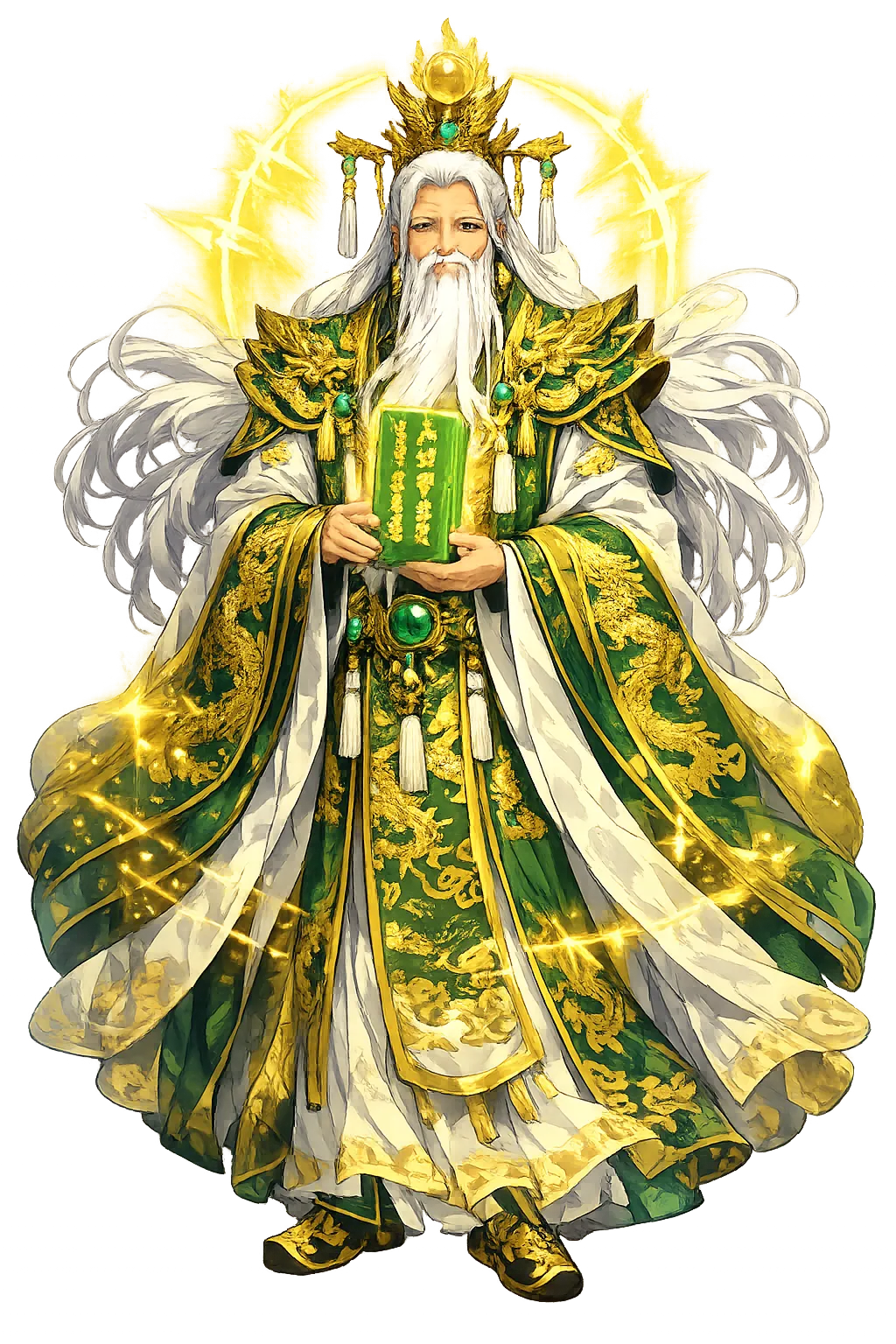
His image is younger than his cult. The Han knew him as a man, and attributions of Han-era portraits are debated; the secure early monumental image is the colossal seated stone Laozi carved at Qingyuan Mountain above Quanzhou in the Song dynasty — weathered, robed, still in situ. The canonical iconography settled later still: the white-bearded immortal with his gourd of elixir, fly-whisk or ruyi scepter in hand, riding a green ox westward — the moment of the Hangu Pass fixed as an image. The most famous painted version is Zhang Lu's Ming-dynasty album leaf of Laozi on his buffalo in the Museum of Fine Arts, Boston: a few wet ink strokes that became the god's portrait for the world. In temples he sits enthroned as one of the Three Pure Ones, third in the ceiling's hierarchy — the manifested Dao given a beard and a throne, the unnameable consenting, at last, to be painted.

06

Reception & Transformation

The name after its own age — transmission, translation, survival

Afterlives

His transmission is one of the longest journeys of any name in this catalog. The biography is Sima Qian's (c. 90 BCE), already half-legend; the apocryphal Huáhú jīng of the third century CE made him the Buddha's source and provoked a millennium of Buddhist-Daoist polemic; the Tang made him an imperial ancestor and set his book beside the state classics. The manuscript record keeps deepening the story: the Mawangdui silk copies, excavated 1973 with their reversed section order, and the Guodian bamboo strips of 1993, a cache centuries older than any previously known copy, transformed Laozi scholarship at a stroke. Europe received him through translation: Stanislas Julien's French Dàodéjīng (1842), John Chalmers's English (1868), James Legge's Sacred Books of the East volumes (1891), and Arthur Waley's The Way and Its Power (1934) made 'Tao' a household word — the little book now often called the most translated text after the Bible. A border guard's five thousand characters have crossed every frontier the sage himself refused to stop at.

Identifications Across Traditions

Tàishàng Lǎojūn is the Daoist answer to the question of how a philosophy becomes a religion. The historical Laozi, if he existed, was a thinker; Tàishàng Lǎojūn is a god. This transition mirrors the broader Chinese pattern of deifying sages, from Confucius to Guān Yǔ. Buddhism influenced the structure of his cult — the Three Pure Ones parallel Buddhist trikāya theology — while popular religion absorbed him into a vast pantheon of immortals, city gods, and celestial bureaucrats. In the West, Laozi is often read as a purely philosophical figure, but in Chinese temples he is honoured with incense, images, and prayers for longevity.

Modern Legacy

Tàishàng's legacy is inseparable from the Dàodéjīng, one of the most translated books in world literature. As Tàishàng Lǎojūn, he presides over Daoist temples, alchemical traditions, and popular practices of longevity and exorcism. His image appears in countless paintings, statues, and New Year prints, often riding a crane or holding a ruyi. Modern Daoist movements, martial-arts lineages, and global wellness culture all claim some connection to Laozi, though the sage would likely smile at the irony. The name Tàishàng has also become an adjective of highest rank, applied to emperors, elders, and even video-game bosses.

07

The Meditation

What Tàishàng means — beyond the dictionary

Tàishàng is the teaching that cannot be taught. The Dàodéjīng opens by saying that the Dao that can be spoken is not the eternal Dao, and yet the text goes on to speak of it for eighty-one brief chapters. Tàishàng Lǎojūn is the figure who resolves this paradox by embodying it: he is the sage who became a god by disappearing into the teaching he left behind.

To sit with Tàishàng is to practice not-knowing. It is to recognise that the more names we give to the ultimate, the further we stray from it, and yet that naming is itself a kind of devotion. The gourd, the ruyi, the crane — these are not idols but reminders. The real Tàishàng is the silence between the words of the Dàodéjīng, the emptiness that makes the vessel useful.

08

Frequently Asked Questions

Common questions about Tàishàng, Supreme Lord, Dao, and Unicode restoration

01How do you pronounce Tàishàng?

In reconstructed pronunciation, Tàishàng is /tʰaɪ̯˥˩ ʂɑŋ˥˩/ — approximately TIE-SHUHNG — 'tai' like 'tie' with a sharp falling tone, 'shang' with a retroflex 'sh' and a falling tone.

02What does Tàishàng mean?

Tàishàng means Supreme, great in the chinese tradition.

03What are the symbols of Tàishàng?

Tàishàng is associated with Ruyi sceptre (The curved head-rest that signifies power, wish-fulfilment, and divine authority.), Gourd of elixir (The bottle that holds the medicine of immortality and the hidden medicine of the Dao.), Crane (Longevity and the celestial mount that carries the immortal to heaven.), Tàijí disc (The supreme polarity from which yin and yang unfold.).

04Why restore Tàishàng in Unicode?

Plain ASCII taishang strips the stress, length, and script that make the name specific. Unicode restoration returns the name to its original written dignity.

05What is the most important myth about Tàishàng?

“Laozi Leaves the Pass” — the Hagiography story that anchors the mythology of Tàishàng, told in full on the lore page.

09

Scholarly Sources

The philological foundations of this restoration

Every claim on this page is grounded in established scholarship. The orthographic restorations follow disciplinary convention. The etymological chain follows the best available reference works. This is not invention — it is resurrection through scholarship.

◈

Lexicography & Philology

◎

Primary Texts

  • Primary sources in the chinese tradition for Tàishàng.
◉

Archaeology & Art History

  • Material evidence — iconography, inscriptions, and temple archaeology — for Tàishàng and related cults.
✦

Religious Studies

  • Laozi, Daodejing (Tao Te Ching)
  • Daozang (Daoist Canon)
  • Sima Qian, Shiji (Records of the Grand Historian), Laozi biography
  • Bokenkamp, Early Daoist Scriptures
  • Kohn, Daoism and Chinese Culture
  • Unihan Database (Unicode Consortium)
Return

The Surface Awaits

You have traced the name from its earliest attestation to its Unicode restoration. Now return to the myth. The story is where the name lives.

Back to Lore
Tàishàng mascot